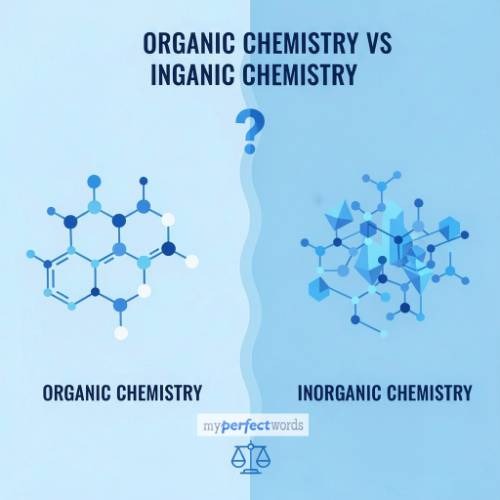
What Is Organic Chemistry?
Organic chemistry is the study of carbon-containing compounds, especially those that have carbon-hydrogen (C-H) bonds. It grew out of the chemistry of living things proteins, DNA, fats, and sugars are all organic compounds. But it's not limited to biology. Plastics, pharmaceuticals, and fuels are also organic chemistry at work.
Carbon has some unusual properties that make this possible. It forms four bonds at once (tetravalency) and can link to itself in long chains and rings (catenation). That's why there are an estimated 19 million known organic compounds more than any other class of substances.
Everyday examples you'll recognise: aspirin, ethanol (the alcohol in drinks), glucose, polyester, and most of the active ingredients in medications.
Organic chemistry is essentially the chemistry of carbon and because carbon can form millions of different compounds, it's one of the largest branches of chemistry in existence.
What Is Inorganic Chemistry?
Inorganic chemistry covers compounds that don't contain carbon-hydrogen bonds. That's a wide category: metals, minerals, salts, acids, gases, and ceramics all fall here. It also includes organometallic compounds, which we'll come back to.
The applications are just as broad. Semiconductors in your phone, the iron in your blood, chlorine used to treat water, ammonia in fertilisers, titanium dioxide in sunscreen all inorganic chemistry.
| One thing that surprises students: carbon dioxide (CO2) and carbon monoxide (CO) are inorganic, even though they contain carbon. They're classified that way because they don't have C-H bonds. |
Inorganic chemistry covers everything from the minerals in your bones to the semiconductors in your phone it's the chemistry of the non-living world, and a few surprising things that aren't.
If you're working with formulas and need to write them correctly, check out our guide on how to write chemical formulas.
Organic vs Inorganic Chemistry: Key Differences
Here's a side-by-side comparison of the two branches:
Feature | Organic Chemistry | Inorganic Chemistry |
Focus | Carbon-containing compounds (with C-H bonds) | Compounds without C-H bonds |
Bond types | Mainly covalent bonds | Mainly ionic bonds |
Known compounds | 19 million | 500,000 |
Melting/boiling points | Generally lower | Generally higher |
Solubility in water | Often insoluble | Often soluble |
Real-world applications | Pharmaceuticals, plastics, fuels, food | Metals, semiconductors, fertilisers, ceramics |
Reaction speed | Slower (hours to days) | Faster (seconds to minutes) |
The single biggest difference comes down to carbon: if a compound has a carbon-hydrogen bond, it's organic, and that one rule covers millions of molecules.
| The table gives you the textbook answer. In practice, organic chemistry tends to involve a lot of reaction mechanisms and molecular structures, while inorganic chemistry leans more on periodic table patterns and electron behaviour. |
Organic or Inorganic Chemistry: What’s the Difference?
Learn how these two chemistry branches differ in concepts and applications
Knowing the distinctions helps you understand chemistry more deeply.
Where Organic and Inorganic Chemistry Overlap
The boundary between these two fields has always been blurry, and it's getting blurrier. The classic definition of organic as "compounds from living things" was disproved in 1828 when urea (a biological compound) was synthesised in a lab from inorganic materials. The carbon-H bond rule is more reliable, but it still has edge cases.
The clearest overlap is organometallic chemistry. These compounds contain a bond between a carbon atom and a metal. The cobalt compound in vitamin B12 is a well-known example. Chemists who work in this area draw on both branches constantly.
Biochemistry is another crossover zone. It bridges organic chemistry (amino acids, enzymes, carbohydrates) and inorganic chemistry (metal ions essential for enzyme function).
The boundary between organic and inorganic chemistry has blurred significantly, especially in areas like organometallic chemistry, where metal atoms bond directly to carbon.
| The practical takeaway for students: don't lose sleep over edge cases in introductory courses. At the first-year and high school level, the C-H bond rule will get you through almost everything. |
Is Organic Chemistry Harder Than Inorganic?
Organic chemistry has a reputation for being the harder of the two, and that reputation isn't completely bad. Here's what's behind it.
Organic chemistry requires memorising a large number of reaction mechanisms, functional groups, and multi-step synthesis pathways. You also need to visualise 3D molecular structures, which doesn't come naturally to everyone. When students hit orgo, the volume of material to track is genuinely high.
Inorganic chemistry, by contrast, tends to rely more on pattern recognition. If you understand how the periodic table is organised and how electrons behave, a lot of inorganic chemistry follows logically from those foundations.
That said, difficulty is relative. Students who are good at memorisation and spatial thinking often find organic chemistry manageable. Students who prefer logic and systems often prefer inorganic. Neither is inherently impossible.
Organic chemistry's reputation for being difficult comes from the sheer volume of reactions and mechanisms students need to understand, but it's very learnable with consistent practice.
| The honest answer is that your background, your course level, and how you study matter more than which branch is "objectively harder." |
How to Tell Which Branch Your Chemistry Homework Falls Under
This is the section most guides skip. You know the difference in theory but when you're looking at an actual problem set, how do you know which branch you're working in?
Start with one question: does the molecule contain a carbon-hydrogen bond?
If yes you're in organic territory. If no you're most likely dealing with inorganic chemistry.
Some quick examples to make that concrete:
Compound | Formula | Branch | Why |
Ethanol | C2H5OH | Organic | Has C-H bonds |
Sodium chloride | NaCl | Inorganic | No carbon at all |
Carbon dioxide | CO2 | Inorganic | Carbon present, but no C-H bond |
Aspirin | C9H8O4 | Organic | Has C-H bonds |
Ammonia | NH3 | Inorganic | No carbon at all |
The fastest way to tell if you're dealing with organic chemistry is to look for a carbon-hydrogen bond. If it's there, you're in organic territory.
If you're still unsure after checking the formula, look at your chemistry homework topic. Problems involving functional groups (like OH, COOH, or NH2) are organic. Problems involving redox reactions, metals, acid-base equilibria, or salts are usually inorganic.
| If your homework involves writing or balancing equations, our guide on how to balance chemical equations walks through the process step by step. |
Master the Basics of Organic and Inorganic Chemistry
Learn how these two branches shape modern chemistry
- Structure and bonding insights
- Real-world chemistry uses
- Important chemical reactions
- unlimited revisions
Strong fundamentals make advanced chemistry much easier to learn.
Order Now