
What Is a Graduate School Essay?
A graduate school essay is a narrative piece that tells your academic and professional story.
Unlike undergraduate application essays that often focus on personal growth, graduate school essays need to demonstrate your readiness for advanced study, with clear professional goals.
These essays are required by most graduate programs as part of your application package. While programs might call them personal statements, statements of purpose, research statements, or diversity statements, they all serve the same fundamental purpose.
What makes grad school essays unique is their audience. You're writing for faculty members who are experts in your field.
They want to see that you understand their research, have clear goals for your graduate work, and can communicate complex ideas effectively.
Why Graduate School Essays Matter
Your essay reveals things your transcripts and test scores never can. It shows how you think, how you communicate, and whether you're genuinely interested in their specific program or just applying everywhere. See what your essay should reflect:
Demonstrating Communication Skills:
Admissions committees use your essay to evaluate your communication skills. If you can't write clearly and persuasively now, how will you handle research papers, grant proposals, or a dissertation? Your essay demonstrates that you can organize complex ideas, support arguments with evidence, and engage readers.
Providing Academic Context:
Your essay also provides crucial context. Maybe you had a rough semester. Perhaps you changed majors. Your essay lets you explain these situations and show how they shaped your path. Without this context, admissions committees can only guess what happened.
Showing Genuine Program Fit:
More importantly, your essay demonstrates genuine interest. It's easy to list a program on your application. It's much harder to explain specifically why Professor Chen's research on protein folding aligns with your interests, why the structural biology lab excites you, and how you'd contribute to ongoing projects. This level of detail shows you've done your homework.
Revealing Your Future Potential:
Your GPA shows what you've done. Your essay shows what you'll do. It reveals your motivation, your work ethic, your resilience, and your potential to succeed in a rigorous graduate program. Two candidates might have identical credentials on paper. The one with a compelling, well-crafted essay gets the acceptance letter. That's how much your essay matters.
What Admissions Officers Look For in Your Graduate School Essay
Understanding what admissions committees evaluate helps you craft a stronger essay. They're actively looking for specific qualities that predict success in graduate school.
Passion for Your Field
They want to see genuine passion for your field through evidence of sustained engagement. Have you spent summers in labs? Do you read research papers for fun? Can you discuss recent developments?
Your enthusiasm should come through in specific details, not vague declarations.
Clear Academic and Career Goals
They're evaluating whether you have clear, achievable goals. They want to know exactly what you plan to research, what questions you're trying to answer, and how you'll use your degree. Vague goals suggest you're not ready for graduate study.
Program Fit and Research Alignment
They're checking if you've researched their program. Can you name specific faculty members whose work excites you, mention particular resources or labs you want to access, and explain why their program specifically is the right fit?
This separates serious applicants from those applying everywhere.
Academic Preparation and Experience
They want evidence that you're prepared. What qualifications have you developed? What research experience do you have? Can you discuss methodology in your field?
They're not expecting you to be an expert yet, but you should show you understand what you're getting into.
Intellectual Curiosity and Research Potential
They're looking for intellectual curiosity and potential. Do you ask interesting questions? Can you think critically about your field?
Graduate school is about creating new knowledge. Your essay should show you think like a researcher.
Writing and Communication Skills
They're assessing your writing and communication skills. Can you organize complex ideas clearly? Is your writing concise and engaging?
You'll be writing constantly in graduate school. Your essay proves you can do it well.
Self-Awareness and Professional Maturity
They want to see self-awareness and maturity. Do you understand your strengths and weaknesses? Have you grown from challenges?
Graduate school is demanding. They need to know you can handle setbacks.
Remember, they're not just admitting a student. They're investing in a future colleague. Your essay needs to show you're worth that investment.
Before You Start Writing: Brainstorming Your Topic
Before you start drafting, spend time reflecting on your experiences. Think about the defining moments in your academic journey. Was there a specific class, project, or research experience that crystallized your interest? What challenges have you overcome that demonstrate your resilience?
Consider what aspects of the program genuinely attract you beyond rankings. What specific faculty research excites you? Which labs or resources would you use? What courses would advance your knowledge?
For a comprehensive list of graduate school essay topics and brainstorming strategies, check out our complete guide to graduate school essay topics.
STRUGGLING WITH YOUR GRADUATE ESSAY?
Get Expert Help to Craft a Compelling, Authentic Graduate Essay
From $11/page with fast turnaround and time for revisions
Structure of Your Graduate School Essay
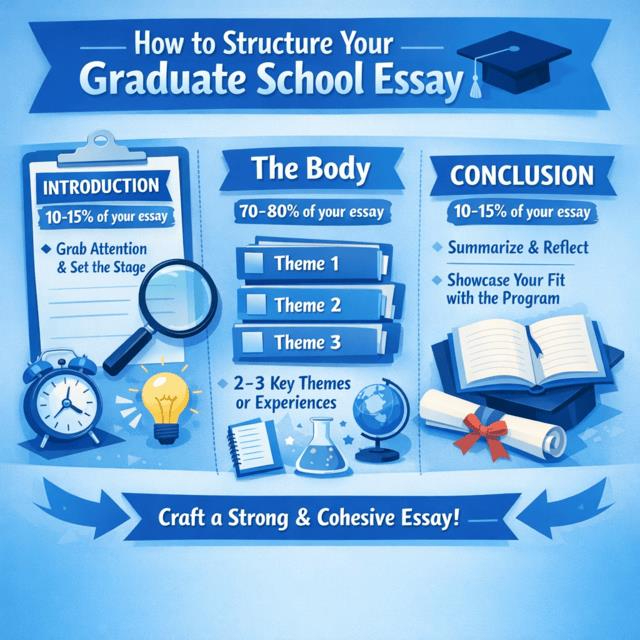
See how you should structure your gradyuate school essay:
How to Write Your Graduate School Essay
Writing a strong graduate school essay takes time. Start six to eight weeks before your deadline to allow for thorough revisions.
Step 1: Research the Program
Review their website carefully. Identify two to three faculty members whose research aligns with yours.
Read their recent publications. Look at program-specific strengths like unique labs, partnerships, or interdisciplinary opportunities. Note specific courses that excite you. Read current students' profiles if available.
Step 2: Gather Your Materials
List relevant experiences: research, work, volunteer activities, achievements. Identify two to three defining moments with specific details you can describe vividly. Note concrete skills you've developed.
Collect application requirements: word count, prompts, formatting. Check for sample essays or guidance the program has shared.
Step 3: Create a Detailed Outline
Map out two to three main themes. Decide which experiences best illustrate each. Plan your introduction hook.
Structure body paragraphs logically with smooth transitions. Draft your conclusion approach. Your outline is your roadmap—spend time here to make writing easier.
Step 4: Write Your First Draft
Don't aim for perfection. Get ideas down. Write in your own voice, not how you think you "should" sound.
Use specific details and concrete examples. Show, don't tell. Connect every experience to future goals. Include transition sentences between paragraphs.
Step 5: Let It Sit
Step away completely. This break gives you fresh perspective.
When you return, you'll see your essay with "reviewer eyes" instead of "writer eyes."
Step 6: Revise for Content
Does every paragraph advance your thesis?
Are examples specific enough? Have you shown genuine program knowledge? Does it sound like you? Have you explained why this program specifically? Are your goals realistic and well-defined?
Step 7: Edit for Clarity
Cut unnecessary words. Vary sentence length and structure.
Ensure smooth transitions and check for repetitive language. Read aloud to catch awkward phrasing. Remove awkward phrases or clichés.
Step 8: Get Feedback
Ask a professor in your field, current graduate students, and someone outside your field to read it.
Consider professional editing services. Be open to criticism—it makes your essay stronger.
Step 9: Final Polish
Proofread multiple times.
Check formatting requirements. Verify word count. Ensure faculty names are spelled correctly. Double-check program name and details. Read aloud one final time.
Tips for Making Your Graduat School Essay Stand Out
Explore the tips and techniques to make your graduate school essay stand out.
- Be Specific About the Program
Name faculty members and discuss their research specifically. Mention labs, centers, or resources you want to access. Reference recent achievements. Explain how these align with your goals.
- Use Concrete Examples
Instead of "I have strong research skills," write "I spent six months analyzing data from 200 patient samples, revealing three previously unknown correlations." Show through stories, not statements.
- Demonstrate Intellectual Curiosity
Ask questions your research could answer. Discuss how you'd approach problems. Reference recent developments in your field. Show you're actively engaged with current research.
- Show Your Authentic Voice
Write like you speak, but professionally. Use your natural phrasing. Let your personality come through. Clear, direct writing is more impressive than unnecessarily complex sentences.
- Connect the Dots
Show clear progression and purpose. Make "why you" and "why here" crystal clear. By the end, admissions committees should understand exactly why their program is right for you.
- Include a Memorable Opening
Start with a specific moment or scene. Create a vivid image. Avoid generic openings that could appear in anyone's essay.
Sample Graduate School Essay (With Analysis)
Here is a sample Essay for you.
The mass spectrometer at the back of my undergraduate research lab sat unused for three months. "Broken," everyone said. But I couldn't accept that answer. I spent two weeks troubleshooting every component, finally discovering that a simple recalibration fixed the issue. That experience taught me something crucial: the most significant breakthroughs often come from questioning accepted limitations.
This mindset has shaped my research trajectory. During my thesis work on protein-protein interactions, I challenged conventional wisdom about inaccessible binding sites. By modifying the standard protocol, we identified three previously unknown binding sites. This work resulted in co-authorship on a paper submitted to the Journal of Biological Chemistry, showing me the power of rigorous methodology combined with creative problem-solving.
My goal is to pursue a PhD in Biochemistry focusing on structural biology. Specifically, I want to understand how post-translational modifications affect protein folding dynamics. Professor Sarah Chen's recent work on ubiquitin-mediated protein degradation aligns perfectly with these interests. Her lab's use of cryo-EM to visualize protein structures represents exactly the approach I want to develop expertise in.
Northwestern's Biochemistry program offers the ideal environment for this work. The Structural Biology Center provides access to cutting-edge cryo-EM equipment, and the collaborative culture between departments would allow me to integrate computational modeling with experimental validation. I'm particularly excited about working with Professor Chen's group while taking advantage of Northwestern's proximity to Argonne National Laboratory for synchrotron radiation experiments.
Beyond research, I'm committed to making science more accessible. As president of my university's STEM outreach program, I've developed hands-on activities for K-8 students in underserved communities. At Northwestern, I'd continue this work and potentially develop new initiatives focused on demystifying graduate research for undergraduates.
My path hasn't been straightforward. My sophomore year GPA suffered when I took on too many responsibilities. However, that experience taught me better time management and realistic goal-setting, skills that improved my performance significantly. More importantly, it showed me the importance of asking for help and building support networks.
Five years from now, I see myself leading a research team investigating protein misfolding diseases. Northwestern's infrastructure, Professor Chen's mentorship, and the program's emphasis on interdisciplinary collaboration provide exactly what I need to achieve this goal. I'm ready to contribute while developing into the independent scientist I'm working to become.
Why This Essay Works:
- The opening uses a specific, memorable anecdote showing problem-solving skills and personality. You can picture this student refusing to accept "broken" as an answer.
- The research focus is specific and realistic, not vague. Concrete plans to study post-translational modifications demonstrate graduate-level readiness.
- Program knowledge is thorough. The essay names Professor Chen, discusses her research accurately, mentions the Structural Biology Center, the collaborative culture, and proximity to Argonne National Laboratory. This proves genuine interest.
- Every claim has specific evidence. The protein-protein interaction project, methodology modification, and co-authorship are quantified achievements.
- The GPA drop is addressed honestly without dwelling on it, focusing on growth and showing maturity.
- The essay explains why Northwestern specifically through explicit connections between goals and program strengths.
- Outreach work shows broader commitment beyond personal goals, making the student well-rounded.
- The conclusion is forward-looking with a clear vision, expressing confidence without arrogance.
- The voice sounds authentic, like a real person, not a template.
Ready for Expert Graduate Essay Support?
Let our professional writers help you create an essay that gets you accepted.
- 100% human-written essays—zero AI detection
- Writers with graduate degrees who understand the process
- Unlimited revisions until you're completely satisfied
- AI detection reports included with every order
Start at $11/page with 5,000+ successful graduate essays delivered.
Get Started TodayCommon Mistakes to Avoid When Writing Graduate School Essay
Here are some common mistakes you should avoid when you are writing your graduate school essay.
- Writing a Generic Essay
Admissions committees can tell immediately when you've written a generic essay. The fix is specificity. Name faculty members and discuss their research. Mention particular labs or resources.
Reference recent program achievements. Avoid phrases like "your prestigious program" that could apply anywhere.
- Focusing Only on Past Without Connecting to Future
Every past experience should connect to future goals. Use: "I did X, which taught me Y, and will help me accomplish Z." Balance past experiences with forward-looking plans.
- Being Too Humble or Too Boastful
State achievements confidently with specific evidence. Don't say "I think I might be good at research."
Say "I led a research project that resulted in co-authorship on a paper." That's confidence without being boastful.
- Ignoring Weaknesses
If you have significant weaknesses, address them briefly. Focus on what you learned and how you've grown.
Show maturity by demonstrating how challenges made you stronger.
- Using Clichés
Avoid "I have always wanted to," "passion for helping people," "sparked my interest." Show your passion through specific experiences instead.
- Missing Word Count Requirements
Hit within 10% of the target. Exceeding suggests you can't edit yourself. Writing too little suggests you don't have enough to say.
- Typos and Grammatical Errors
Even one typo raises doubts about your professionalism. Proofread multiple times. Use grammar tools. Have others review it.
- Copying or Using AI
Plagiarism means automatic rejection. AI-generated essays have a distinctive voice that experienced readers identify. Use samples for inspiration only. Write in your own voice.
Conclusion
Thoroughly research each program by understanding its strengths, faculty, and how it aligns with your goals.
Create a detailed outline connecting your experiences to the program, draft freely, revise for substance before style, and seek feedback before submitting.
Be specific, use concrete examples, clearly link past experiences to future goals, and let your authentic voice shine, generic essays are rejected, but focused, genuine ones stand out.
When you need professional support, MyPerfectWords is here to help. Our expert writers understand what admissions committees look for and can help you create an essay that truly represents your best self.