What is a Finance Essay?
A finance essay is an academic paper that examines financial concepts, analyzes economic data, or presents arguments about financial issues.
These essays teach you to think critically about money, markets, and financial decisions. You're not just memorizing formulas, you're learning to apply financial theories to real situations and support your conclusions with data.
Finance essays have three key characteristics:
- First, they're analytical. You explain why things matter and what they mean.
- Second, they're research-based. Every claim needs backing from academic sources, financial reports, or economic data.
- Third, they're evidence-driven. Your argument stands on facts, not opinions.
You might write different types depending on your assignment. An analytical essay examines a financial concept and breaks down its components. An argumentative essay takes a position on a financial debate and defends it. An expository essay explains financial processes or theories without arguing a specific stance.
Finance essays differ from general business essays in their focus. Business essays cover broader topics like management or marketing. Finance essays zero in on money: how it's raised, invested, managed, and measured. You'll work with numbers, ratios, and financial statements more than you would in other business writing.
Finance Essay Structure
Every strong finance essay follows a framework. Knowing this structure before you start saves time and creates better results.
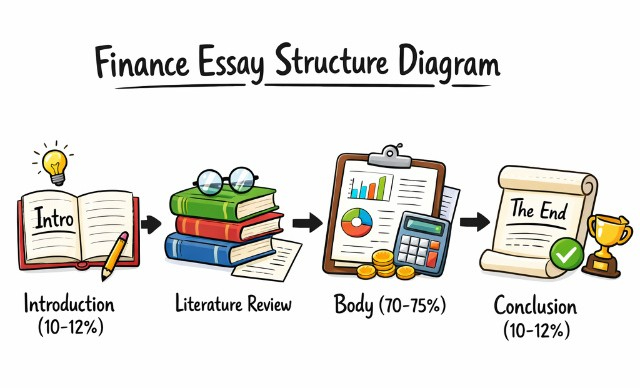
I. Introduction
Your introduction does four jobs in about 10-12% of your total word count.
Start with a hook that grabs attention. This could be a surprising statistic, a relevant question, or a brief example. Next, provide background context so readers understand what you're analyzing. Then comes your thesis statement: the backbone of your essay. A strong thesis tells readers what you're arguing, why it matters, and how you'll prove it.
| End with a roadmap sentence that previews your main points. |
II. Literature Review (if required)
Not all finance essays need a literature review, but many upper-level papers do. The literature review shows you understand existing research on your topic. You're not just summarizing, you're critically analyzing how findings relate to your argument.
Organize sources thematically, not chronologically. Group studies by what they found, not when they were published.
| Critical analysis means engaging with sources, not just listing them. |
III. Body/Analysis
Your body section carries the weight: about 70-75% of your essay's total length.
Each main argument gets its own section with a clear topic sentence. Use the PEEL structure:
- Point (your claim)
- Evidence (data supporting it)
- Explanation (why the evidence matters)
- Link (connection to your thesis).
Present data clearly. Use tables for comparing multiple companies or time periods. Use charts when trends matter more than exact numbers. Always label axes, include units, and cite your data source.
| Maintain logical flow between sections. Use transitional phrases that show relationships. Address counterarguments to show intellectual honesty and strengthen your position. |
IV. Conclusion
Your conclusion wraps everything up in about 10-12% of your word count.
Restate your thesis without copy-pasting from your introduction. Summarize your key findings. Discuss implications: what do your findings mean for investors, managers, or policymakers? Suggest future research directions.
| End decisively. |
Step-by-Step Guide to Writing a Finance Essay
Breaking the writing process into steps makes it manageable.
Step 1: Choose Your Topic
If your professor assigns the topic, you're done with this step. If not, pick wisely. A narrow topic beats a broad one. Consider topic relevance to your course. Check data availability before committing; publicly traded companies make research easier. Personal interest matters too.
Need ideas? Check out our list of finance essay topics for inspiration.
Step 2: Research Thoroughly
Start with academic databases like JSTOR and Google Scholar. Access financial reports directly through the SEC's EDGAR database for company 10-Ks and 10-Qs. Look for peer-reviewed journals. Use government sources like the Federal Reserve for economic data.
Take organized notes. Record full citations immediately, key findings, and page numbers for potential quotes.
Step 3: Develop Your Thesis
Your thesis is the most important sentence in your essay. A strong thesis makes a specific, debatable claim.
Weak: "This essay discusses corporate debt." Strong: "This essay argues that retail companies with debt-to-equity ratios exceeding 2.5 face significantly higher bankruptcy risk during economic recessions." |
Make it debatable. Use this formula: [Your position] + [Because] + [Preview of evidence].
Step 4: Create an Outline
An outline transforms your research into logical structure. It reveals gaps in your argument before you write thousands of words. Check that each section builds on the previous one.
Step 5: Write the First Draft
Write your body paragraphs first because you know your argument best after researching. Don't self-edit while drafting. Follow your outline but stay flexible. Use topic sentences to start each paragraph.
First drafts are supposed to be messy.
Step 6: Analyze and Support
Every claim needs evidence. Explain data, don't just cite it. After presenting numbers, tell readers what they mean. Integrate quotes smoothly with proper introduction.
Balance analysis with description. Spend 70% of your energy analyzing and 30% describing.
Step 7: Revise and Edit
Do structural revision first. Check if your argument flows logically, each paragraph supports your thesis, and you have enough evidence. Only after structure is solid, focus on grammar and style.
Read your essay aloud to catch awkward phrasing. Get feedback if possible.
Struggling with Your Finance Essay? Let our expert writers handle it while you focus on what matters. Join countless students who trust MyPerfectWords
Finance Essay Format (APA, MLA, Chicago)
Getting the format right matters. Professors notice formatting errors, and they cost points. Here's how you format for different styles:
General Formatting Basics
- Use Times New Roman 12-point font.
- Set 1-inch margins on all sides.
- Double-space your entire essay.
- Add page numbers in the top right corner.
- Include a title page with your essay title, name, course information, and date.
APA Format for Finance Essays
APA (American Psychological Association) format is the standard for finance essays.
For in-text citations, use (Author, Year) format. For direct quotes, add page numbers: (Author, Year, p. X). Your reference page is titled "References," uses hanging indents, and alphabetically orders entries.
Example reference for a journal article: Jensen, M. C. (2022). Agency costs of free cash flow. Journal of Financial Economics, 76(2), 323-329.
Example reference for a company report: Apple Inc. (2023). 2023 annual report (Form 10-K). U.S. Securities and Exchange Commission. https://www.sec.gov/edgar
MLA Format
MLA format is rare in finance but possible in interdisciplinary courses. In-text citations use (Author Page Number). Your Works Cited page lists sources alphabetically with hanging indents.
Chicago Format
Chicago style uses footnotes or endnotes instead of in-text citations. It's common in history courses but rare in finance.
Citation Style | In-Text Format | When Used | Common In |
APA | (Author, Year) | Most common | Finance, economics |
MLA | (Author Page) | Rare | Interdisciplinary |
Chicago | Footnotes | Rare | Business history |
For detailed examples of properly formatted finance essays, see our finance essay examples and explore real-world examples with annotations.
Common Finance Essay Mistakes to Avoid
Watch out for these errors. They're common, preventable, and costly.
- Weak thesis statements. Writing "This essay is about capital structure" tells readers nothing. A thesis must argue something specific. The difference? One describes a topic; the other makes a claim.
- Insufficient evidence. Claiming "the company's financial health deteriorated" without showing the numbers leaves readers skeptical. Back every assertion with data.
- Poor data analysis. Listing numbers isn't analysis. After presenting numbers, explain what they mean and why they matter.
- Ignoring counterarguments. Academic writing requires acknowledging opposing views. Address contrary evidence to show intellectual honesty.
- Plagiarism. This includes both intentional copying and accidental plagiarism. If you paraphrase someone's ideas, cite them. When in doubt, cite.
- Inconsistent formatting. Mixing citation styles looks sloppy. Pick one style and stick with it throughout.
- Neglecting proofreading. Typos and grammar errors undermine credibility. Read your essay aloud to catch errors.
Finance Essay Writing Tips
These strategies separate good essays from great ones.
- Start with data. Before writing, find compelling statistics or financial reports. Strong data drives strong arguments.
- Use real-world examples. Connect financial theories to actual companies and events. Specific examples stick in readers' minds.
- Show, don't tell. Demonstrate your analysis through specific decisions and outcomes instead of stating conclusions.
- Integrate visuals. If allowed, use charts, graphs, or tables. A table comparing five companies' financial ratios conveys information faster than five paragraphs.
- Cite recent sources. Finance changes rapidly. Prioritize sources from the last 5 years when possible.
- Write multiple drafts. Your first draft should not be your final draft. Great writers rewrite.
- Get feedback early. Visit your professor during office hours with a draft. Use your university's writing center. Ask a classmate to read your draft.
Read finance publications. The Wall Street Journal, Financial Times, and Bloomberg publish clear, concise financial writing daily. Learn from their techniques.
Conclusion
Writing a finance essay doesn't have to feel overwhelming. When you break it down into clear steps, choosing a focused topic, researching thoroughly, developing a strong thesis, and following a proven structure, the process becomes manageable.
Remember the framework: a clear introduction with your thesis, a detailed body section with evidence-backed analysis, and a conclusion that ties everything together. Follow proper formatting (usually APA for finance), back every claim with data, and write in a conversational tone that makes complex concepts accessible.
Avoid the common mistakes that trip up most students: weak thesis statements, insufficient evidence, and poor data analysis. Instead, focus on showing your analysis through specific examples, integrating real-world cases, and explaining what the numbers actually mean.
Most importantly, give yourself time. A strong finance essay takes 10-20 hours when you factor in research, writing, and revision. Start early, get feedback, and don't skip the editing phase. If you get confused, you can always get essay help from a good writing service.
Whether you're analyzing capital structure, evaluating investment decisions, or arguing about financial policy, these principles will help you produce work that demonstrates critical thinking and earns strong grades. You've got this.
Ready to Get Expert Help? Writing a finance essay takes time, research, and financial expertise. If you need professional assistance, we're here to help. Join countless students who trust MyPerfectWords