What Makes a Good Law Essay?
Before you start writing, you need to know what you're aiming for. A first-class law essay doesn't just describe the law; it analyzes, evaluates, and argues a clear position.
Here's what professors look for in high-grade law essays:
- Critical analysis over description. Don't just explain what the law says. Analyze why it exists, how courts interpret it, and whether it's effective. Your professor wants to see you think critically about legal principles.
- Strong legal authority. Every claim needs support from cases, statutes, or academic sources. Weak essays make assertions without evidence. Strong essays cite relevant legal authority for each point.
- Clear structure and logical flow. Your arguments should build on each other naturally. Each paragraph should connect to your thesis and transition smoothly to the next point.
- Original thinking. The best essays don't just repeat what others say. They offer fresh insights, identify tensions in the law, or propose new interpretations.
- Precise legal writing. Vague language weakens your arguments. Use specific legal terms correctly and avoid unnecessary words.
Law essays differ from other academic writing because they require legal reasoning skills. You're not just presenting information, you're making a legal argument that could theoretically persuade a judge or influence policy.
Need Expert Law Essay Help? Get Professional Law Essay Writing Assistance Professional writers, 100% original work, delivered on time.
Before You Start: Understanding the Essay Question
The biggest mistake students make is answering the wrong question. You can write a brilliant essay, but if it doesn't address what's actually asked, you'll lose marks.
Break down the question into three parts:
- Directive words tell you what to do. "Analyze" means examine in detail. "Discuss" means present different viewpoints. "Evaluate" means assess strengths and weaknesses. "Compare" means identify similarities and differences. "Critically assess" means analyze and judge the merit of something.
- Content words identify the legal topics you need to cover. These are usually specific legal concepts, cases, statutes, or doctrines.
- Scope words limit what you discuss. Words like "in England and Wales," "since 2010," or "in contract law" tell you exactly what to include and exclude.
Let's look at an example:
"Critically evaluate whether the doctrine of promissory estoppel provides an adequate alternative to consideration in English contract law."
|
This question asks you to assess how well promissory estoppel works as a substitute for consideration. You'll need to explain both concepts, examine cases where promissory estoppel was used, and argue whether it's an adequate alternative.
If you need help choosing a topic, explore our law essay topics guide.
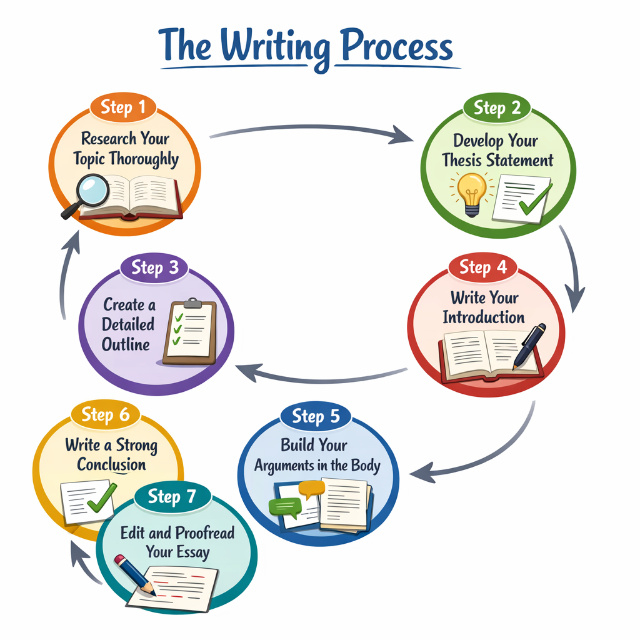
Step 1: Research Your Topic Thoroughly
Once you understand the question, it's time to gather your evidence. Legal research can feel overwhelming, but you don't need to read everything; you need to read the right things.
1. Start with Primary Sources
These are the actual law: cases and statutes. For case law, use databases like Westlaw, LexisNexis, or free resources like Google Scholar. For statutes, check official government websites.
2. Then Move to Secondary Sources
These are academic commentaries that analyze the law: journal articles, textbooks, and legal encyclopedias. They help you understand different perspectives and identify key cases you might have missed.
3. Evaluate Source Quality
Not all sources are equal. Court of Appeal decisions carry more weight than lower court rulings. Peer-reviewed journals are more credible than blog posts. Recent sources reflect current law better than outdated ones.
4. Make Smart Notes
Don't just copy quotes. Write down the legal principle, the case citation, and why it matters for your argument. Note the page numbers so you can cite properly later.
5. Know When to Stop Researching
You'll never read everything written on a topic. Stop when you've found 5-10 strong primary sources, understand the main debates, and have evidence for your thesis. More research won't necessarily improve your essay; better analysis will.
Step 2: Develop Your Thesis Statement
Your thesis statement is your promise to the reader about what you'll prove. It's the single most important sentence in your essay.
A strong thesis has three qualities:
- It's arguable. You can't just state a fact. "The doctrine of consideration exists in contract law" isn't a thesis; it's obvious. "The doctrine of consideration is outdated and should be replaced with a more flexible approach" is arguable.
- It's specific. Vague theses lead to vague essays. "Contract law has problems" is too broad. "The rigid application of consideration in Williams v Roffey creates unfair outcomes in commercial negotiations" is specific.
- It's defensible with evidence. You need to be able to support your position with cases, statutes, and scholarly analysis. Don't make claims you can't back up.
Here's the difference between weak and strong thesis statements:
Weak: "This essay will discuss promissory estoppel."
Better: "Promissory estoppel is an important doctrine in contract law."
Strong: "While promissory estoppel prevents injustice in individual cases, its inconsistent application and inability to create new rights make it an inadequate replacement for consideration in English contract law."
|
Here's another example showing thesis evolution:
Weak: "The law on negligence is complex."
Better: "The law on negligence has changed significantly over time."
Strong: "The expansion of duty of care in negligence law since Donoghue v Stevenson has improved protection for consumers, but recent judicial retreat in cases like Caparo threatens these gains by prioritizing policy concerns over justice."
|
Write your thesis after you've done some initial research but before you start writing. It might evolve as you write, and that's fine. Your thesis should guide your essay, but be willing to refine it if your research takes you somewhere more interesting.
Once you have your thesis, every paragraph in your essay should support it or address counterarguments to it.
Step 3: Create a Detailed Outline
Don't skip outlining. It's the difference between a rambling essay and a focused argument.
1. Start with Your Main Points
What are the 3-5 key arguments that support your thesis? Each one should be substantial enough to deserve its own section.
2. Arrange Them Logically
Sometimes chronological order works (tracing how the law developed). Sometimes it's strongest argument first, then weaker arguments. Sometimes it's claim, then counterargument, then rebuttal.
3. Add Supporting Evidence
Under each main point, list the cases, statutes, or academic sources you'll use. This prevents you from forgetting important evidence when you're writing.
4. Plan Your Transitions
How will you move from one point to the next? Good transitions show how your arguments connect and build on each other.
Once you understand the question and have your thesis, plan your law essay structure. A well-organized outline makes the actual writing much faster because you're never staring at a blank page wondering what comes next.
Step 4: Write Your Introduction
Your introduction sets up everything that follows. It should accomplish four things in about 10-15% of your total word count.
- Hook your reader. Start with something interesting, a surprising case outcome, a controversial legal development, or a real-world problem the law addresses. Don't start with generic statements like "Since the beginning of time, humans have had laws."
- Provide context. Give your reader the background they need. What's the legal issue? Why does it matter? What's the current state of the law?
- State your thesis clearly. This is your roadmap. Your introduction should provide a roadmap for your essay's structure, showing readers what arguments you'll make and in what order.
- Preview your argument. Briefly outline the main points you'll make. This helps your reader follow your logic.
What NOT to do in introductions:
|
Here's a brief example of a strong introduction:
"When Williams v Roffey Bros [1991] redefined consideration in contract law, it seemed to signal a more flexible, fairness-oriented approach. Yet thirty years later, the doctrine remains frustratingly inconsistent. While courts now recognize practical benefits as valid consideration, they simultaneously refuse to extend promissory estoppel beyond a defensive shield. This essay argues that these half-measures create unnecessary complexity and that English contract law should fully adopt either a flexible consideration doctrine or a robust promissory estoppel principle, but not this awkward hybrid. This analysis will examine the theoretical foundations of consideration, trace its evolution through key cases, and demonstrate why the current compromise satisfies neither doctrinal consistency nor practical justice."
This introduction hooks with a specific case, establishes the problem, states a clear thesis, and previews the argument structure.
Step 5: Build Your Arguments in the Body
The body is where you prove your thesis. Each paragraph should make one clear point supported by evidence.
Use the IRAC method for legal analysis:
- Issue: What's the legal question this paragraph addresses?
- Rule: What's the relevant law (case, statute, principle)?
- Application: How does this law apply to the question? This is where your analysis happens.
- Conclusion: What does this mean for your argument?
Here's how IRAC works in practice:
"The question is whether promissory estoppel can create new rights or only prevent enforcement of existing ones [Issue]. In Combe v Combe [1951], the Court of Appeal held that promissory estoppel acts as a 'shield, not a sword'; it can defend against a claim but cannot create a cause of action [Rule]. This limitation means that even when Party A reasonably relies on Party B's promise, Party A cannot sue to enforce that promise unless consideration exists [Application]. Therefore, promissory estoppel remains fundamentally limited as an alternative to consideration, unable to provide relief in precisely the situations where consideration doctrine seems most unfair [Conclusion]."
Paragraph structure matters. Start each paragraph with a topic sentence that states your point. Follow with evidence and analysis. End with a sentence that connects to your thesis or transitions to the next point. Use evidence effectively. Don't just list cases. Explain what they establish and why they matter for your argument. One well-analyzed case is better than five briefly mentioned ones. Address counterarguments. Strong essays acknowledge opposing views and explain why your position is still stronger. This shows you understand the complexity of legal issues. Transition between points. Use phrases like "Building on this point," "However," or "This principle applies even more clearly in..." to show how your arguments connect. |
For inspiration on structuring compelling legal analysis, check our law essay examples.
Struggling with Your Law Essay?
Our expert writers make law essays simple.
Join countless students who trust us with their essays.
Step 6: Write a Strong Conclusion
Your conclusion synthesizes everything you've argued. It's not just a summary; it's where you show the significance of your analysis.
What to include:
Restate your thesis (in different words). Remind your reader of your main argument. Synthesize your key points. Show how your arguments work together to support your thesis. Don't just list them again; explain how they combine to prove your position. Address implications. What does your argument mean for the law? Should courts change their approach? Are reforms needed? End strongly. Your last sentence should leave a lasting impression. |
What to avoid:
- Don't introduce new information or cases in your conclusion
- Don't apologize for your argument ("While this essay is limited...")
- Don't end abruptly, give your reader closure
- Don't just repeat your introduction word-for-word
Here's a brief example:
"The current hybrid approach to consideration and promissory estoppel satisfies no one. Maintaining rigid consideration requirements while partially recognizing promissory estoppel creates doctrinal incoherence without providing meaningful relief. English contract law should choose: either fully embrace Williams v Roffey's practical benefit approach and eliminate the need for promissory estoppel, or empower promissory estoppel as a true sword and accept that fairness sometimes outweighs formal bargain theory. Until courts commit to one path, practitioners and parties will continue navigating an unnecessarily complex landscape where similar facts produce unpredictable outcomes."
This conclusion synthesizes the analysis, restates the thesis differently, and ends with implications for the law.
Step 7: Edit and Proofread Your Essay
Editing isn't optional; it's where good essays become great ones. Don't skip this step even if you're short on time.
First edit: Content and structure. Read through your entire essay. Does each paragraph support your thesis? Do your arguments flow logically? Are your transitions clear? Is your evidence strong? This is about the big picture. Second edit: Clarity and style. Look at individual sentences. Cut unnecessary words. Replace vague language with precise terms. Check that you've explained legal concepts clearly. Make sure you're using legal terminology correctly. Third edit: Grammar and citations. Check spelling, punctuation, and grammar. Verify every citation is correct and complete. Make sure case names are italicized (or underlined) and citations follow your required format (OSCOLA, Bluebook, etc.). |
Use the read-aloud technique. Read your essay out loud. You'll catch awkward phrasing, run-on sentences, and unclear logic that you'd miss reading silently.
Common mistakes to catch:
- Inconsistent verb tenses
- Missing case citations
- Unclear pronoun references ("it," "this," "they" without clear antecedent)
- Overly long sentences (if you run out of breath, break it up)
- Incorrect case names or citation formats
- Paragraphs that don't connect to your thesis
Give yourself time between writing and editing. Fresh eyes catch more mistakes.
Common Mistakes to Avoid When Writing Law Essays
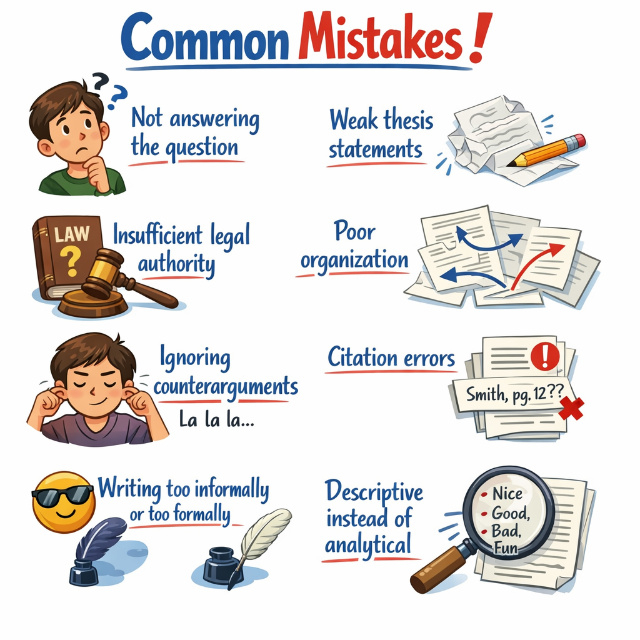
Even strong students make these errors. Here's what to watch for:
- Not answering the question. This is the most common mistake. You can write a perfect essay on the wrong topic and still fail. Keep referring back to the question as you write.
- Weak thesis statements. If your thesis doesn't take a clear position, your whole essay will be vague. Every paragraph should clearly connect to proving your thesis.
- Insufficient legal authority. Your opinion alone isn't enough. Every claim needs support from cases, statutes, or credible academic sources. "It seems unfair" is weak. "This outcome conflicts with the principle established in [Case]" is strong.
- Poor organization. If your reader can't follow your logic, your argument fails. Use clear topic sentences, transitions, and a logical structure.
- Ignoring counterarguments. Real legal issues are complex. If you only present one side, you seem either biased or unaware of the full picture.
- Citation errors. Wrong case names, missing citations, or incorrect format undermine your credibility. Double-check every citation.
- Writing too informally or too formally. Don't use slang or contractions in the essay itself. But also don't use unnecessarily complex language that obscures your meaning.
- Descriptive instead of analytical. Don't just explain what the law is. Analyze why it works this way, whether it's effective, and what tensions exist.
Tips for Writing Law Essays Under Time Pressure
Law school doesn't give you unlimited time. Here's how to write effectively when you're racing the clock:
1. Spend Time on the Question and Outline
It's tempting to start writing immediately, but 15 minutes planning prevents hours of rewriting. Make sure you understand the question and have a clear structure.
2. Use Efficient Research Methods
Start with your course materials and lecture notes. Check textbook footnotes for key cases. Use secondary sources to identify the main debates quickly, then read the primary sources.
3. Outline as You Research
Don't separate these tasks. As you find relevant cases, slot them into your outline under the appropriate argument. This saves time later.
4. Write Fast, Edit Later
Get your ideas down without stopping to perfect every sentence. You can refine language during editing. Don't let perfectionism slow your first draft.
5. Use the Structure You Know
Stick with proven formats like IRAC. Don't try experimental structures when time is short.
6. Focus on Quality Over Quantity
Three well-analyzed cases beat ten cases mentioned briefly. Deep analysis of key authorities is always better than surface coverage of many sources.
7. Know When to Ask for Help
If you're truly stuck or running out of time, it's better to get professional assistance than submit incomplete work. Our expert legal writers can help you meet deadlines without compromising quality.
Conclusion
Writing a law essay doesn't have to be overwhelming. By following this step-by-step process, understanding the question, researching thoroughly, developing a strong thesis, outlining carefully, and writing with clear structure, you'll produce essays that demonstrate legal reasoning and analytical skills.
Remember that first-class law essays do more than just describe the law. They analyze critically, argue persuasively, and support claims with strong legal authority. Every paragraph should earn its place by advancing your thesis.
The key is preparation. Time spent understanding the question and planning your structure saves hours of rewriting later. And editing is not optional; it's where good essays become great ones.
If you still need help, then get in touch with writers at our essay writing service so they can help you.
Ready to Submit a First-Class Essay? Let our experts handle the hard work. Get the grade you deserve without the stress.