What Is a Lab Report Example?
A lab report example is a complete, finished document not a template you fill in, and not a list of formatting rules. It's an actual report that demonstrates everything working together: the structure, the tone, the depth of detail, the way data gets presented.
Studying examples teaches you things that format guides can't. You'll see how much detail belongs in a Methods section, how formal the writing should be, and how a Discussion section actually ties results back to a hypothesis. That practical understanding is hard to get any other way.
The table below shows how examples, templates, and format guides differ and when each one is useful.
Feature | Lab Report Example | Lab Report Template | Lab Report Format Guide |
What it shows | A complete, finished report | A blank structure to fill in | Rules and structural requirements |
Best for | Seeing real application in practice | Creating your own report framework | Understanding the requirements |
What you take away | Realistic expectations; writing style | A starting structure | The rules you're writing toward |
For detailed formatting requirements margins, fonts, citation styles see our lab report format guide.
Why Study Lab Report Examples?
Reading a finished example closes the gap between knowing what to do and actually doing it well. Most students understand the sections. Fewer understand how much to write in each one, what tone hits the right balance between formal and readable, or how the Discussion section is supposed to feel different from the Results section.
Examples solve all of that. You're not guessing anymore you're pattern-matching against something real.
They're especially useful for picking up discipline-specific conventions. A biology lab report looks and feels different from a physics lab report, even when both follow the same basic structure. Seeing those differences across three examples gives you a far sharper picture than any explanation could.
| The real value of studying lab report examples is that you're internalizing expectations, not just memorizing rules. |
Biology Lab Report Example
The following is a simplified but realistic biology lab report based on an observational experiment measuring the effect of light intensity on plant growth.
Title: Effect of Light Intensity on the Growth Rate of Phaseolus vulgaris (Common Bean)
Abstract
This experiment examined how varying light intensity affects the growth rate of common bean (Phaseolus vulgaris) seedlings over a 14-day period. Three groups of seedlings were exposed to low, medium, and high light intensities. Height was measured every 48 hours. Results showed a positive correlation between light intensity and growth rate, with high-intensity seedlings growing 43% taller than low-intensity seedlings by day 14. These findings support the hypothesis that increased light exposure accelerates photosynthetic activity, which drives vegetative growth.
Introduction
Photosynthesis is the primary mechanism by which plants convert light energy into the chemical energy needed for growth. The rate of photosynthesis is directly influenced by light intensity, with higher intensities generally increasing the rate up to a saturation point (Taiz & Zeiger, 2010). It was hypothesized that Phaseolus vulgaris seedlings exposed to higher light intensities would exhibit significantly greater growth rates than those exposed to low light, due to increased availability of energy for cellular processes.
Materials and Methods
Fifteen Phaseolus vulgaris seeds were germinated in identical 10 cm plastic pots filled with standard potting mix. Seeds were divided into three groups of five (n=5 per group). Group A was placed 90 cm from a 60W fluorescent lamp (low intensity), Group B at 45 cm (medium intensity), and Group C at 15 cm (high intensity). All other variables temperature (22°C), watering schedule (50 mL every 48 hours), and pot placement were kept constant. Seedling height was measured from soil level to the apical meristem every 48 hours using a standard ruler. Measurements were recorded in centimeters and averaged across each group.
Results
Mean seedling heights increased across all three groups over the 14-day observation period. By day 14, Group C (high intensity) seedlings reached a mean height of 18.4 cm (SD = 1.2), compared to 14.1 cm (SD = 1.8) for Group B (medium intensity) and 12.9 cm (SD = 2.1) for Group A (low intensity).
Day | Group A (Low) | Group B (Medium) | Group C (High) |
0 | 0.0 cm | 0.0 cm | 0.0 cm |
2 | 1.1 cm | 1.4 cm | 1.6 cm |
6 | 4.8 cm | 6.3 cm | 7.9 cm |
10 | 9.2 cm | 11.0 cm | 14.1 cm |
14 | 12.9 cm | 14.1 cm | 18.4 cm |
Group C seedlings grew 43% taller than Group A by the end of the observation period. No seedlings in any group showed signs of disease or wilting during the experiment.
Discussion
The results supported the hypothesis. Seedlings exposed to higher light intensity showed greater growth than those in low-light conditions, consistent with established relationships between light intensity and photosynthetic rate in C3 plants (Taiz & Zeiger, 2010). The plateau in growth rate differences between Groups B and C after day 10 may suggest approaching light saturation, a well-documented phenomenon in Phaseolus vulgaris (Smith & Brown, 2018). One limitation of this study was the small sample size (n=5), which limited statistical power. Artificial light sources may also differ from natural sunlight spectra, potentially affecting the applicability of these findings to outdoor growing conditions.
Conclusion
This experiment demonstrated that increasing light intensity significantly increases the growth rate of Phaseolus vulgaris seedlings over a 14-day period. These findings support the hypothesis and are consistent with existing research on photosynthesis and plant growth. Future studies should use larger sample sizes and examine the light saturation point more precisely to determine the optimal light intensity for this species.
References
Smith, A., & Brown, K. (2018). Light saturation in legumes: A comparative study. Journal of Plant Science, 12(3), 45–58.
Taiz, L., & Zeiger, E. (2010). Plant physiology (5th ed.). Sinauer Associates.
What Makes This Biology Lab Report Effective?
This example works for several concrete reasons worth noting before you write your own.
|
Common Mistakes to Avoid (Based on This Example)
- Writing Methods like a step-by-step recipe ("Step 1: Add water...") instead of a past-tense description of what you actually did
- Putting interpretation into the Results section ("The high light group grew better, which proves photosynthesis works")
- Skipping error analysis or limitations in the Discussion
- Not linking Discussion findings back to the hypothesis you stated in the Introduction
Chemistry Lab Report Example
The following example is based on an acid-base titration experiment one of the most common chemistry lab assignments.
Title: Determination of Acetic Acid Concentration in Vinegar by Acid-Base Titration
Abstract
This experiment determined the concentration of acetic acid (CH?COOH) in commercial white vinegar using sodium hydroxide (NaOH) as the titrant. Three trials were conducted. The mean acetic acid concentration was found to be 5.1% (w/v), with a standard deviation of 0.15%. This value falls within the expected range of 4–8% for commercial vinegar and supports the reliability of acid-base titration as an analytical method.
Introduction
Acid-base titration is a quantitative analytical technique used to determine the concentration of an unknown acid or base by reacting it with a solution of known concentration. In this experiment, acetic acid a weak organic acid was the analyte, and sodium hydroxide (NaOH) served as the titrant. The neutralization reaction proceeds as follows:
CH?COOH + NaOH ? CH?COONa + H?O
It was hypothesized that the concentration of acetic acid in commercial white vinegar would fall within the range of 4–8% (w/v), consistent with FDA labeling standards for vinegar products (FDA, 2021).
Experimental Procedure
A 0.1 M NaOH solution was prepared by dissolving 4.00 g NaOH in 1000 mL of deionized water. The solution was standardized against potassium hydrogen phthalate (KHP). A 10.00 mL sample of commercial white vinegar was pipetted into a 250 mL Erlenmeyer flask and diluted with 40 mL deionized water. Three drops of phenolphthalein indicator were added. The NaOH solution was added dropwise from a 50 mL burette until a pale pink color persisted for 30 seconds (endpoint). The volume of NaOH used was recorded. The procedure was repeated for three trials.
Results
Trial | Volume NaOH Used (mL) | Calculated [CH?COOH] % (w/v) |
1 | 8.45 | 5.07 |
2 | 8.52 | 5.11 |
3 | 8.48 | 5.09 |
Mean | 8.48 | 5.09 |
SD | 0.035 | 0.020 |
Sample Calculation (Trial 1):
- Moles NaOH = 0.1 M × 0.00845 L = 0.000845 mol
- Moles CH?COOH = 0.000845 mol (1:1 ratio)
- Mass CH?COOH = 0.000845 × 60.05 g/mol = 0.0508 g
- Concentration = (0.0508 g / 10.00 mL) × 100% = 5.07% (w/v)
Discussion
The mean acetic acid concentration of 5.09% falls within the expected 4–8% range for commercial vinegar, supporting the hypothesis. The low standard deviation (0.020%) across three trials indicates good reproducibility. Possible sources of error include subjective endpoint determination (phenolphthalein color change), slight variations in pipetting volume, and CO? absorption by the NaOH solution over time, which can reduce titrant concentration. The last source of error would cause a slight overestimation of the acetic acid concentration.
Conclusion
Acid-base titration successfully determined the concentration of acetic acid in commercial white vinegar to be 5.09 ± 0.020% (w/v). This result is consistent with FDA labeling requirements and confirms the hypothesis. Future experiments could use a potentiometric titration (pH meter) to reduce subjectivity in endpoint determination.
References
FDA. (2021). Compliance policy guide: Vinegar definitions. U.S. Food and Drug Administration.
Harris, D. C. (2015). Quantitative chemical analysis (9th ed.). W. H. Freeman.
What Makes This Chemistry Lab Report Strong?
|
Key Differences from the Biology Example
Chemistry reports lean heavily on quantitative data more than biology reports. You'll spend more space on calculations and less on qualitative observations. The emphasis on precision, significant figures, uncertainty, and error analysis reflects the discipline's standards. Chemical equations are also a structural feature you won't find in a biology report.
Professional Lab Reports Made Simple Let our science-background writers handle it while you focus on exams. Precision matters in scientific writing.
Physics Lab Report Example
This example is based on a simple pendulum experiment, one of the most common introductory physics labs.
Title: Experimental Determination of the Acceleration Due to Gravity Using a Simple Pendulum
Abstract
This experiment measured the period of a simple pendulum at five different lengths to determine the local acceleration due to gravity (g). Using the relationship T = 2??(L/g), the experimental value of g was calculated as 9.76 ± 0.14 m/s², compared to the accepted value of 9.81 m/s². The 0.51% discrepancy is attributed primarily to air resistance and the finite amplitude of oscillations.
Introduction
A simple pendulum undergoes simple harmonic motion for small angular displacements (? < 15°). The period T of oscillation is related to the pendulum length L and gravitational acceleration g by:
T = 2??(L/g)
Rearranging: g = 4?²L/T²
This relationship allows experimental determination of g from easily measurable quantities. It was hypothesized that the experimental value of g would fall within 2% of the accepted value of 9.81 m/s², assuming proper technique and small-angle conditions.
Apparatus and Procedure
A 1.5 m length of string was attached to a steel bob (mass: 100 g). The string length was adjusted to five lengths: 0.25, 0.40, 0.60, 0.80, and 1.00 m. For each length, the bob was displaced approximately 10° from vertical and released. The time for 10 complete oscillations was measured using a digital stopwatch (resolution: 0.01 s). Five trials were conducted at each length. The mean period was calculated and used to determine g.
Data and Analysis
Length L (m) | Mean T for 10 oscillations (s) | Period T (s) | Calculated g (m/s²) |
0.25 | 10.01 | 1.001 | 9.87 |
0.40 | 12.68 | 1.268 | 9.81 |
0.60 | 15.51 | 1.551 | 9.83 |
0.80 | 17.89 | 1.789 | 9.87 |
1.00 | 20.04 | 2.004 | 9.82 |
Mean | 9.84 |
A graph of T² vs. L was plotted. The slope of the best-fit line (slope = 4?²/g) yielded g = 9.76 m/s². Uncertainty was propagated using standard methods, giving g = 9.76 ± 0.14 m/s².
Discussion
The experimental value of g (9.76 ± 0.14 m/s²) differs from the accepted value (9.81 m/s²) by 0.51%, well within the typical range for a pendulum experiment of this type. The accepted value falls within the experimental uncertainty range (9.62–9.90 m/s²), confirming the validity of the measurement. Primary sources of error include air resistance (which adds a damping force, slightly extending the period and leading to underestimation of g) and the finite amplitude of oscillations (the small-angle approximation introduces error above 5–10°). Reaction time in stopwatch use also contributes, though this was minimized by timing 10 oscillations rather than one.
Conclusion
The acceleration due to gravity was experimentally determined to be 9.76 ± 0.14 m/s², a 0.51% deviation from the accepted value of 9.81 m/s². This result supports the hypothesis and validates the simple pendulum as a reliable method for estimating g in classroom settings. Future experiments could reduce timing uncertainty using a photogate sensor.
References
Halliday, D., Resnick, R., & Krane, K. S. (2014). Physics (5th ed.). Wiley.
Taylor, J. R. (1997). An introduction to error analysis (2nd ed.). University Science Books.
What Makes This Physics Lab Report Exemplary?
|
Physics Specific Considerations
Physics reports rely more heavily on mathematical notation than biology or chemistry reports. Equations are numbered and referenced in the text. Graphs showing trends and relationships are essential, not optional. Error propagation, formally calculating how measurement uncertainties compound through your calculations, is expected at the upper-division level and common even in intro courses.
Use Lab Report Examples Effectively
Seeing good examples is only half the work. Here's how to actually translate what you're seeing into a better report of your own.
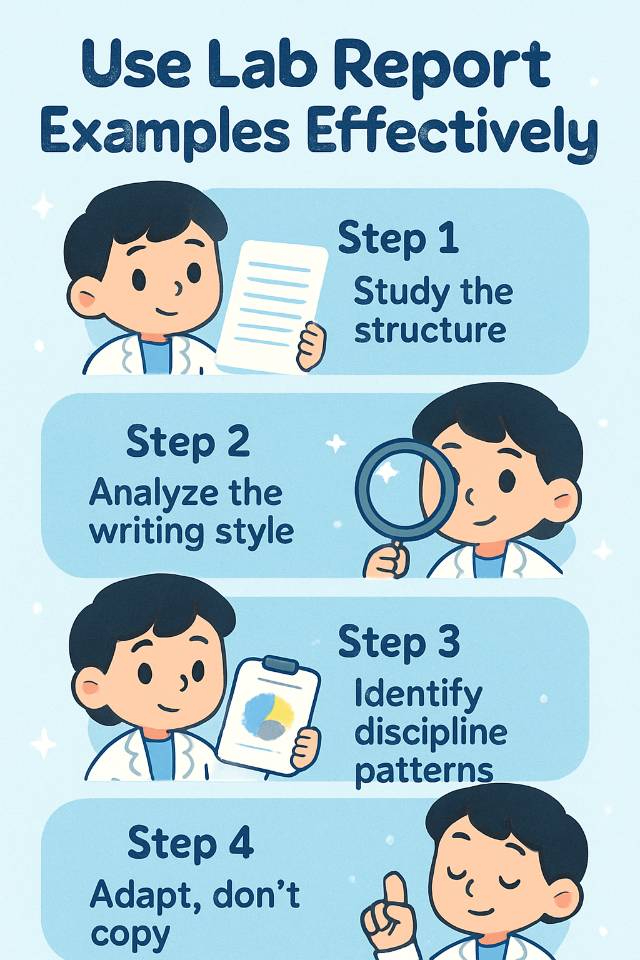
Step 1: Study the structure
Notice how sections flow into each other. The Introduction ends with a hypothesis. The Methods describe exactly how you tested it. The Results report what happened. The Discussion explains what it means. That chain should hold in any lab report.
Step 2: Analyze the writing style
Observe the verb tenses (past tense for procedures, present tense for data interpretation), the level of formality, and how technical terms are used precisely without becoming impenetrable.
Step 3: Identify discipline patterns
The biology example emphasizes observations and qualitative description. The chemistry example emphasizes calculations and precision. The physics example emphasizes mathematical relationships and uncertainty. Your report should reflect your discipline's conventions.
Step 4: Adapt, don't copy
Use these examples to understand what's expected. Write your own content based on your own experiment. The goal is pattern recognition, not reproduction.
| Important: These examples are for learning purposes only. Never copy text directly from examples into your own lab report. That's plagiarism and violates academic integrity policies at every institution. Use them to understand expectations, then write your own original work. |
Annotated Lab Report Example Checklist
Use this checklist when evaluating examples you find elsewhere or checking your own work before you submit.
Title
- Descriptive and specific
- Includes key variables or experimental focus
- Concise (under 15 words ideally)
Abstract
- Summarizes all major sections in a few sentences
- States hypothesis or objective
- Highlights key results
- States main conclusion
- Can stand alone without reading the full report
Introduction
- Provides background and context
- States hypothesis clearly and specifically
- Cites relevant sources
- Explains the purpose of the experiment
Methods
- Detailed enough for replication
- Written in past tense
- Organized logically
- Materials and equipment listed with specifics
Results
- Presents data objectively (no interpretation)
- Uses tables and/or figures effectively
- Labels and captions are clear
- Text describes what the data shows without explaining why
Discussion
- Interprets the results
- Connects findings back to the hypothesis
- Addresses limitations
- Discusses sources of error
- Relates to broader scientific context
Conclusion
- Summarizes main findings
- States whether hypothesis was supported
- Suggests future research directions
- Brief and clear
References
- Proper format (APA, MLA, CSE, etc.)
- All in-text citations appear in the reference list
- Alphabetized or formatted per style guide
For detailed guidance on conclusion writing, check our article on lab report conclusion.
Downloadable Lab Report Examples
To give you a better understanding of the lab reports’ writing process and structure, we have gathered some helpful examples.
Go through these examples and write your lab report accordingly.
Common Mistakes in Lab Report Examples to Avoid
Studying good examples helps. But knowing what weak reports look like is just as useful. These are the mistakes that show up most consistently in student lab reports.
- Mistake 1: Copying lab manual instructions into Methods. The Methods section describes what you did, not what you were told to do. Rewrite everything in past tense as a description of your actual procedure, with specifics unique to your run.
- Mistake 2: Interpreting results in the Results section. Results = facts. Discussion = interpretation. "The high-intensity group grew tallest" belongs in Results. "This supports the hypothesis because..." belongs in Discussion. Keep them separate.
- Mistake 3: A vague or missing hypothesis. "We will test the effect of light on plants" is not a hypothesis. "It was hypothesized that plants exposed to higher light intensity would grow taller due to increased photosynthetic activity" is. Be specific.
- Mistake 4: Data without textual context. Tables and graphs don't explain themselves. Always include a text description of what the data shows, even when a table makes the pattern obvious.
- Mistake 5: No error analysis. Every experiment has limitations. Students who skip this section seem like they haven't thought critically about their own work. Discuss at least two specific sources of error and their likely directional impact.
- Mistake 6: Informal tone. "We got some pretty cool results" has no place in a lab report. Keep the language objective and formal: "The results demonstrated a statistically significant relationship between..."
- Mistake 7: Missing or improperly formatted citations. Any background information, established theory, or accepted values you reference need a citation. Check your course's required style (APA, MLA, CSE) and follow it consistently.
Final Thoughts!
Studying lab report examples is one of the most practical ways to improve your scientific writing. By seeing how finished reports are structured, how the writing flows, and how different disciplines handle their conventions, you build an intuition that's hard to get from rules alone.
Use the three examples in this article as reference points. Work through the checklist before you submit. Pay attention to what makes each example function well, not just what it looks like on the surface.
Ready to Submit a Flawless Lab Report?
Stop stressing about formatting and technical writing.
- All major formats: APA, MLA, Chicago, CSE
- Originality.ai and Turnitin verified
- Professional editing and proofreading included
- Clear hypothesis and conclusion
We transform raw data into well-organized lab reports.
Get Started Now