What Is a Political Science Essay?
A political science essay is an academic paper that analyzes political phenomena, institutions, or theories using evidence-based arguments and systematic methodology. It's not a platform for personal political opinions, nor is it simply a description of political events. Instead, it's a rigorous analytical exercise that examines political questions through the lens of political science theory and empirical evidence.
The core characteristics that define political science essays set them apart from other types of academic writing. They're evidence-based rather than opinion-driven; every claim must be supported by data, scholarly research, or documented cases. They're theory-informed, connecting your analysis to broader frameworks political scientists use. They follow systematic methodology, and they're analytical rather than descriptive, focusing on explaining why and how political phenomena occur.
Political science essays differ from related types of writing in important ways. Unlike opinion pieces or op-eds, they require theoretical frameworks and scholarly evidence. Compared to history essays, which emphasize chronological development, political science essays focus on political power, institutions, and behavior. And unlike general research papers, they use specific methodologies drawn from the discipline, comparative analysis, case studies, or theoretical interpretation.
Remember: The purpose goes beyond completing assignments. These essays train you to analyze political phenomena systematically, test hypotheses about political behavior, apply theory to real-world cases, and contribute to broader understanding of power and governance.
Types of Political Science Essays
Political science encompasses several essay types, each with distinct purposes and approaches.
Argumentative Essays make and defend a specific claim about political phenomena. You'll present a clear thesis, support it with evidence from multiple sources, address counterarguments directly, and build a persuasive case. For example, you might argue "The War Powers Resolution failed to effectively limit presidential authority" by taking a clear position and defending it with institutional analysis and historical cases.
Comparative Analysis Essays examine similarities and differences between political systems, policies, or cases to identify patterns and explanations. These are central to comparative politics courses. A strong comparative essay analyzes two or more cases systematically and explains patterns using political science frameworks. You might compare how the US and UK legislatures respond to executive overreach using institutional theory.
Theoretical Analysis Essays apply political theory to analyze phenomena or evaluate theoretical claims themselves. You'll interpret theoretical arguments, evaluate their logical consistency, connect abstract theory to concrete practice, and sometimes critique frameworks by showing their limitations. A question like "Evaluate Rawls' theory of justice in light of contemporary income inequality" requires understanding the theoretical framework and applying it to current conditions.
Policy Evaluation Essays analyze and assess public policies using systematic criteria. You'll identify the problem the policy addresses, describe the intervention, assess it using appropriate criteria (effectiveness, efficiency, equity), and sometimes offer recommendations. For example, evaluating the Affordable Care Act requires establishing criteria, gathering evidence about outcomes, and making reasoned judgments about policy success.
While these types have different structures, they all share core elements: theory integration, evidence-based analysis, and systematic argumentation.
Understanding Political Science Essay Structure
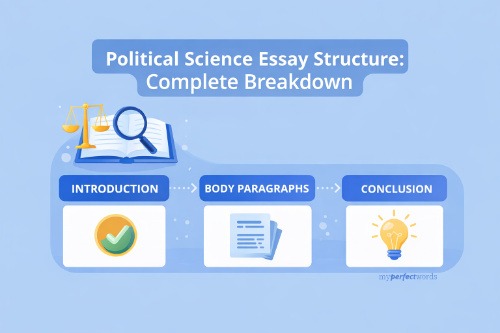
Regardless of type, all political science essays follow organizational principles that support clear political argument. The basic structure includes three components:
| An introduction that establishes context and presents your thesis, a body that presents evidence systematically and integrates theory throughout, and a conclusion that synthesizes your argument and discusses broader implications. |
Several political science-specific structural elements distinguish these essays. You'll integrate theory throughout your analysis, not just mention it once. Your evidence must come from appropriate sources: peer-reviewed scholarship, empirical data, or primary documents. Your analysis must move beyond description, every section should explain significance and connect to your thesis. And you must engage with counterarguments.
Different essay types require specific structural approaches. Comparative essays might use point-by-point comparison or block comparison. Theoretical essays may need dedicated theory sections. Policy evaluations follow a problem-policy-evaluation flow.
For a detailed breakdown of how to structure each type of political science essay, including templates and organization strategies, see our complete guide to political science essay structure.
Choosing Your Political Science Essay Topic
Before you can structure your essay, you need a strong topic. Not all topics work equally well, some are too broad, others too narrow, and some lack analytical potential.
A strong political science topic is specific enough to be manageable within your word limit. "Democracy" is too broad; "factors explaining democratic backsliding in Hungary between 2010 and 2020" gives you clear boundaries. It has analytical potential, you must be able to explain and analyze, not just describe. The scope is feasible given your time and resources. Source availability matters, you need access to scholarly sources and evidence. And it's theory-relevant, connecting to political science frameworks.
Common topic pitfalls include topics that are too broad ("American politics"), too narrow ("City council vote on March 15, 2024"), purely descriptive ("What NATO does"), or opinion-based ("Why my preferred policy is best").
The topic selection process should be systematic. Start with course themes to ensure your topic connects to frameworks you're studying. Narrow from broad area to specific question. Verify that sources are available. Ensure an analytical angle exists, can you explain why something happened? Check that scope is manageable.
Consider the difference between weak and strong topics. A weak topic like "The role of political parties" is too vague and descriptive. A strong topic like "How candidate-centered campaigning weakened party loyalty in US elections from 1960 to 2000" is specific, analytical, and scoped appropriately.
Need specific topic ideas? Browse our comprehensive list of political science essay topics organized by subfield, with guidance on how to develop and narrow your topic.
Conducting Political Science Essay Research
Once you have your topic, conduct research that will support a strong political science argument. Political science research draws on several distinct types of sources.
Primary sources provide original evidence and data. In political science, these include government documents (legislation, treaties, court decisions), statistical data (election results, economic indicators), speeches from political actors, party platforms, survey data, and historical documents. Use primary sources to provide evidence of what happened or what was said. Find them through government websites, data repositories, and archives.
Secondary sources offer scholarly analysis and interpretation. These include peer-reviewed journal articles, academic books published by university presses, high-quality think tank reports, and book chapters in edited volumes. Use secondary sources to understand existing scholarship, theoretical frameworks, and prior analysis. Find them through academic databases like JSTOR or Google Scholar. Quality check: look for peer review and publication by academic presses.
Current events sources provide contemporary context from major newspaper reporting (New York Times, Washington Post), news agencies (Associated Press, Reuters), and specialized political publications (Politico, The Hill). Use current events sources for facts and events that provide context, but exercise caution. These sources report what's happening but don't typically offer the theoretical analysis political science requires.
The research process should follow a systematic approach. Start with a literature review: what have scholars said about your question? What theories do they apply? Begin with course readings and branch out from their citations.
Evaluate sources carefully using credibility and relevance checks. For credibility, ask whether the source is peer-reviewed, who the author is, and what credentials they have, when it was published, and whether other scholars cite it. For relevance, consider whether it addresses your specific question and provides the evidence or theory you need.
Developing Your Political Science Essay Argument
With strong research in hand, you're ready to develop a political science argument. This is where your essay moves from information gathering to analysis.
A political science argument is not simply an opinion or claim. It's an evidence-based explanation grounded in political science theory. It's theory-informed, addresses alternative explanations, and makes a contestable claim, something others could reasonably disagree with.
Consider the difference between opinion and political science argument.
Saying "Congress should pass more bipartisan legislation" is an opinion.
A political science argument would be: "Institutional changes since the 1970s, particularly primary system reforms and party polarization, have reduced incentives for congressional bipartisanship." This second statement is evidence-based, theory-informed, and contestable.
Crafting your Thesis Statement
This requires attention to specific components. A strong thesis makes a specific claim rather than a vague statement. It's arguable; someone could disagree with reasonable evidence. It's supported by evidence you can actually access. It's theory-connected, relating to political science frameworks. And it's scoped appropriately to fit your essay length.
Watch how a thesis can evolve from too vague to appropriately specific. "Political parties have changed in recent decades" is too vague. "Republican and Democratic parties have become more ideologically homogeneous since 1980" is better.
The best version: "Candidate-centered campaigns and primary reforms have increased ideological homogeneity within Republican and Democratic parties, reducing cross-party cooperation in Congress."
Integrating Theory into your Argument
This distinguishes political science from journalism. Theory provides a framework for analysis, connects your specific case to broader patterns, allows for generalization beyond a single case, and shows your engagement with the discipline.
To choose relevant theory, ask what theories are discussed in your course or readings. What frameworks do scholars use when studying your topic? Which theory best helps explain the patterns you're observing? Common political science theories include institutional theory, rational choice theory, constructivism, realism and liberalism in international relations, and party system theories.
Addressing Counterarguments
This is essential for strong political science writing. It shows analytical sophistication, strengthens your argument by anticipating objections, and demonstrates awareness of alternative explanations.
To address counterarguments effectively, identify the strongest alternative explanation. Acknowledge its merits honestly. Explain why your argument is more compelling with specific reasons and evidence.
| For example: "While some scholars attribute congressional gridlock primarily to partisan media (Smith 2020), institutional factors provide a more complete explanation because they account for both the timing of polarization increases and the persistence of polarization across varying media environments." |
Running Out of Time for Your Essay?
Our expert writers deliver quality political science essays fast.
Focus on understanding concepts while we handle the writing.
Applying Political Theory to Your Political Science Essay
Theory application distinguishes political science from descriptive writing about politics. Theory is not optional decoration, it's the lens through which you analyze evidence. Theory connects your specific case to broader patterns, allows for explanation and prediction, and demonstrates you're engaged with the political science discipline.
Applying theory effectively requires a systematic approach.
First, select appropriate theory by asking what theories relate to your topic and which theory helps explain what you're analyzing. Don't force theory onto evidence it doesn't fit.
Second, explain the theory briefly. Provide two to three sentences on core principles, focusing on aspects relevant to your argument. Cite the original theorist. For example: "Institutional theory suggests that political outcomes are shaped by formal rules and informal norms that structure actor behavior (March and Olsen 1984)."
Third, connect theory to evidence. Show explicitly how theory helps explain your case. Point to specific evidence that aligns with theoretical predictions. For example: "Senate filibuster rules created incentives for minority party obstruction, as institutional theory would predict. This is evident in the 300% increase in cloture motions from 1970 to 2020."
Fourth, acknowledge limitations. No theory explains everything perfectly. Noting where theory fits well and where it has limits shows analytical sophistication.
Common mistakes in theory application weaken many essays. Some essays have no theory at all, they're purely descriptive. Some name-drop theory but don't actually apply it. Some over-theorize, becoming all theory with little evidence. Some force theory onto evidence it doesn't explain well. Balancing theory and evidence requires getting the mix right. Theory should provide your framework (roughly 20-30% of your essay), evidence should provide substance (50-60%), and analysis should connect them (20-30%). Introduce theory early, return to it when analyzing each piece of evidence, and let theory illuminate your evidence without overwhelming it. |
Writing Your Political Science Essay (Step-by-Step)
Writing a political science essay is not a linear process. You'll move between steps, revising as you go. Here's a framework to guide you.
Step 1: Create an Outline
Include your thesis statement, main points (each will become a body paragraph), evidence supporting each point, where theory fits, and counterarguments you need to address. Outlining ensures logical flow and prevents rambling.
Step 2: Write the Introduction
Include a hook (interesting fact, question, or contemporary example), context explaining why this topic matters, your thesis clearly stated, and a roadmap previewing your main points. Some writers draft the introduction last, after they know exactly what they're introducing. That's fine.
Step 3: Write Body Paragraphs
Strong body paragraphs follow a standard structure: topic sentence stating the main point, evidence from your research, analysis explaining what the evidence means, theory connection showing how political science theory helps explain what you're observing, and a link connecting this point back to your thesis.
Follow these principles: one main point per paragraph, evidence must directly support that point, don't just present evidence, analyze its significance, and use transitions between paragraphs.
Step 4: Address Counterarguments
You can address counterarguments in a dedicated paragraph before your conclusion or throughout the body. Either approach works. State the strongest alternative explanation clearly, acknowledge its evidence or logical appeal, explain why your argument is stronger with specific reasons, and support your position with additional evidence.
Step 5: Write the Conclusion
Restate your thesis using different wording, summarize key evidence briefly without introducing new evidence, discuss broader implications of why your analysis matters beyond the specific case, and end with a final thought or question for further research.
Step 6: Revise and Edit
Revision addresses big-picture issues: Does your thesis appear in the introduction? Does each paragraph support your thesis? Is theory applied consistently? Are counterarguments addressed? Editing addresses sentence-level issues: Are sentences clear? Is writing appropriately formal? Are all sources cited correctly? Take a break between writing and revising if possible.
Common Mistakes to Avoid in a Political Science Essay
Mistake 1: Description Instead of Analysis
This appears when you summarize what happened without explaining why. There's no theory or interpretation. Instead of "Congress passed the Affordable Care Act in 2010. Some states opposed it," write "Congressional passage of the ACA demonstrates partisan polarization's impact on legislative process. Zero Republican votes reflected institutional incentives for party-line voting (Lee 2009)."
| Fix this by asking "Why?" after each fact and connecting evidence to theory. |
Mistake 2: Unsupported Claims
Making arguments without evidence or presenting generalizations without data weakens your essay. Instead of "Everyone knows partisan media causes polarization," write "Scholars debate partisan media's role, with some finding significant effects (Stroud 2011) while others emphasize selective exposure limitations (Prior 2013)."
| Ensure every claim has a citation. |
Mistake 3: Weak or Missing Theory
Some essays have no mention of political science theory, name-drop theory but never apply it, or use theory from the wrong discipline. Instead of "People vote for candidates they like," write "Rational choice theory suggests voters select candidates who maximize their expected utility based on policy preferences (Downs 1957)."
| Identify which political science theory applies and show how it illuminates your case. |
Mistake 4: Ignoring Counterarguments
Only presenting evidence supporting your thesis or not acknowledging alternative explanations weakens your argument. Address the strongest alternative explanation and explain why your argument is more compelling.
Mistake 5: Poor Source Quality
Relying on Wikipedia, general websites, or op-eds instead of peer-reviewed articles and academic books undermines your credibility. Use academic databases and check whether sources are peer-reviewed.
Strong Political Science Essay Examples
Understanding theory, structure, and process is essential, but seeing these principles in action can solidify your understanding.
| Examples matter because they show theory application in practice, demonstrate what strong analysis looks like, help you identify effective techniques, and make abstract principles concrete. Seeing how other students successfully integrated theory, structured arguments, and analyzed evidence can help you do the same. |
When studying example essays, examine the thesis strength. Is it specific and arguable? Notice theory application, how is theory introduced and used? Assess evidence quality. What types of sources are cited? Analyze analysis depth, does it go beyond description? Observe structure logic and see how counterarguments are handled.
For annotated political science essay examples across different subfields, with detailed breakdowns showing what makes them strong, see our collection of political science essay examples.
Conclusion
Political science essays are distinct from other academic writing because they're evidence-based, theory-informed, and analytically focused. Success requires understanding your essay type and applying appropriate structure. Strong political science essays connect theory to evidence systematically, showing not just what happened but why it happened using frameworks political scientists employ.
Research quality matters tremendously, you need scholarly sources and primary data, not just general websites. Theory application is non-negotiable because it's what transforms description into political science analysis. Avoid common mistakes like description without analysis, missing theory, weak sources, and unsupported claims.
Writing political science essays becomes easier with practice. Your first few essays might feel challenging as you learn to integrate theory and analyze rather than just describe, but this skill develops over time. Start early, use the process outlined here, and don't hesitate to seek help from professors during office hours. If you still need help, we have an essay writing service waiting to cater to all your needs.
Remember, political science writing isn't about having all the answers; it's about asking good questions and analyzing them systematically using appropriate frameworks and evidence. Whether you're analyzing American institutions, comparing electoral systems, applying political theory, or evaluating policies, the principles in this guide will serve you throughout your coursework.
Ready to Submit an Excellent Political Science Essay? Let our political science experts handle the heavy lifting. 3-hour rush delivery available.