Why Structure Matters in Political Science Essays
Political science essay structure is the organizational framework that determines where thesis, theory, evidence, and analysis appear in your essay.
Structure is how you present your argument logically. Political science focuses on causal relationships and evidence-based claims; you're explaining why events happen, how institutions function, or what causes political outcomes. Your structure shows readers how your argument unfolds, guiding them through your logic step by step.
Professors assess organization as part of analytical thinking. Political science essays aren't "describe and discuss" assignments where you simply report information. They're "argue with evidence and address counterarguments" assignments where you make and defend specific claims. Structure supports this analytical approach by creating clear paths from thesis to evidence to conclusion.
Poor structure makes even strong arguments hard to follow. You might have excellent research, compelling evidence, and sophisticated analysis, but lose significant points because readers can't track your logic. When your structure is unclear, readers struggle to understand which points support your thesis and how pieces fit together. Structure is the roadmap your reader follows through your evidence and analysis.
Different questions require different structures. An argumentative essay about why revolutions occur needs different organization than a comparative essay examining electoral systems. A theoretical analysis applying Hobbes to modern states organizes differently from a policy evaluation assessing universal basic income. Matching structure to essay type is essential for political science success.
Basic Political Science Essay Structure
All political science essays share common components, though emphasis varies by type. Understanding this universal framework helps you adapt to different assignments while maintaining core organizational principles.
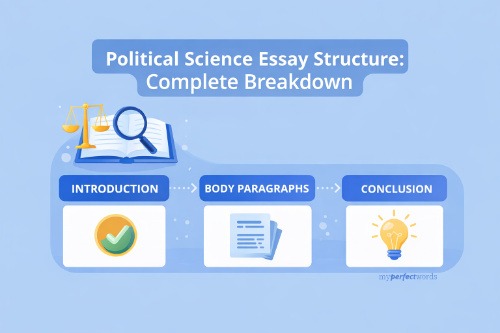
Introduction (10-15%): Hook/context that draws readers in, research question or puzzle you're addressing, thesis statement presenting your argument, and roadmap previewing your structure. Body (70-80%): Theory or framework (if applicable) explaining your analytical approach, evidence and case studies supporting your claims, analysis connecting evidence to thesis and explaining significance, and counterarguments with your responses showing you've considered alternatives. Conclusion (10-15%): Restate thesis in fresh language, synthesize evidence to show how pieces fit together, discuss broader implications of your findings, and suggest future research directions. |
Here's the specific breakdown:
- Introduction (10-15%) sets up your argument and tells readers what to expect.
- Body (70-80%) develops your argument, theory (if applicable) takes 15-20%, evidence and analysis use 50-60%, and counterarguments require 10-15%.
- Conclusion (10-15%) wraps up your argument without introducing new evidence.
For a 2,500-word essay:
- Intro (250-375 words)
- Body (1,750-2,000 words)
- Conclusion (250-375 words).
For a 1,500-word essay:
- Intro (150-225)
- Body (1,050-1,200)
- Conclusion (150-225).
For a 5,000-word research paper:
- Intro (500-750)
- Body (3,500-4,000)
- Conclusion (500-750).
Political science structure differs from other disciplines in specific ways. Theory integration provides frameworks for understanding political phenomena. Evidence-based argumentation relies on data and case studies rather than personal opinion. Counterargument engagement strengthens rather than weakens your case by showing you've thoroughly considered alternatives. Formal academic tone is maintained throughout, reflecting the scholarly nature of political science inquiry.
Introduction Structure
Strong introductions follow a specific pattern.
Hook (1-2 sentences): Start with an interesting statistic, question, or example. "Why do some democracies collapse while others endure?"
Context/Background (2-3 sentences): Brief context for your question. Establish why this matters.
Research Question (1 sentence): "This essay examines whether economic inequality drives democratic backsliding."
Thesis Statement (1-2 sentences): Your answer, specific and contestable. "I argue that rising economic inequality, combined with weak institutions, creates conditions for democratic erosion."
Roadmap (1-2 sentences): Preview your argument. "First, I examine theories of democratic stability. Then I analyze three case studies."
Avoid: Starting too broad, dictionary definitions, restating the assignment, or giving away your entire argument.
For detailed guidance on thesis development, see our guide on how to write a political science essay.
Body Paragraph Structure
Political science body paragraphs follow specific anatomy. Each element serves a purpose in building your argument.
Topic Sentence (1 sentence): State the paragraph's main point. Connect it directly to your thesis.
Example: "Economic inequality weakens democratic institutions by reducing citizens' political participation."
Theory/Explanation (1-2 sentences): Explain why this point is true. What's the causal mechanism? Reference political theory if applicable.
Example: "Lipset's modernization theory suggests economic resources enable democratic engagement. When inequality concentrates wealth, marginalized groups lack the resources necessary to participate effectively in politics."
Evidence (2-4 sentences): Present concrete data, case study facts, or scholarly citations. Be specific with numbers, dates, and sources.
Example: "In Hungary, income inequality rose 15% between 2010-2020. During the same period, voter turnout in lower-income districts dropped from 68% to 52% (Smith 2021). Participation in local civic organizations also declined by 30% in these communities."
Analysis (2-3 sentences): Explain what the evidence means. How does it support your claim? This is critical; don't just present evidence, analyze it. Show the connection to your argument.
Example: "This decline suggests economically marginalized citizens withdrew from democratic processes as inequality rose, validating resource-based participation theory. The parallel drop in civic engagement indicates economic factors affect multiple participation channels, not just voting."
Transition (1 sentence): Connect to your next point. Maintain argument flow.
Example: "While economic factors matter, institutional weakness amplifies these effects."
Typical paragraphs run 150-250 words and contain one main point each. If your paragraph exceeds 300 words, it's probably covering multiple points and should be split into two paragraphs. If it's under 100 words, you likely need more evidence or analysis.
Structure for Argumentative Political Science Essays
Argumentative essays make specific claims about political phenomena. You're arguing for a particular explanation, answering "why" or "how" questions.
- Introduction (10-15%): Hook, research question, clear thesis, roadmap.
- Theoretical Framework (15-20%): Relevant political theories, your theoretical approach, why this theory applies.
- Evidence & Analysis (40-50%): Multiple pieces of evidence (3-5 depending on length). Analyze each piece. Connect explicitly to thesis. One body paragraph = one piece of supporting evidence.
- Counterarguments (10-15%): Acknowledge alternative explanations. Present opposing evidence. Explain why your argument is stronger.
- Conclusion (10-15%): Restate thesis, synthesize evidence, discuss implications, note future research needs.
Visual structure:
INTRO: State your claim
THEORY: Explain framework
EVIDENCE 1, 2, 3: Support + analysis
COUNTERARGUMENTS: Address alternatives
CONCLUSION: Reinforce claim
Example with thesis "Economic sanctions rarely achieve political goals": Intro + Theory (coercion theory) + Iran case + North Korea case + Russia case + Counterarguments (South Africa) + Conclusion.
See argumentative structure in action at our political science essay examples.
Structure for Comparative Political Essays
Comparative essays examine two or more cases, identifying similarities and differences.
APPROACH 1: Point-by-Point Comparison
- Introduction + Thesis II. Comparison Point 1: Case A, Case B, Analysis III. Comparison Point 2: Case A, Case B, Analysis IV. Comparison Point 3: Case A, Case B, Analysis V. Synthesis & Conclusion
Best for: Highlighting differences, clear comparison dimensions, shorter essays (under 3,000 words). |
APPROACH 2: Block Comparison
- Introduction + Thesis II. Case A: Background, Features, Outcomes III. Case B: Background, Features, Outcomes IV. Direct Comparison: Similarities, Differences, Why differences matter V. Conclusion
Best for: Complex cases needing full context, 3+ cases, longer essays (3,000+ words). |
Use point-by-point for 2 cases with clear dimensions. Use block for 3+ cases needing full context.
Transition phrases: "In contrast to Case A...", "Similarly, Case B demonstrates...", "While X shows A, Y reveals B..."
Need comparison topics? Browse our political science essay topics guide.
Structure for Theoretical Analysis Essays
Theoretical analysis essays analyze political theory or apply theory to contemporary situations.
- Introduction (10-15%): Introduce theory/theorist, research question, thesis (your interpretation/application), roadmap.
- Theory Explanation (20-25%): Summarize relevant theory. Explain key concepts. Identify assumptions. Note original context.
- Theory Application/Analysis (40-50%)
- Option A - Testing Theory: Apply theory to case. Does theory explain outcomes? Evidence supporting/contradicting theory.
- Option B - Evaluating Theory: Assess logical consistency. Evaluate normative implications. Compare to alternatives.
- Counterarguments/Limitations (10-15%): Acknowledge weaknesses. Address criticisms. Explain scope conditions.
- Conclusion (10-15%): Synthesize analysis. Assess theory's value. Discuss modern relevance.
What you emphasize depends on assignment:
"Explain theory": 30-40% Theory Explanation.
"Apply theory to case": 50-60% Application.
"Evaluate theory": 60% Analysis + Counterarguments.
Visual:
INTRO: Thesis about theory
THEORY: What does it say?
APPLICATION/EVALUATION
LIMITATIONS
CONCLUSION
Short on Time for Your Political Science Paper? Our expert writers deliver quality political science essays fast. Focus on understanding concepts while we handle the writing.
Structure for Policy Evaluation Essays
Policy evaluation essays assess specific policies or programs.
- Introduction (10-15%): Identify problem, state policy being evaluated, thesis (your evaluation), preview criteria.
- Policy Problem & Context (15-20%): Define problem. Why significant? Who's affected? Historical context.
- Policy Description (10-15%): What does policy do? Mechanisms. Timeline. Stakeholders.
- Evaluation Criteria (10%): State assessment standards. Common: effectiveness, efficiency, equity, feasibility.
- Policy Evaluation (35-40%): For each criterion, assess performance, present evidence, compare to alternatives. One subsection per criterion.
- Alternative Approaches (10-15%): Discuss policy alternatives. Why evaluated policy is better/worse. Trade-offs.
- Recommendations & Conclusion (10-15%): Overall assessment. Specific recommendations. Implementation considerations.
Choose criteria based on goals:
Technical problem: effectiveness/feasibility.
Reduce inequality: equity/accessibility.
Improve efficiency: cost-benefit.
Visual:
INTRO
PROBLEM
POLICY
CRITERIA
EVALUATION (Criterion 1, 2, 3)
ALTERNATIVES
CONCLUSION
Where Theory Fits in Your Structure
Theory placement depends on essay type and theory's role.
Dedicated Theory Section (Early): When theory is central framework. Place after introduction. 15-25% of essay. For essays applying rational choice theory or Marxist frameworks. Integrated Throughout: When using multiple theories. Introduce as needed. For comparative essays using different theories per case. Within Literature Review: For research papers with extensive secondary sources. Best for 5,000+ words. |
How much theory: Argumentative (10-15%), Theoretical Analysis (25-35%), Comparative (15-20%), Policy Evaluation (5-10%).
Balance theory and evidence. Don't spend entire essay on theory without application. Don't use theory as filler. Do explain only relevant theory. Connect theory to evidence explicitly. Balance theory (20-30%) with evidence/analysis (60-70%).
Weak: "Democratic peace theory says democracies don't fight. Doyle wrote about this. Now I'll discuss India-Pakistan." Strong: "Democratic peace theory predicts democracies rarely wage war due to shared norms (Doyle 1983). This suggests India-Pakistan conflict should have decreased as both democratized. However, the Kargil War (1999) reveals democratic institutions alone cannot overcome territorial disputes." |
Organizing Evidence and Case Studies
Single Case Study: Chronological (by time periods) or Thematic (by dimensions like political, economic, social).
Multiple Case Studies:
- Separate Case Sections: Full analysis of each, then cross-case comparison (best for 3+ complex cases)
- Thematic Cross-Case: Each theme shows all cases' evidence, then analysis (best for testing variables)
- Nested Cases: Primary case (60%), secondary cases confirming pattern, exception explained (best for one main case with supporting examples)
Evidence organization rules: Most compelling evidence first. Group related evidence. Explicit connections to thesis. Balance across cases.
Conclusion Structure
- Restate Thesis (1-2 sentences): Paraphrase. Reflect completed analysis. "The evidence presented demonstrates that..."
- Synthesize Key Evidence (2-3 sentences): Reference main points. Show how pieces fit. "Analysis of three case studies revealed consistent patterns: economic inequality preceded backsliding (Hungary, Poland), while stable economies maintained democracy (Czech Republic)."
- Address Limitations (1-2 sentences): Acknowledge scope. Note remaining questions. "While this focused on economic factors, cultural and institutional variables warrant further examination."
- Broader Implications (1-2 sentences): Why does your argument matter? Real-world significance. "These findings suggest policymakers should prioritize economic redistribution as democracy protection."
- Future Research (1 sentence) [Optional]: What should scholars study next?
Conclusion length: 1,500-word essay (150-200), 2,500-word essay (200-250), 3,500-word essay (250-300).
Don't: Start with "In conclusion." Copy-paste introduction. Introduce new arguments. End with clichés. Apologize.
Do: Synthesize concisely. Show confidence. Connect to significance. End strong.
Common Structure Mistakes
MISTAKE 1: Weak Thesis Placement
Problem: Thesis hidden or absent. Fix: Place at end of introduction. Make specific and clear. |
MISTAKE 2: Unbalanced Sections
Problem: Introduction 30%, body 50%. Fix: Introduction 10-15%, Body 70-80%, Conclusion 10-15%. |
MISTAKE 3: Theory Without Application
Problem: Pages of theory without connecting to case. Fix: Theory 15-20% maximum. Every theory paragraph needs "This explains my case because..." |
MISTAKE 4: Evidence Without Analysis
Problem: Listing facts without significance. Fix: Every evidence sentence needs 1-2 analysis sentences. Formula: Evidence + Analysis (why it matters). |
MISTAKE 5: Missing Transitions
Problem: Choppy, disjointed. Fix: Last sentence previews next section. First sentence links to previous. |
MISTAKE 6: Poor Topic Sentences
Problem: Unclear paragraph focus. Fix: First sentence states main point clearly. |
MISTAKE 7: Ignoring Counterarguments
Problem: Incomplete argument. Fix: Dedicate 10-15% to counterarguments. State fairly, explain why yours is stronger. |
MISTAKE 8: Conclusion as Summary Only
Problem: Just repeating introduction. Fix: Go beyond restating. Synthesize how evidence supported argument. Add implications. |
Conclusion
Political science essay structure varies by type, argumentative, comparative, theoretical, and policy essays each have distinct organizational requirements. All essays share a basic framework: introduction, body, conclusion. Theory placement depends on essay type. Avoid common mistakes like weak thesis placement, unbalanced sections, and missing analysis.
Once you identify your essay type and follow the appropriate template, organization becomes straightforward. You're applying proven organizational patterns political scientists use.
Strong structure is your argument's foundation. Get the organization right, and your evidence and analysis will shine.
Ready to Submit an Excellent Political Science Essay?
Let our experts handle the heavy lifting.
- Political science PhDs and grad students
- Proper structure and theory integration
- AI detection reports included
- Revisions until you're satisfied
3-hour rush delivery available.
Place Your Order