What Is Coursework? (The Quick Answer)
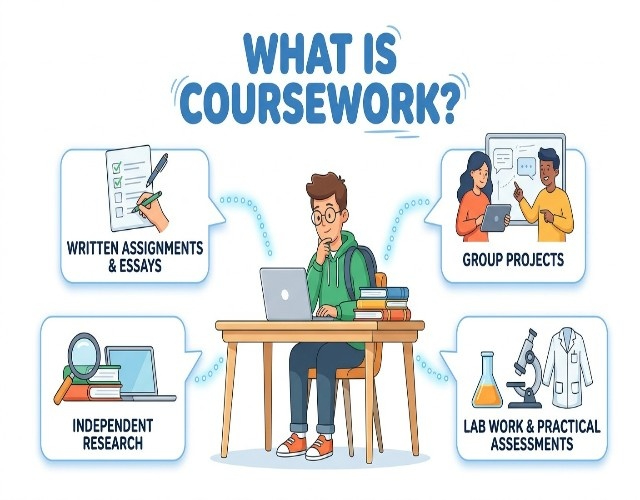
Coursework is extended academic work completed over a set period, assessed as part of your final grade. Unlike a timed exam, you're given days or weeks to research, plan, write, and refine your response.
It can take a lot of different forms depending on your subject:
What stays consistent is that it's formally submitted and marked, and it typically carries 20 to 40% of your final grade. That's not something you want to wing. |
"Coursework is your chance to show depth of understanding over time, not just what you know on the day."
Writing Coursework Step by Step
Follow these steps to plan, research, write, and refine your coursework effectively while keeping your ideas clear, structured, and academically strong.
Step 1: Understand the Brief Before You Do Anything
This is the most skipped step, and it's the most expensive mistake you can make. Students dive straight into research or start writing before they've actually understood what they're being asked to do. Hours later, they realise they've answered the wrong question.
Understanding the brief means identifying:
|
Practical tip: print the brief and annotate it. Circle the command words: analyse, evaluate, discuss, compare. These aren't decorations. They define what your marker expects you to do with the topic, and getting this wrong means losing marks even if your content is good.
Step 2: Choose (or Refine) Your Coursework Topic
If your topic is assigned, your job is to angle it well within the brief. Think about what argument or position you can take that's genuinely supportable with the sources available to you.
If your topic is open, you need to find something specific enough to argue but broad enough to meet your word count. "Climate change" is too broad. "The impact of carbon pricing on consumer behaviour in the UK" is workable.
A quick test: run a Google Scholar search before you commit to a topic. If you can't find five or six credible sources in ten minutes, pick something else. Running out of sources mid-project is a painful position to be in.
"The best topic is one you can actually argue, not just describe."
Step 3: Research the Right Way
Don't just collect everything and hope it's useful. Before you start, know what you're actually looking for. What does your argument need? Evidence that supports your position, evidence that complicates it, and context that frames the whole thing.
There are two types of sources worth distinguishing:
|
You need both. Descriptive sources give you context. Argumentative ones give you material to engage with.
For most university coursework, 8 to 12 solid sources is a reasonable target. More isn't always better; five sources you've actually read and understood will serve you better than twenty you've skimmed.
Keep track of everything as you go. A simple table in Google Scholar notes, or a citation manager like Zotero will save you hours at the referencing stage.
| What to avoid: Wikipedia as a primary source, studies older than your brief suggests, and anything you can't actually access in full. |
Step 4: Plan Your Coursework Structure
Planning before you write isn't a delay; it saves hours of painful editing later. If you know what you're arguing before you write a single sentence, you'll write faster and more clearly.
The standard coursework structure has three parts:
Introduction Your intro needs to do three things: set the context, establish your argument or focus, and tell the reader how the piece is structured. It doesn't need to be long. Around 10% of your total word count is the right proportion. What it doesn't need: a definition of terms that takes up half the page, or a long history of the topic before you get to the actual question. Body This is where 80% of your word count lives. Each section should advance your argument, not just add more information. A useful test for every paragraph: does this section move my argument forward, or is it just background? Organise your body sections around your argument, not around the chronology of your sources. If your structure is "I read Source A, then Source B, then Source C," you're describing your research process, not making an argument. Conclusion A conclusion synthesises, it doesn't summarise. You're not just repeating what you said. You're explaining what it means, what it adds up to, and what it implies. The last 10% of your word count should feel like an earned landing, not a list of things you already covered. |
Step 5: Write the First Draft
The point of a first draft is to get it out, not get it perfect. Trying to perfect every sentence as you write is how students miss deadlines and lose momentum.
Writing your introduction: Context, then argument, then roadmap. One paragraph that tells the reader what you're arguing and how the piece is organised. That's it.
Writing body paragraphs: The PEEL structure works well here, Point, Evidence, Explanation, Link. Make your point, bring in evidence to support it, explain what the evidence means in the context of your argument, then link back to the question or your broader thesis.
Writing your conclusion: Don't restate your introduction. Instead, pull together what your argument has established and explain its significance. What does this actually mean? What's the bigger picture?
| On tone: aim for academic but clear. You're not trying to impress anyone with complexity. The clearest, most direct version of your argument will always land better than a convoluted one dressed up in formal language. |
"Your first draft is meant to be rough. Trying to perfect it as you go is how students miss deadlines."
Step 6: Reference Coursework Correctly
Referencing isn't just about avoiding plagiarism, it signals academic credibility to your marker. A well-referenced piece tells them you've engaged seriously with the literature.
The three most common referencing styles are:
Always check your brief for which one you're required to use. If it's not specified, ask before you submit.
The most common referencing mistakes: in-text citations that don't match your reference list, wrong format for online sources, and inconsistent formatting throughout. These are easy marks to lose because they're entirely fixable.
| Practical tip: Use citation style guides or a reference manager throughout the writing process, not at the end. Doing it retrospectively is slower and more error-prone. |
Running Out of Time on Your Coursework?
Let a human writer take it from here. Deadline matched, zero AI.
100% human-written coursework, every time
Step 7: Edit, Proofread, and Review Your Coursework
Editing and proofreading are different passes. Don't try to do both at once.
Editing pass, look at the big picture:
Proofreading pass, look at the detail:
|
The read-aloud test is genuinely useful: read your work out loud. Anything that sounds awkward when spoken probably needs rewriting. If you stumble over a sentence, your reader will too.
| Before you submit: check the submission requirements one more time. File format, submission portal, whether you need a cover sheet, these things catch people out at the last minute. |
How Coursework Writing Differs Across Countries
1. United Kingdom (UK)
Coursework in the UK often emphasizes critical analysis, independent research, and structured arguments. Universities commonly use Harvard referencing, and assignments may include essays, reports, and case studies.
2. United States (USA)
In the US, coursework focuses on analytical thinking, discussion-based writing, and clear thesis statements. Students often use APA or MLA citation styles, and assignments may include essays, research papers, and reflective writing.
3. Australia
Australian coursework prioritizes evidence-based arguments, academic integrity, and clear structure. Universities frequently use APA or Harvard referencing, and assignments often involve research essays and reports.
4. Canada
Canadian coursework combines research, critical thinking, and practical application of concepts. Citation styles such as APA, MLA, and Chicago are commonly used depending on the discipline.
5. Germany and Other European Countries
Coursework often requires in-depth theoretical understanding and strong academic research. Students are expected to provide detailed references and well-supported arguments.
6. Asian Countries (e.g., Singapore, India)
Coursework may focus on conceptual understanding, structured writing, and exam-based evaluation. Increasingly, universities also emphasize research skills and academic referencing.
| Understanding these differences can help students adapt their writing style, structure, and referencing methods when completing coursework for different academic systems. |
Common Coursework Mistakes to Avoid
Not reading the brief properly: It's the most common mistake and the most avoidable one. Spend 15 minutes on the brief before anything else.
Starting too late: Coursework requires time to let ideas develop. Work backwards from your deadline: set a research deadline, a first draft deadline, and an editing window. Don't leave it all to the last few days.
Writing descriptively, not analytically: Describing the topic is not the same as arguing something about it. Every section should be pushing your argument forward, not just adding information.
Ignoring word count limits: Going significantly over or under your word count signals poor scope management. Most submissions allow a 10% margin; stay within it.
Referencing at the end. Build your reference list as you write. Doing it all at the end creates errors and eats up time you don't have.
To Sum Up!
Writing coursework effectively requires understanding both the assignment requirements and the academic expectations of your country.
By following a clear step-by-step approach, conducting thorough research, organizing your ideas, and adhering to proper formatting and citation styles, you can produce high-quality, well-structured coursework.
Adapting your writing to the standards of different countries, whether the UK, USA, Australia, or elsewhere, ensures your work meets academic expectations and maximizes your grades.
With careful planning, attention to detail, and strong writing techniques, students can excel in coursework across any educational system.
Ace Your Coursework With Expert Help
Boost your grades and submit high-quality coursework with professional guidance tailored to your needs.
- Expert writers matched to your exact subject area
- Delivered before your deadline, rush orders accepted
- Zero AI content, Originality.ai verified on every order
- Unlimited Free Revisions
Get professional coursework writing support today and ensure your assignments stand out academically.
Get Coursework Writing Help