MyPerfectWords - Essay Writing Service
  • Writers
  • Services
    • Descriptive Essay
    • Argumentative Essay
    • Nursing Essay
    • History Essay
    • Research Paper
    • Term Paper
    • Thesis
    • Dissertation
    • Admission Essay
    • View All Services
  • About Us
  • Pricing
  • Samples
  • Blog
Place an Order
  • Login
  • Signup
MyPerfectWords - Essay Writing Service
MPW Logo
  • Writers IconWriters
  • Services IconServices
    • Descriptive Essay
    • Argumentative Essay
    • Nursing Essay
    • History Essay
    • Research Paper
    • Term Paper
    • Thesis
    • Dissertation
    • Admission Essay
    • View All Services
  • About Us IconAbout Us
  • Pricing IconPricing
  • Blog IconBlog
  • Account IconAccount
    • Login
    • Sign Up
Place an Order
Email Iconinfo@myperfectwords.comPhone Icon(+1) 888 687 4420

Home

>

Blog

>

How To Write Mba Essay

How to Write an MBA Essay (A Step by Step Guide That Actually Works)

CJ

Written ByCordon J.

Reviewed By Michael R.

13 min read

Published: Mar 3, 2026

Last Updated: Mar 3, 2026

How to Write an MBA Essay

You've been putting off this essay for weeks. Now the deadline is three weeks away, you've stared at a blank document for 20 minutes, and you're no closer to writing a single word. Sound familiar?

An MBA essay is a personal narrative that tells the admissions committee who you are beyond your GPA and test scores. It's the one part of the application that only you can write, which is why most applicants find it the hardest part.

This guide walks you through a clear 6-step process: from pre-writing exercises all the way to handling multiple school applications. No vague tips. Just a process you can actually follow.


Expert MBA Essay Help

Your MBA Essay, Written by Professionals

Order Now

100% human writers. Deadline-safe. Originality.ai verified.

Understanding MBA Essays
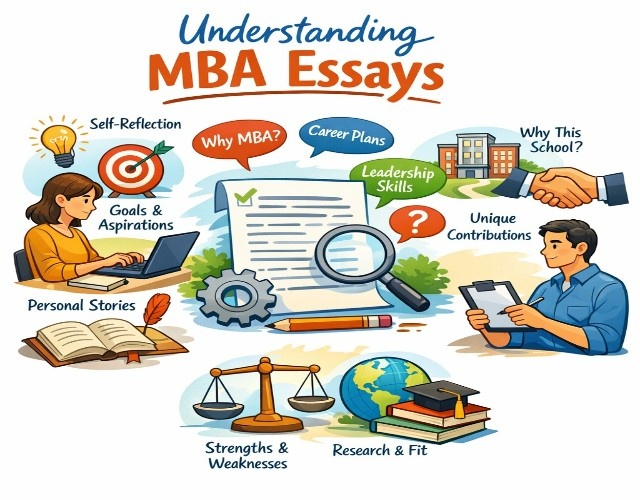
An MBA essay is a critical part of your business school application. It allows admissions committees to look beyond test scores and resumes to understand your personality, leadership potential, career goals, and overall fit with the program. Unlike academic essays, MBA essays are personal, strategic, and goal-oriented.

What Admissions Committees Actually Look For

Before you write anything, it helps to know who you're writing for.

AdComs read thousands of essays every cycle. They're not looking for the most impressive story. They're looking for self-awareness, clarity of purpose, and a narrative that holds together, someone who knows where they've been, where they're going, and why an MBA fits into that story.

Your essay is not a resume in paragraph form. Listing achievements without connecting them to a larger point is one of the most common mistakes applicants make. The committee already has your resume. The essay is where you explain what those achievements mean.

What they're specifically looking for:

  • Authenticity (specificity, not just vulnerability)
  • A coherent "why MBA, why now" narrative
  • Evidence you've researched the program
  • Proof you'll contribute to the class, not just benefit from it.

Your GPA and test scores are fixed. The essay is the one part of your application you can still get right.

The essay typically makes up around 15% of the application. That's not everything, but it's often the difference between two similarly qualified candidates.

Before You Write a Single Word (Pre-Writing Exercises)

Most applicants skip this part. Most applicants write three bad drafts, wondering why nothing feels right. Those two things are related.

Pre-writing is where you figure out what you actually want to say. The writing comes later.

Exercise 1: The "Why MBA?" Clarity Test

Answer these three questions in writing before you touch a prompt:

  • What specific skill or knowledge gap is holding back my career right now?
  • What do I plan to do in the five years after my MBA, specifically?
  • Why can't I get there without the degree?

If you can't answer these in two sentences each, you're not ready to write yet. That's not a criticism, it's useful information. Go work those out first.

Exercise 2: Career Story Mapping

Plot your professional journey as a 3-act arc.

  • Act 1: where you started and what you learned.
  • Act 2: a pivot, challenge, or moment that changed your direction.
  • Act 3: where you're headed and what's missing.

This arc becomes the backbone of almost every essay you write, regardless of the specific prompt.

Exercise 3: Differentiator Inventory

List 5 to 7 things about you that won't appear on your resume. Not awards or titles. Things like:

  • An unusual industry combination
  • A perspective shaped by living in three countries
  • A failure that taught you something most people in your field don't know. This is your raw material.

If you can't answer "why do I need an MBA right now" in two sentences, you're not ready to write yet.

How to Write an MBA Essay Step by Step

Step 1: Understand Your MBA Essay Prompt

Before you write a single word of your actual essay, read the prompt three times.

Most MBA prompts fall into a handful of categories: career goals, leadership examples, failure or challenges, community contributions, and "why this school."

A full breakdown of each type is in our guide to MBA essay topics, but for now, what matters is learning to read beneath the surface of any prompt.

Every MBA essay prompt, no matter how it's phrased, is asking the same thing: who are you, and why are you here?

"Tell us about a time you led through ambiguity" is asking who you are as a leader. "Why an MBA?" is asking you to prove you've thought this through. Even open-ended prompts like "share something about yourself" are asking you to show the committee something meaningful, not just interesting.

Use the "so what" test on your answer: whatever story or experience you plan to share, ask yourself what specific insight about you it reveals. If the answer is generic, hard worker, team player, resilient, go deeper or pick a different story.

Step 2: Find Your Story

This is where most applicants go wrong. They write the story that sounds most impressive rather than the most true one, and AdComs can tell the difference.

Pull out your differentiator inventory from the pre-writing phase. Look for the story that's specific to you, not just the story that looks best on paper. A startup failure you actually learned from is more compelling than a successful project you led but barely remember.

The specificity test: Can you name a date, a place, or a number? "In Q3 2022, when our team missed our launch deadline by three weeks..." is a story. "When I managed a difficult project..." is not.

One thing that surprises a lot of applicants: one strong story can answer many different prompts. The same experience can become a leadership essay, a failure essay, or a contribution essay depending on what angle you take. You don't need a different story for every prompt. You need a flexible story that reveals who you are.

Expert Tip

Admissions committees read thousands of essays about successful projects. They remember the ones that feel real.

Step 3: Structure Your MBA Essay

Structure isn't about following a template. It's about making sure your reader knows where they are and what to pay attention to at every moment.

A framework that works for most MBA essays:

  • Hook: Drop the reader into a specific moment, contrast, or question
  • Context: Brief background, who you were, what was at stake
  • Conflict or challenge: The real problem, the pressure, the decision you had to make
  • Action: What you did, specifically, not "I led the team" but what you actually did
  • Result and reflection: What happened, and what it tells us about who you are now

For detailed word count guidance and format requirements by school, see our guide to MBA essay format and word count requirements.

Three opening lines that work:

  • Starting mid-scene (in-media-res),
  • A contrast ("I've failed at more things than most people have tried")
  • A specific detail that creates immediate texture. 

What doesn't work:

  • Starting with "I was born in..."
  • "Since I was a child, I've always known..."

Your opening line has to earn the next sentence. If it doesn't stop someone mid-scan, rewrite it.

Close by circling back to where you started. A "full circle" ending, where your conclusion echoes your opening, creates a sense of intention. It signals that the essay was crafted, not just written.

Step 4: Write Your First MBA Essay Draft 

Give yourself permission to write a bad first draft. Not a mediocre one. A genuinely bad one. That's the goal.

The first draft's job is to exist. Editing nothing is impossible. You need words on the page before you can improve them.

A few rules that make first drafts easier:

  • Write to the word count from the start. If your target is 500 words, don't write 1,200 and cut later. That's a different and harder task.
  • One idea per paragraph. If a paragraph is trying to do two things, split it.
  • Write like you talk, not like you email your boss. "I leveraged cross-functional synergies" is not how any person has ever spoken out loud.
  • Flag problems instead of fixing them. If a sentence feels off, write [FIX THIS] and keep moving. You're drafting, not editing.

Red flags to skip in this draft:

  • Passive voice ("was achieved by" instead of "I achieved")
  • Vague language ("various stakeholders," "many challenges")
  • Telling without showing ("I'm a strong leader" instead of describing a moment that proves it).

The first draft isn't supposed to be good. It's supposed to exist.

Struggling to Get Your Draft Started?

Our expert writers turn your story into a compelling MBA essay, fast.

Get MBA Essay Writing Help

Writers matched to your target school and industry

Step 5: Edit and Revise Your MBA Essay

Wait at least 24 hours before reading your first draft back. You'll catch things you'd miss immediately after writing, because your brain will read what it intended to write instead of what's actually there.

When you're ready, edit in three passes:

Pass 1: Content. Does every paragraph answer the prompt? Does every section earn its place in the essay? Does your story land on a clear, specific insight about you? Cut anything that doesn't pull its weight.
Pass 2: Voice. Read the essay out loud. Every sentence that makes you stumble is a sentence that needs rewriting. You're looking for moments where you sound like you're writing a report, not talking to a person.
Pass 3: Cut. Most first drafts are 20% longer than they need to be. Find the padding and remove it. Filler phrases like "in order to," "it is important to note that," and "as previously mentioned" can almost always go.

If you can cut a sentence and the paragraph still makes sense, cut it.

Red flags to find in this pass:

  • Clichés ("thinking outside the box")
  • Restating your resume ("as seen in my work experience")
  • Humblebragging that reads like bragging ("despite being the youngest person ever to...").

After revisions, get one outside reader who'll give you hard feedback, not just reassurance. Someone who knows nothing about your industry is often better than someone who does.

Step 6: How to Apply to Multiple Schools Without Starting Over

If you're applying to six schools, you're not writing six essays. You're writing one strong core narrative and customizing 30% of it per school.

Here's how the 70/30 rule works:

The 70% that stays the same: your core story, your career arc, your differentiators, your voice. This is you. It doesn't change school to school.

The 30% that changes: the "why this school" section, references to specific programs or clubs or faculty, and language that mirrors what each school values. Wharton talks about leadership. Booth talks about independent thinking. Kellogg talks about collaboration. Your essay should reflect that you've paid attention.

What to research for each school:

  • The curriculum structure
  • Two or three specific programs
  • Concentrations relevant to your goals
  • One or two student organizations
  • If possible, something the school is known for in your target industry.

You don't need six different essays. You need one great story told six different ways.

This approach also makes later applications faster. Once your core narrative is solid, customization takes a few hours, not a few days.

Writing Tips to Write an Effective MBA Essay

Use the following expert tips to strengthen your MBA essay and make your application stand out.


  • Understand the Prompt Clearly: Analyze what the school is really asking before you start writing.

  • Show, Don’t Just Tell: Use specific examples, measurable achievements, and real experiences to demonstrate leadership and impact.

  • Be Authentic: Admissions committees value honesty and self-awareness over exaggerated claims.

  • Focus on Impact: Highlight results using numbers, outcomes, or tangible improvements you created.

  • Connect Past, Present, and Future: Clearly link your experiences to your career goals and explain how the MBA program fits into your plan.

  • Keep It Structured and Concise: Stay within the word limit and ensure each paragraph supports your main message.

  • Reflect on Growth: Show lessons learned from challenges or failures to demonstrate maturity.

  • Edit and Proofread Carefully: Eliminate grammar errors, repetition, and unclear sentences before submission.

Common MBA Essay Mistakes to Avoid

Here's what separates the essays that work from the ones that don't.

Sounding like your resume.

If someone could read your essay and think, "this is just his LinkedIn bio," start over. The essay should reveal things the resume can't.

Being vague about your goals.

 "I want to go into business" is not a goal. "I plan to join a mid-market private equity firm focused on healthcare infrastructure within two years of graduating" is a goal. Specificity signals that you've thought this through.

Forgetting to answer the prompt.

It happens more than you'd think. You write a great story, but it doesn't actually connect back to what was asked. Always check.

Overloading the essay. 

One story, told well, is better than three stories told quickly. Depth beats breadth.

Padding to hit the word count.

If you're adding sentences to reach 650 words rather than because you have something to say, that shows. Cut and rewrite until every sentence is doing real work.

The most common MBA essay mistake isn't bad writing. It's not having a clear point.

In Conclusion,

Writing a strong MBA essay requires clarity, strategy, and authenticity. By understanding the prompt, structuring your response effectively, and showcasing measurable leadership impact, you can create a compelling narrative that resonates with admissions committees.

A well-written MBA application essay connects your past achievements, present motivations, and future career goals clearly and purposefully.

Applying these MBA essay writing tips will help you stay within the required word count, maintain focus, and present your unique value confidently. With careful planning, thoughtful reflection, and thorough editing, you can craft an MBA essay that strengthens your application and increases your chances of admission to your target business school.

Ready to Submit a Standout MBA Essay?

Let our professional writers handle it, so you can focus on the rest of your application.

  • Subject-matched writers with business school expertise
  • Fast turnaround, get your draft in as little as 3 hours
  • Unlimited revisions until you're satisfied
  • Confidential, plagiarism-free, and 100% yours

Place your order in 2 minutes. Deadlines met, guaranteed.

Get Expert Help

Frequently Asked Questions

How long does it take to write a good MBA essay?

Most applicants underestimate this. A strong essay takes two to four weeks from first pre-writing exercises to a polished draft, not two to four days. Factor in revision time, outside feedback, and the waiting period before your final read-back.

Should I write about a failure or a success in MBA Essay?

Either can work. What matters is the quality of the reflection, not the outcome of the story. A failure with genuine insight is stronger than a success story with shallow takeaways. If you're writing about failure, make sure the weight of the essay lands on what you learned, not what went wrong.

Can I use the same MBA essay for multiple schools?

Use the same core narrative, but don't submit identical essays. The why this school section should always be school-specific. Admissions committees read thousands of essays; recycled content is noticeable.

What's the biggest red flag in an MBA essay?

A disconnect between what you claim and what your story shows. If you say you're a collaborative leader but your essay is entirely about what you did, the committee notices. Make sure your evidence matches your claims.

How many MBA essays do I have to write?

Most programs require one to three essays, though some schools like Wharton use a multi-part format that adds up to more writing. Optional essays are also common at most programs. If you're applying to five or six schools, plan for a significant amount of writing time.

Cordon J.

Cordon J.Verified

Cordon. is a published author and writing specialist. He has worked in the publishing industry for many years, providing writing services and digital content. His own writing career began with a focus on literature and linguistics, which he continues to pursue. Cordon is an engaging and professional individual, always looking to help others achieve their goals.

Specializes in:

SpeechLaw,Finance Essay,Persuasive Essay,College Admission EssayDescriptive EssayFinanceBusinessReflective EssayPsychology EssayEducationLiteratureannotated bibliography essayGraduate School EssayNarrative EssayMarketingEconomicsLife SciencesNatural Sc
Read All Articles by Cordon J.

Keep Reading

Essay Writing7 min read

MBA Essay Examples: Real Samples and What Makes Them Work

MBA Essay Examples
Essay Writing10 min read

MBA Essay Topics: Every Prompt Type Explained (And What Schools Actually Want)

MBA Essay Topics
Essay Writing8 min read

MBA Essay Format: Word Count, Structure, and Outline Guide

MBA Essay Format

On this Page

    MPW Logo White
    • Phone Icon(+1) 888 687 4420
    • Email Iconinfo@myperfectwords.com
    facebook Iconinstagram Icontwitter Iconpinterest Iconyoutube Icontiktok Iconlinkedin Icongoogle Icon

    Company

    • About
    • Samples
    • FAQs
    • Reviews
    • Pricing
    • Referral Program
    • Jobs
    • Contact Us

    Legal & Policies

    • Terms
    • Privacy Policy
    • Cookies Policy
    • Refund Policy
    • Academic Integrity

    Resources

    • Blog
    • EssayBot
    • AI Detector & Humanizer
    • All Services

    We Accept

    MasterCardVisaExpressDiscover

    Created and promoted by Skyscrapers LLC © 2026 - All rights reserved

    Disclaimer: The materials provided by our experts are meant solely for research and educational purposes, and should not be submitted as completed assignments. MyPerfectWords.com firmly opposes and does not support any form of plagiarism.

    dmca Imagesitelock Imagepci Imagesecure Image