The 6 Most Common MBA Essay Types
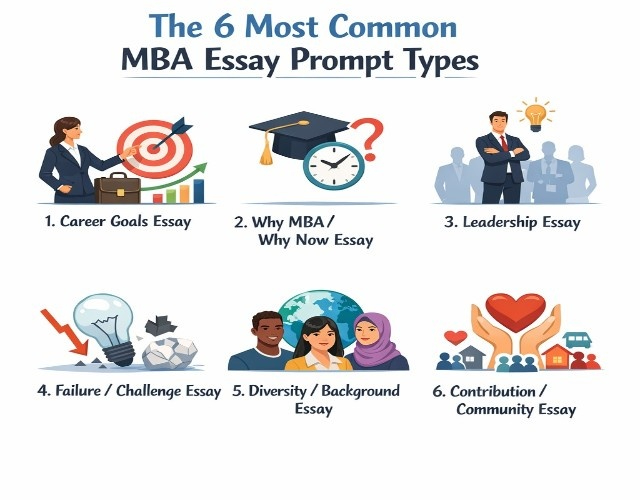
Every MBA essay you'll encounter fits one of these categories. Some schools use two or three of them. A few use all six. Here's what each one actually wants.
1. Career Goals Essay
The career goals prompt asks: where are you headed, and why does an MBA make sense right now?
It sounds simple. It's not. Most applicants write something like "I want to move into leadership roles in the tech industry", and that tells an admissions reader almost nothing.
Strong goals essays name specific industries, specific roles, and even specific organizations. They show a logical progression from where you are today to where you're going, with the MBA as the clear bridge.
| Wharton breaks this into two parts, short-term and long-term goals, as separate responses. Haas asks about short and long-term goals with an emphasis on your reasoning. Booth's prompt is open-ended and invites deeper reflection, with a 250-word minimum that rewards candidates who've thought this through carefully. |
The most common mistake here is being too vague. "I want to make an impact in business" tells an adcom nothing. The more specific you are, the more convincing you are.
| Once you know what you want to say, check our guide on how to write your MBA essay for how to structure the narrative. |
2. Why MBA / Why Now Essay
This prompt is asking you to justify the degree itself. Why do you need an MBA, and why at this point in your career?
What schools actually want is evidence that you've thought seriously about this decision. They're not looking for enthusiasm; they're looking for reasoning. "To advance my career" is the weakest possible answer. Strong responses are specific about the gap an MBA fills, why that gap matters right now, and why waiting would cost you something.
Tuck frames this especially directly, with a prominent "why now" component built into their prompts. The best responses address both dimensions: why the degree and why this specific school.
| One trap to avoid: focusing entirely on what you'll gain without mentioning what you'll contribute. Adcoms read thousands of essays. The ones that stand out acknowledge the school as a place where you'll give as much as you take. |
3. Leadership Essay
Leadership prompts want a specific example, not a personality claim. Saying "I'm a natural leader" in an MBA essay is the equivalent of writing "I'm a hard worker" on a resume. It says nothing.
What schools actually want is evidence: a situation, a decision you made, and the result. The best leadership essays focus on moments where you influenced others without relying on authority, because that's the kind of leadership that scales.
Wharton frames this around the "value you'll add" to the cohort. HBS leans into the "business-minded" framing, looking for candidates who see leadership through the lens of impact and purpose. Both want specifics.
| The single biggest mistake: describing your title rather than your actions. "As team leads, I managed a group of five" is a job description. What did you actually do? What was hard about it? What changed because you were there? |
4. Failure / Challenge Essay
This one makes applicants nervous, and understandably so. You're being asked to share something that went wrong.
What admissions committees want is not a dramatic story. They want self-awareness. They want to see that you can look at a failure honestly, understand what it taught you, and show how it changed your approach. The failure itself matters much less than what you did next.
| The most common mistake is choosing a "safe" failure, a minor setback that wasn't really your fault, or a humble-brag disguised as a challenge. Adcoms can spot these immediately. |
Pick something real. Then spend more words on what you learned than on what went wrong.
5. Diversity / Background Essay
This prompt asks what unique perspective you bring to the classroom and the cohort. It's not just about demographic diversity; it's about the full range of experiences, viewpoints, and backgrounds that shape how you see the world.
Post-2023, many schools have shifted away from explicit DEI framing and toward "contribution" language. The underlying question is the same: how will your presence make the experience richer for everyone around you? But the framing has become more neutral and experience-driven.
Haas uses the concept of "distance traveled", acknowledging that context matters when evaluating achievement. INSEAD takes an unusually candid approach, asking applicants to describe themselves honestly and in detail.
| The mistake most applicants make is being abstract. "I come from a diverse background" doesn't tell anyone anything. Be specific about the experiences that shaped you and how those experiences translate into something a classroom full of MBA students would benefit from. |
6. Contribution / Community Essay
This is the prompt that trips up the most applicants, because it looks like a goals essay, but it's actually the opposite.
A goals essay asks what you want. A contribution essay asks what you'll give.
Admissions committees want specifics: clubs you'd join, initiatives you'd start, how you'd show up for your classmates. The difference between a generic contribution essay and a strong one is research.
If you can name specific programs, student organizations, or faculty members that connect to your background and interests, you signal that you've actually thought about this school, not just business school in general.
| The biggest mistake: writing another goals essay and calling it a contribution essay. If your response is mostly about what the program will do for you, start over. |
Latest MBA Essay Topics Based on the Most Common Prompts
Below are updated and trend-focused MBA essay topics aligned with the six most common MBA essay prompt types. These reflect what many top business schools are currently emphasizing: leadership in uncertainty, innovation, impact, and authenticity.
- How will you leverage AI and emerging technologies to shape your post-MBA career?
- What long-term impact do you want to create in a rapidly changing global economy?
- How does your MBA fit into your plan to transition industries or functions?
- What measurable success do you aim to achieve within five years after graduation?
- Why is this the critical moment in your career to pursue an MBA?
- What leadership gaps have you identified that require formal business education?
- How will an MBA accelerate your ability to lead digital transformation?
- Why is delaying your MBA not an option at this stage?
- Describe how you led a team through uncertainty or rapid change.
- Share an example of inclusive leadership in a diverse workplace.
- How have you driven innovation within resource constraints?
- What leadership lessons did you learn from managing remote or hybrid teams?
- How has your cultural background influenced your professional ambitions?
- What unconventional experience sets you apart from other applicants?
- How has working in a global or cross-functional environment shaped you?
- In what ways will your perspective enrich classroom discussions?
- How will you contribute to a collaborative and innovative MBA environment?
- Which student-led initiatives align with your values and why?
- How will you support diversity, equity, and inclusion within your cohort?
- What unique skill or network will you bring to your MBA community?
Let an Expert Handle Your MBA Essay
Our writers have helped 50,000+ students get into top business schools.
100% human-written, passes Turnitin and Originality.ai
Easy and Short MBA Essay Topics
- My short-term career goal after the MBA
- Why I want to switch industries
- My long-term leadership vision
- The impact I want to make in business
- Why now is the right time for my MBA
- How an MBA will accelerate my growth
- Skills I need to become a better leader
- Why business school fits my career plan
- A time I led without authority
- My proudest leadership moment
- Leading a team under pressure
- A leadership lesson I learned the hard way
- A professional setback that shaped me
- The biggest risk I have taken
- A mistake that changed my perspective
- Overcoming self-doubt in my career
- A defining moment in my life
- The experience that shaped my values
- What makes my journey unique
- A challenge that built my resilience
- How I will contribute to my MBA class
- A student club I want to lead
- Bringing diversity of thought to campus
- Supporting collaboration in business school
School Specific Prompt Variations (Quick Reference)
The same six prompt types appear across every program, but each school puts its own spin on them. Here's a quick reference for some of the most competitive programs:
| School | Essay Type | Word Limit | What Makes It Unique |
|---|---|---|---|
| Harvard (HBS) | "Business-Minded" narrative | 300 words | Focuses on values and purpose, not just career path |
| Wharton | Two-part goals + community | 50 + 150 + 500 words | Separates short-term and long-term clearly |
| Booth (Chicago) | Goals essay | 250 words minimum | Open-ended, invites deeper reflection |
| Haas (Berkeley) | Goals + "distance traveled" | Specified per prompt | Strong emphasis on personal journey and context |
| Tuck (Dartmouth) | Why MBA + Who you are | Two distinct prompts | "Aware" criterion runs throughout both |
One important note: business school prompts change every year. Always verify current requirements on each school's admissions page before you write a single word.
For word count and formatting requirements, see our MBA essay format and word count requirements guide.
Choosing Your MBA Essay Topic Within a Prompt
Knowing the six prompt types is step one. The harder part is figuring out which personal story to use when you're sitting in front of a blank document.
Start with the prompt's underlying question, not its exact wording. Wharton's community prompt and Booth's goals prompt look different on the surface, but both want to know whether you've thought carefully about who you are and what you're doing here.
| Once you understand what the prompt is really asking, identify two or three experiences from your life that could answer it. Then pick the most specific one. Here's a useful test: can only you tell this story, or could anyone with a similar title tell basically the same one? If anyone could tell it, keep looking. |
The topics that tend to fall flat are the "safe" ones that thousands of applicants reach for every year: led a team project at work, studied abroad and grew as a person, volunteered, and gained perspective. These aren't bad experiences. They're just overexposed. The more specific and personal your angle, the more it sticks.
Want to see how strong topics play out in finished essays? Our MBA essay examples article walks through how real prompts translate into compelling responses.
To Sum Up!
Choosing the right MBA essay topic is crucial for crafting a compelling and focused application. Easy and short topics help you present your career goals, leadership experiences, personal growth, and contributions clearly and concisely.
By selecting a topic that highlights your unique strengths and aligns with the program’s values, you can write an MBA essay that stands out to admissions committees and increases your chances of acceptance.
Ready to Write Your MBA Essay?
You know the prompts. Now let our experts write a response that gets you noticed.
- Writers with MBA admissions knowledge, not just writing skills
- No AI, every essay written by a human expert
- School-specific approach for every prompt type
- Fast turnaround, even for last-minute applications
Your MBA application is too important to rush alone.
Get Expert Help