What is a Poetry Analysis Essay?
A poetry analysis essay is an essay that examines how a poem uses literary devices, structure, and language to create meaning.
Here's what confuses most students: analysis is not the same as summary. When you summarize, you're just retelling what happens in the poem. When you analyze, you're explaining how the poet's choices create specific effects.
Think of it this way. If someone asks "What's the poem about?", you're summarizing. If they ask "How does the poet create that meaning?", you're analyzing.
A poetry analysis essay doesn't just tell readers what a poem means, it shows them how the poet creates that meaning through deliberate choices in form, language, and structure.
Teachers assign these essays because poetry packs meaning into compressed language. Learning to unpack that compression teaches you to read carefully, think critically, and write precisely. These skills transfer to everything from analyzing data to understanding complex arguments.
How to Read and Annotate a Poem
Before you can analyze a poem, you need to really understand it. This means multiple readings with different focuses.
Read Aloud (First Step)
- Reading poetry silently doesn't work. You miss too much. Poetry is meant to be heard, and sound is often part of the meaning.
- Read the poem aloud at least twice. On your first reading, just listen. Don't analyze anything yet. Notice how it makes you feel. Where does your voice naturally pause? What words get emphasized? Where does the poem slow down or speed up?
- On your second reading, start paying attention to technical elements. Notice rhyme patterns, repeated sounds, and where line breaks fall. These aren't accidents. Poets make deliberate choices about where lines end and where stanzas break.
- On your third reading (yes, three times minimum), focus on meaning. What's happening in each stanza? Where does the tone shift? What images stand out?
Annotation Tips for Poetry
Grab a pen or use digital highlighting. You're looking for patterns and devices that create meaning.
Circle or highlight:
- Unfamiliar words (look them up immediately)
- Poetic devices (metaphors, similes, personification)
- Repeated words or phrases (repetition is always intentional)
- Strong imagery or sensory details
Mark in the margins:
- Line breaks and stanza divisions (note if they're mid sentence)
- Shifts in tone, speaker, or time
- Rhyme scheme if present (ABAB, AABB, etc.)
- Where the poem breaks from typical patterns
- Questions or confusions (you'll figure them out later)
Poetry Specific Annotation Techniques
Poetry has unique features you won't find in prose. Pay attention to these.
- Enjambment vs End Stopped Lines: If a line runs into the next without punctuation, that's enjambment. It creates momentum and connects ideas. If a line ends with punctuation (period, comma, dash), it's end stopped. This creates pauses and separates ideas. Mark these differences.
- Meter Patterns: If you're analyzing formal poetry (like Shakespeare), you might need to identify the meter. Don't stress about this unless the assignment specifically asks for it. When meter matters, you'll notice it disrupts or enhances the rhythm.
- The Volta (Turn): In sonnets and some other poems, there's a shift or turn where the argument or tone changes. In Shakespearean sonnets, this usually happens at the final couplet. In Petrarchan sonnets, it's after line 8. Mark these turns with a star.
- Speaker vs Poet: The speaker is the voice in the poem. The poet is the actual person who wrote it. These aren't always the same. Note when the speaker seems to have a distinct identity separate from the poet.
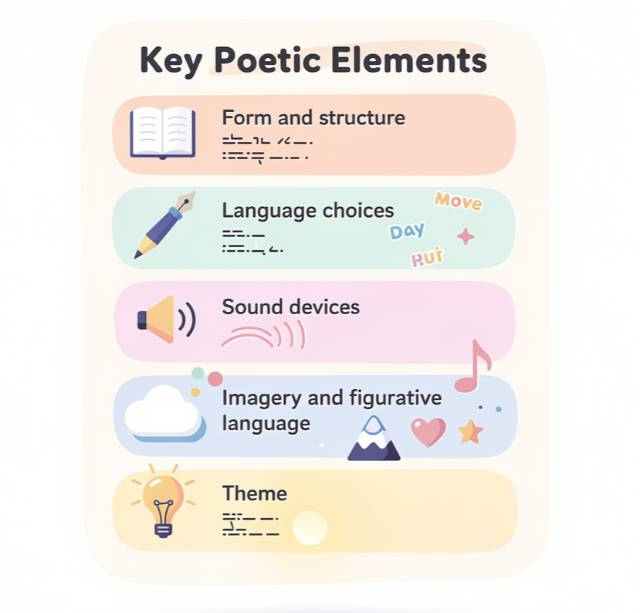
Key Poetic Elements to Analyze
You can't analyze everything in one essay. Choose the elements that matter most for your specific poem and argument. Here's what to look for.
Form and Structure
Form is the poem's shape and organization. It's not just decoration that creates meaning.
Sonnets have 14 lines and follow strict rhyme schemes. Shakespearean sonnets use ABAB CDCD EFEF GG. Petrarchan sonnets use ABBAABBA CDECDE (or variations). The tight structure often explores a problem and its resolution. Free verse has no regular meter or rhyme scheme. This doesn't mean it lacks structure. Free verse poets use line breaks, white space, and stanza divisions to create rhythm and emphasis. Haiku uses three lines (5-7-5 syllables) to capture a single moment or image. The brevity is the point; haiku compresses meaning into minimal words. |
When analyzing form, ask: How does this structure support the poem's meaning? What would change if the poet used a different form?
Sound Devices
Poetry uses sound to create meaning and mood. These devices work even if you read silently because your brain "hears" the words.
Alliteration repeats initial consonant sounds: "Peter Piper picked a peck of pickled peppers." It can create musicality or emphasize connections between words. Assonance repeats vowel sounds: "The rain in Spain falls mainly on the plain." It's subtler than alliteration but creates similar effects. Consonance repeats consonant sounds anywhere in words (not just initial): "pitter patter." It can create texture or link ideas. Repetition emphasizes through repeating words, phrases, or structures. If a poet says something twice, they want you to pay attention. |
When you notice sound devices, explain their effect. Don't just identify them. How does the harsh "k" sound in "crack and break" enhance the meaning? How does repeated "s" sound create a whisper or hiss?
Imagery and Figurative Language
Imagery is language that appeals to your senses. Figurative language compares things to create new meaning.
Metaphor makes a direct comparison: "Hope is the thing with feathers." It doesn't use "like" or "as"; it says one thing IS another. Simile uses "like" or "as" to compare: "My love is like a red, red rose." It's more explicit than a metaphor. Personification gives human qualities to non human things: "The wind whispered through the trees." Symbolism uses objects to represent abstract ideas. A rose might symbolize love. Darkness might symbolize death or ignorance. |
Tone and Mood
Tone is the poet's attitude toward the subject. Is it reverent? Bitter? Playful? Nostalgic? Mood is the emotional atmosphere created for the reader. You might feel melancholy, hopeful, or anxious. |
Word choice creates both. "The old house stood" feels different from "The old house crouched" or "The old house loomed." Same basic image, different tone.
Need Expert Help?
Get Professional Analytical Essay Writing Service
Our experienced writers deliver 100% human-written analysis essays that earn top grades.
How to Write a Poetry Analysis Essay Step by Step
Now that you know what to look for, here's how to turn your reading and annotations into an essay.
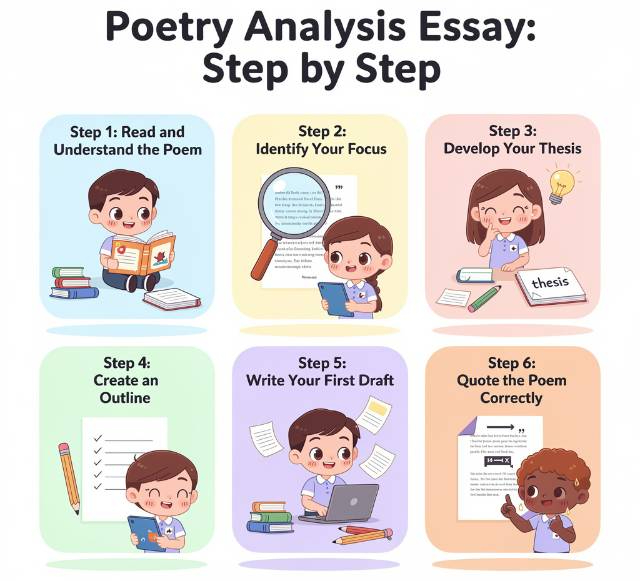
Step 1: Read and Understand the Poem
Start with multiple readings. First reading for general understanding. Second reading for devices and patterns. Third reading for deeper meaning. Annotate as you go.
Look up every unfamiliar word. Poets choose words carefully if you don't know what a word means, you can't analyze it properly.
Research the poem's historical context if it's relevant. When was it written? What was happening in the world at that time? What other poems was the poet writing around the same period?
Step 2: Identify Your Focus
You can't analyze every element in one essay. Choose 2-3 elements that are most significant in this specific poem.
If the poem uses a unique form, analyze form. If sound devices dominate, focus there. If imagery is rich and symbolic, analyze that. Let the poem tell you what matters most.
| Your thesis should connect these elements to the poem's overall meaning or theme. |
Need more topics to write about? Check out our literary analysis essay topics for 50+ ideas across different literary movements and styles.
Step 3: Develop Your Thesis
Your thesis is the argument you're making about how the poem creates meaning. It should be specific and arguable.
Weak thesis: "Emily Dickinson uses many literary devices in 'Because I could not stop for Death.'" Strong thesis: "Through personification of Death as a courteous gentleman and symbolic imagery of a journey, Dickinson transforms the typically frightening subject of mortality into something peaceful and almost romantic." |
Your thesis should answer: How does the poet use [specific techniques] to create [specific meaning or effect]?
Step 4: Create an Outline
For detailed guidance on structuring your analysis essay, see our literary analysis essay outline guide. Here are the poetry specific considerations:
Structure your essay with an introduction, body paragraphs (one per major element you're analyzing), and a conclusion. Each body paragraph should focus on one specific element or technique.
Use chronological order (moving through the poem stanza by stanza) only if the poem tells a clear story or shows development over time. For most poems, thematic organization works better.
Step 5: Write Your First Draft
Introduction: Hook with something interesting about the poem. Provide brief context (poet, when written, basic subject). End with your thesis statement.
Body paragraphs: Each paragraph analyzes one element. Start with a topic sentence that states your claim about that element. Provide evidence (quotes from the poem). Explain how that evidence supports your interpretation.
Conclusion: Don't just restate your thesis. Synthesize your analysis. What's the bigger takeaway? Why does this poem's technique matter?
Step 6: Quote the Poem Correctly
Poetry has specific citation rules. Get these wrong, and your essay looks amateur.
For short quotes (3 lines or fewer): Integrate into your text with quotation marks. Use a slash with spaces ( / ) to show line breaks:
"Frost describes the road as 'just as fair' / And having perhaps the better claim' before admitting both roads 'equally lay.'"
For longer quotes (4+ lines): Use block quote format. Indent the entire quote. No quotation marks needed. Preserve the poem's original line breaks:
Because I could not stop for Death
He kindly stopped for me
The Carriage held but just Ourselves
And Immortality.
Citing specific lines: Put line numbers in parentheses after the quote: (lines 1-4) for the first citation, then just numbers (5-8) for subsequent citations.
Common Mistakes in Poetry Analysis Essay to Avoid
You're working hard on this essay. Don't undermine your effort with these common errors.
Mistake #1: Summary Instead of Analysis
Problem: "In this poem, the speaker talks about a bird. The bird is blue. Then the bird flies away."
Fix: "The blue bird symbolizes fleeting happiness, emphasized by the abrupt final line break that mimics the sudden departure."
Analysis explains how and why, not just what.
Mistake #2: Identifying Devices Without Explaining Their Effect
Problem: "Frost uses alliteration in line 3."
Fix: "The harsh alliteration of 'wanted wear' emphasizes the weight of the speaker's decision, mirroring the difficulty of choosing between equally uncertain paths."
Always connect the device to the meaning.
Mistake #3: Assuming the Speaker is the Poet
Most poems have a speaker who isn't exactly the poet. Even in confessional poetry, there's a constructed speaker. Say "the speaker" not "the poet" unless you have biographical evidence linking them.
Mistake #4: Over Quoting, Under Analyzing
Your analysis should be longer than your quotes. If half your essay is quoted poetry, you're not analyzing enough. Aim for this ratio: Every 2 lines of poetry gets 4-6 lines of your analysis.
Mistake #5: Ignoring Form
Form isn't decoration. If the poet chose a sonnet over free verse, that choice matters. If they broke traditional form in specific places, that matters too. Don't skip the form in your analysis.
Bottom Line
You now have the tools to analyze any poem effectively. Start with close reading. Choose your focus elements. Build a clear thesis. Support every claim with evidence. Explain how devices create meaning.
The next time you're assigned a poetry analysis essay, you won't stare at that page wondering where to start. You'll have a process. Read it three times. Annotate deliberately. Choose what matters. Build your argument. Quote correctly. Explain the how and why. For better undestanding about literary writing, check out our comprehensive literary analysis essay guide
Poetry analysis gets easier with practice. Each poem you analyze teaches you to read more carefully and think more deeply. These skills last far beyond English class.
Expert Poetry Analysis Essay Help
Every poem has layers of meaning waiting to be discovered. With our expert writers who specialize in literary analysis, you'll receive:
- Deep analysis of poetic devices, form, and meaning
- Original interpretations
- Clear, well-structured essays
- 100% plagiarism-free work
Let our professional writers help you decode complex poetry and craft essays that impress your professors.
Get Started Now