Personal Statement Definition
A personal statement is a narrative essay that shows admissions committees who you are as a person. It's your chance to step out from behind your grades and test scores and reveal the experiences, challenges, and values that shaped you.
The purpose of a personal statement is simple: help admissions understand your character, motivation, and personal development. It's not about listing achievements; that's what your resume and transcript do. Instead, it's about showing how you think, what drives you, and why you're passionate about your chosen field.
Here's what typically goes into a personal statement:
Your personal journey. This might include defining moments that sparked your interest in a field, challenges you've overcome, or experiences that changed your perspective. For example, if you're applying to law school, you might write about volunteering at a legal aid clinic and discovering your passion for advocacy. |
Your character and values. Admissions committees want to see what kind of person you are. Are you resilient? Curious? Committed to service? Your personal statement shows these qualities through specific examples, not just by claiming them. |
Your motivation. Why do you care about this field? What personal connection do you have to the work? This is where storytelling matters. Instead of saying "I want to study medicine," you might describe the moment you realized healthcare disparities affected your own community. |
The tone of a personal statement is narrative and reflective. You're allowed to be vulnerable, use emotional language, and write in a way that feels personal. Think of it as a well-crafted story where you're the main character.
Personal statements typically run 1-3 pages (around 500-1,000 words) and are most common for undergraduate applications, humanities graduate programs, and professional schools like law and medicine. They're less structured than statements of purpose, which gives you creative freedom, but also means you need strong storytelling skills to pull it off.
For a complete guide on structure, prompts, and strategy, see our personal statement writing article.
What Is a Statement of Purpose?
A statement of purpose is a professional document that outlines your academic background, research interests, and career goals. It's essentially your pitch to a graduate program: here's what I've done, here's what I want to study, and here's why your program is the perfect fit.
The purpose of a statement of purpose is to demonstrate you're academically prepared, intellectually engaged, and a good match for the specific program you're applying to. Faculty members reading your SOP want to know if you understand what graduate-level research looks like and whether your interests align with their department's strengths.
Here's what goes into a statement of purpose:
Your academic background. This includes relevant coursework, research experience, publications, presentations, and technical skills. If you worked in a lab studying gene expression, you'd mention the specific techniques you learned and the outcomes of your work. |
Your research interests. Be specific here. "I want to study biology" is too vague. "I want to investigate how microplastics affect marine invertebrate reproduction" shows you've thought deeply about your research direction. |
Program fit. This is critical. You need to mention specific faculty members whose work aligns with yours, particular research centers or resources the program offers, and how the program's strengths match your goals. Generic statements like "Your prestigious program" won't cut it. |
Your career objectives. Where do you see yourself in five or ten years? Academic research? Industry? Policy? Be clear and realistic about your trajectory. |
The tone of a statement of purpose is professional, academic, and forward-looking. You're writing to convince faculty that you're ready for rigorous graduate work. Use confident, assertive language and avoid overly emotional or personal anecdotes.
Statements of purpose typically run 2-3 pages (1,000-1,500 words) and are standard for graduate programs, especially STEM fields, PhD programs, and research-focused master's degrees. The structure is more rigid than a personal statement; you need to be clear, logical, and comprehensive.
Want to see examples of strong statements of purpose? Visit our statement of purpose examples page to see what works.
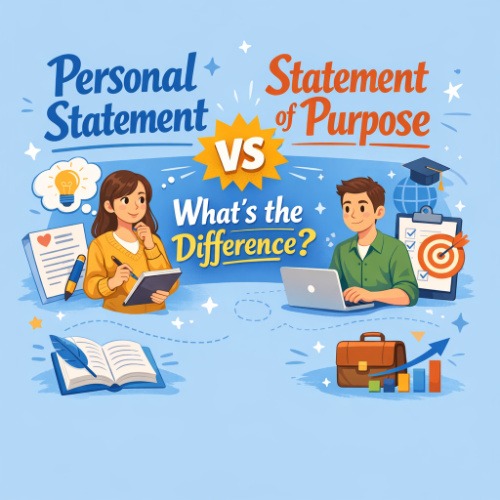
Personal Statement vs Statement of Purpose: Key Differences
Let's break down the differences side by side so you can see exactly how these documents diverge:
| Category | Personal Statement | Statement of Purpose |
| Primary Focus | Who you are | What you want to do |
| Content | Personal journey, character, values | Academic goals, research interests, career plans |
| Tone | Narrative, reflective, emotional | Professional, academic, objective |
| Structure | Story-driven, chronological or thematic | Structured, logical, forward-looking |
| Examples Used | Personal anecdotes, life challenges | Research projects, academic achievements |
| Length | 1-2 pages (500-1,000 words) | 2-3 pages (1,000-1,500 words) |
| Typical For | Humanities, law, medicine, undergrad | STEM, PhD programs, research-focused |
| Verb Tense | Past/present reflecting on journey | Present/future looking ahead |
Now let's unpack what these differences actually mean for your writing:
Content Focus
A personal statement is about your story, who shaped you, what challenges you faced, and why you care about your field on a personal level. You might write about a mentor who changed your perspective, a hardship that taught you resilience, or a community experience that sparked your passion.
A statement of purpose is about your plan, what you'll study, how you'll contribute to the program, and where your career is heading. You'll discuss your research experience, the questions that fascinate you, and how specific faculty members' work aligns with your interests. |
Tone and Voice
In a personal statement, it's okay to be vulnerable and show emotion. You can use phrases like "I felt," "I realized," or "I discovered." The goal is to connect with readers as a human being. You're showing them the person behind the application.
In a statement of purpose, you need to sound confident and assertive. Use phrases like "I will research," "I have developed," or "I plan to investigate." The goal is to convince faculty that you're academically prepared and intellectually serious. |
Structure Approach
A personal statement can be non-linear, thematic, or even creative. You might structure it around a single defining experience, or you might weave together multiple stories that illustrate your growth. There's room for creativity as long as the narrative is coherent.
A statement of purpose must be clear, logical, and sequential. Faculty are busy and need to quickly understand your qualifications and goals. Start with your background, move to your current interests, explain program fit, and end with future plans. No surprises. |
Audience Expectations
When admissions committees read your personal statement, they want to know you as a person. They're asking: "Would this student contribute positively to our community? Do we understand what drives them?"
When faculty read your statement of purpose, they want to know if you're ready for their program. They're asking: "Does this student understand what graduate research involves? Can they succeed here? Would they be a good fit for my lab?" |
Level of Detail
In a personal statement, you're selective with storytelling. You pick one or two experiences and go deep, showing how they shaped you. Depth matters more than breadth.
In a statement of purpose, you need comprehensive coverage. Faculty want to see your full academic trajectory, all relevant experience, and clear understanding of the field. Breadth matters here; you're building a case for your readiness. |
Personal Statement vs Statement of Purpose Examples (Side-by-Side)
Let's look at how the same student would approach both documents. This will show you exactly how the tone, content, and focus differ.
Context: Maria is a biology student applying to ecology PhD programs. She's interested in coral reef conservation and has research experience in marine biology. |
Personal Statement Excerpt
"I was nine years old the first time I saw a coral reef. My family had saved for years to take a vacation to the Florida Keys, and I remember pulling on my snorkel mask and dipping my face underwater. The world transformed. Neon fish darted between brain coral formations, and I watched an octopus change color as it squeezed into a crevice. I surfaced, sputtering with excitement, and told my dad I'd found another planet.
That moment planted something in me. Through middle school, I checked out every marine biology book our small-town library had. In high school, I volunteered at our local aquarium, even though it meant taking two buses each way. When I learned about coral bleaching in my AP Environmental Science class, I felt something break inside me. Those reefs that had shown me wonder were dying, and I wanted to understand why.
That's what drove me to major in biology, to seek out research opportunities, and to spend my summers volunteering with reef restoration projects. The nine-year-old who saw another planet is still here, just with better equipment and deeper questions."
Statement of Purpose Excerpt
"My research experience in Dr. Jennifer Martinez's lab at State University has focused on understanding how thermal stress affects coral symbiosis. Over two years, I've investigated the relationship between zooxanthellae density and coral resilience using fluorescence microscopy and spectrophotometry. My independent project examined whether gradual temperature increases could help corals develop thermal tolerance, and I presented these findings at the Regional Marine Biology Conference in 2024.
I'm particularly drawn to your program because Dr. Robert Chen's work on coral reef restoration aligns perfectly with my research interests. His 2023 paper on assisted evolution in Acropora species demonstrated promising methods for enhancing coral heat tolerance, and I'm eager to contribute to this line of research. Additionally, your Marine Conservation Lab's partnership with the Caribbean Coral Restoration Initiative offers field research opportunities that would complement laboratory work.
My long-term goal is to become a research scientist focused on developing scalable solutions for coral reef conservation. I plan to investigate how we can combine assisted evolution with active restoration to create more resilient reef ecosystems in the face of climate change."
Analysis
Notice the fundamental differences:
Verb tense: The personal statement uses past tense and reflection ("I remember," "I felt," "I wanted"). The statement of purpose uses present and future tense ("I have investigated," "I'm drawn to," "I plan to"). Content: The personal statement tells a story about personal discovery and emotional connection. The statement of purpose presents credentials, research experience, and specific academic plans. Sentence structure: The personal statement includes descriptive details and emotional beats ("I felt something break inside me"). The statement of purpose is direct and efficient ("I presented these findings at the Regional Marine Biology Conference"). |
The personal statement makes you care about Maria as a person. The statement of purpose makes you believe she's ready for graduate research. Same applicant, completely different documents.
For more complete examples, see our statement of purpose examples pages.
Which One Should You Write?
The answer usually lies in the application prompt itself, but sometimes schools aren't clear about what they want. Here's how to figure it out.
How to Tell from the Prompt
- If the application explicitly says "personal statement," they probably want a personal narrative focused on your story, character, and motivation. Look for prompt language like "tell us about yourself," "describe experiences that shaped you," or "explain your passion."
- If it says "statement of purpose" or "statement of intent," they want an academic document focused on your research interests, qualifications, and career goals. Look for language like "describe your research experience," "explain your academic interests," or "discuss your career objectives."
- If it just says "essay" or "statement" without any modifier, you need to dig deeper. Check the program's FAQ page, look at what the prompt is actually asking for, or email the admissions office. Here's a template:
- "I'm preparing my application to [Program Name] and want to ensure I'm submitting the right type of essay. The application asks for a 'statement.' Should this focus primarily on my personal background and motivation, or should it emphasize my academic qualifications and research interests? Thank you for clarifying."
By Program Type
Research-heavy programs like STEM PhD programs, engineering degrees, and hard sciences typically want a statement of purpose. They need to know you understand research methodologies and have specific interests that match their faculty. Professional programs like MBA, law school, and medical school usually want a personal statement or a hybrid document. They care about your character, leadership, and why you're drawn to the profession, not just your academic credentials. Humanities and social sciences programs (English, History, Sociology, Psychology) often prefer personal statements, though research-focused graduate programs in these fields might want statements of purpose. When in doubt: Default to a hybrid approach that includes both personal motivation and academic preparation. Most schools appreciate seeing both dimensions unless they explicitly ask for one or the other. |
Geographic and Institutional Differences
US programs often use the terms interchangeably, which creates confusion. A "personal statement" prompt at one school might really want what another school calls a "statement of purpose." Always read the specific questions they're asking you to address.
UK and European programs tend to be more specific about which document they want. If a UK program asks for a "personal statement," they typically mean it in the traditional sense.
Top-tier programs (Ivy League, highly ranked programs) often have more specific requirements and may ask for both documents. Regional programs may be more flexible about format as long as you address the key questions.
Decision Flowchart
Here's a quick decision tree:
Start: What does the prompt say?
- Says "Personal Statement": Write personal narrative focusing on your story
- Says "Statement of Purpose" or "Statement of Intent": Write academic document focusing on research and goals
- Says "Statement" or "Essay" with no modifier: Check, Is this a research-based program?
- Yes (STEM, PhD, research-focused): Lean toward statement of purpose
- No (Professional, humanities, terminal master's): Lean toward personal statement
- Requires both documents: See next section
Need A Custom Personal Statement?
Our expert writers create compelling personal statements tailored to your story.
Join thousands of students who got accepted with our help.
What If the School Asks for Both?
Some programs, particularly competitive ones like Berkeley, Michigan, and other top-tier schools, require both a personal statement and a statement of purpose. This isn't them being difficult; they genuinely want to see both dimensions of who you are.
Why Schools Ask for Both
Programs that require both documents want the complete picture. They want to know you as a person (personal statement) and as a scholar (statement of purpose). This helps them identify candidates who are not only academically qualified but also personally motivated and good cultural fits for their community.
It's actually an advantage for you. Instead of trying to cram everything into one document, you get dedicated space for your story and separate space for your academic credentials.
How to Divide Content Between Them
The key is treating them as complementary, not redundant. Here's how to split the content:
Personal Statement Should Cover:
- Your background and identity (where you come from, what shaped you)
- Personal challenges you've overcome and what you learned
- The experiences that sparked your interest in your field
- Your values, character, and what drives you as a person
NOT: Detailed research plans, specific faculty interests, or technical credentials (save these for the SOP)
Statement of Purpose Should Cover:
- Your academic background and achievements (relevant coursework, honors)
- Research experience with specific methodologies and outcomes
- Your research interests and how they fit with specific faculty
- Your career trajectory and professional goals
NOT: Personal hardships, family background, or emotional experiences (covered in the PS)
The "Bookend" Strategy
Think of the two documents as bookends holding up your application.
The personal statement explains why you care: your passion, your motivation, and your personal connection to the work. The statement of purpose explains how you'll succeed: your preparation, your plan, and your qualifications. |
Together, they tell a complete story: you're a motivated person with a compelling reason to pursue this field, and you have the skills and preparation to actually succeed in graduate school.
For example, in your personal statement, you might write about how your grandmother's Alzheimer's diagnosis motivated you to study neuroscience. In your statement of purpose, you'd discuss your research experience in a cognitive neuroscience lab, the specific questions about neurodegeneration that fascinate you, and which faculty members' work aligns with your interests.
General Mistakes to Avoid
Don't copy-paste content between the two documents. Even if an experience appears in both, frame it differently. In your personal statement, describe how the experience shaped you emotionally or personally. In your statement of purpose, describe what you learned academically or professionally.
Also, make sure the documents don't contradict each other. If your personal statement says you want to work in clinical practice, but your statement of purpose emphasizes research faculty positions, you'll confuse admissions committees. Keep your narrative consistent across both documents. |
Finally, don't repeat the same anecdotes or examples. You have limited space; use each document to showcase different dimensions of your experience and qualifications.
Important Mistakes to Avoid
Even applicants who understand the difference between these documents can make critical errors. Here are the biggest mistakes for each type and how to avoid them.
Personal Statement Mistakes
- Being too generic. Writing "I've always loved science" or "I want to help people" doesn't tell admissions anything meaningful. Be specific: "During my organic chemistry lab, I spent three weeks troubleshooting a synthesis that kept failing, and I loved every minute of that problem-solving process."
- Listing achievements. If your personal statement reads like a resume, "I earned a 3.9 GPA, volunteered 200 hours, and led three student organizations," you're doing it wrong. That's what the statement of purpose is for. Your personal statement should explore the meaning behind achievements, not just list them.
- Forgetting the "personal." Some applicants are so worried about seeming professional that they strip all personality from their personal statement. Don't be afraid to show vulnerability, emotion, or the real reasons you care about your field.
- Inappropriate sharing. There's a difference between being vulnerable and oversharing. Writing three pages about childhood trauma without connecting it to growth or your academic interests won't help your application. Always ask: "Does this show resilience and growth, or does it just seem like I haven't processed this experience?"
- Sounding entitled. Phrases like "I deserve this opportunity because I've worked hard" or "I've overcome more than other applicants" come across as entitled. Let your experiences speak for themselves without demanding recognition.
Statement of Purpose Mistakes
- Being too personal. Save the deep emotional reflection for your personal statement. Your SOP should be professional and focused on your academic qualifications. Don't write about how your mother's illness changed your perspective; write about the research you did afterward.
- Vague research interests. "I want to study biology" or "I'm interested in machine learning" is far too broad. Name specific questions you want to investigate, methodologies you want to use, or problems you want to solve. Show you've thought deeply about your research direction.
- Not mentioning faculty. One of the biggest red flags is a statement of purpose that could apply to any program. You must mention specific faculty members whose work aligns with yours, and explain why. This shows you've done your homework and understand what makes this program unique.
- Focusing on prestige. "I want to attend your program because you're ranked #1," tells faculty nothing about fit. They want to know you chose them for substantive reasons, their research strengths, their approach, their resources, not just their ranking.
- Generic statements. Phrases like "Your cutting-edge program" or "world-class faculty" could apply anywhere. Be specific about what makes this program right for you. Mention actual courses, research centers, partnerships, or resources by name.
Tips for Writing Either Document
Whether you're writing a personal statement or statement of purpose, these strategies will strengthen your application.
1. Read the Prompt Carefully
Every single word in the prompt matters. If it asks you to "describe two formative experiences," don't write about five. If it specifies 500 words, don't submit 750. Programs use these requirements to see if you can follow instructions, a skill you'll need in graduate school.
Look for specific requirements like word count, formatting preferences, or particular topics to address. Check if they want you to discuss any specific aspects of your background or experience. |
2. Research the Program Thoroughly
Visit the program website and read it as your admission depends on it, because it does. Look at the faculty directory and read their recent publications. Understand what research is happening in the department right now.
Look for program strengths, special resources, research centers, and partnerships. If they have a marine field station, an AI research lab, or a partnership with a major hospital, mention it. This shows you know what makes their program unique. |
3. Show, Don't Tell
Don't say "I'm a persistent person." Instead, write: "When my research hit a dead end, I spent two months trying alternative methodologies, eventually discovering that a pH adjustment made the reaction work."
For personal statements: Don't say "I'm passionate about education." Write about the specific moment you tutored a struggling student and watched understanding dawn on their face. |
For statements of purpose: Don't say "I have strong research skills." Describe the specific techniques you've mastered, the independent project you designed, and the results you achieved. |
4. Be Specific
Replace general statements with concrete details. Use numbers, names, and specific examples. Instead of "I have extensive research experience," write "I spent three years in Dr. Sarah Johnson's neuroscience lab, where I conducted electrophysiology recordings on over 200 neurons."
Instead of "I'm interested in climate change," write "I want to investigate how rising ocean temperatures affect the symbiotic relationship between coral and zooxanthellae." |
5. Get Feedback
Don't write in a vacuum. Ask professors, advisors, and writing center staff to review your drafts. They'll catch clarity issues, spot weaknesses in your argument, and identify places where you need more detail or less repetition.
Fresh eyes are essential because you're too close to your own story to see what's missing or confusing. If you're struggling with structure, clarity, or don't have access to strong reviewers, professional help is available. |
6. Proofread Relentlessly
Grammar errors, typos, and awkward phrasing can sink an otherwise strong application. Admissions committees read hundreds of statements - errors stand out and suggest you don't care about quality or attention to detail.
Read your statement aloud. If you stumble over a sentence or it sounds awkward when spoken, rewrite it. Use grammar checking tools, but don't rely solely on them. They miss context-dependent errors and sometimes suggest changes that make your writing worse.
For more detailed writing strategies and formatting guidance, see our personal statement writing guide and check out our personal statement format article for technical specifications.
The Bottom Line
Personal statements and statements of purpose serve different functions in your graduate school application. A personal statement reveals who you are: your story, your character, your motivation. A statement of purpose demonstrates what you're prepared to do, your research interests, your qualifications, and your career plan.
Understanding this difference is critical. Write the wrong type of document, and you'll confuse admissions committees or miss the opportunity to showcase important parts of your application. Write both well, and you'll present a complete picture of yourself as both a person and a scholar.
The key is matching your document to what the program actually wants. Read the prompt carefully, research what's typical for your field, and when in doubt, reach out to the admissions office for clarification.
Your application documents are your voice in a competitive process. Make every word count, stay true to your authentic self, and show programs why you're not just qualified, but the right fit for their community.
If you need help crafting either document, our expert writers specialize in personal statements and statements of purpose that get results. We've helped thousands of students gain admission to their dream programs with compelling, authentic writing that showcases their unique strengths.
Need A Custom Personal Statement? Our expert writers create compelling personal statements tailored to your story. Join thousands of students who got accepted with our help.