Understanding a Psychology Essay
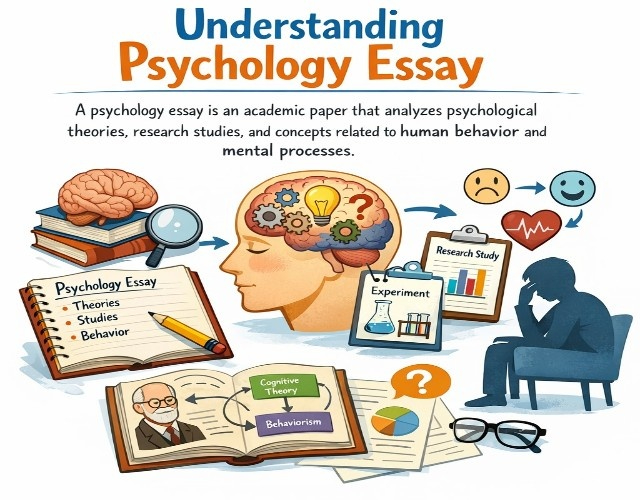
A strong psychology essay explains, evaluates, or applies psychological principles to real-world situations while supporting arguments with research-based evidence rather than personal opinion.
What Makes a Psychology Essay Different?
A lot of students approach psychology essays the same way they'd write an English essay, sharing personal interpretations, building arguments from feeling. That won't work here.
Psychology is a science. Your job isn't to share your opinion; it's to evaluate evidence. Every point you make needs to be grounded in peer-reviewed research, real studies, and empirical data.
There are a few other key differences to know going in. Psychology essays use APA formatting, not MLA or Chicago.
Markers are specifically looking for four things:
- Your knowledge of the topic
- Your ability to think critically
- How well you use evidence
- Whether your structure holds together.
"In a psychology essay, every claim you make needs to be backed by research; personal opinion alone won't cut it."
The good news is that once you understand this, writing a psychology essay becomes a lot more predictable. You're not being asked to be creative. You're being asked to think clearly and argue well.
How to Understand Your Psychology Essay Question
Before you write a single word, read your essay question carefully. Read it again. This sounds obvious, but most marks are lost because students answer the question they assumed they were asked, not the one that's actually on the page.
Start by identifying the command word. This is the verb that tells you what to do, and in psychology, these words have specific meanings:
| Command Word | What It Expects |
|---|---|
| Discuss | Present arguments for and against; weigh up the evidence |
| Evaluate | Make a judgement based on evidence; consider strengths and limitations |
| Compare | Identify similarities and differences between two things |
| Critically Analyze | Break down the evidence and assess how strong it is |
After you've identified the command word, break the question into three parts: what topic is it about, what angle or aspect are you addressing, and what's the scope (is it asking you to focus on a specific theory, study, or population)?
"The biggest mistake students make is answering the question they wish they'd been given, not the one they were actually asked."
Underline the key terms before you write anything. If a word is ambiguous, you may need to briefly define it early in your essay. That small step of truly understanding what's being asked is worth more than an hour of extra writing.
How to Create a Psychology Essay Outline
Writing without an outline is one of the most common reasons psychology essays fall apart. You end up with paragraphs that wander, points that repeat, and a conclusion that doesn't feel earned.
A good outline takes about ten minutes to build and saves you hours of rewriting.
A solid outline is the difference between an essay that wanders and one that convinces.
For a standard 1,500-word essay, your outline should look roughly like this:
Introduction (150 words): Hook, Brief context, Thesis statement Body Paragraph 1 (200 words): Point + evidence + explanation Body Paragraph 2 (200 words): Point + evidence + explanation Body Paragraph 3 (200 words): Counterargument + evidence + explanation Body Paragraph 4 (200 words): Additional point or evaluation Conclusion (150 words): Summary of argument + implications |
Scale this up proportionally for longer essays. A 2,500-word essay would have 5 to 6 body paragraphs. The rule that doesn't change regardless of length: one point per paragraph. The moment you try to pack two ideas into one paragraph, the structure collapses.
Before you open a blank document, write your outline. You'll finish faster, stay on track, and your marker will notice the difference.
How to Write a Psychology Essay Introduction
Your introduction has one job: tell the examiner exactly what you're going to argue before you argue it. That's it.
A strong psychology intro has four components. A hook that frames the question and pulls the reader in. Brief context that gives the examiner the necessary background without wading into your argument. A thesis statement that makes your position clear. And signposting that tells the reader what the essay covers.
| Keep your intro to roughly 10% of your total word count. For a 1,500 word essay, that's 150 words, enough to do the job, nothing more. |
One common mistake: don't open with a dictionary definition. "According to the Oxford English Dictionary, psychology is..." is one of the weakest openings you can write. If a definition is central to your argument, define the term in your own words in context. Don't outsource your writing to a dictionary.
Your intro tells the examiner what you're going to argue, make it clear and confident.
Your thesis statement is the most important sentence in your introduction. It should name your position directly. Not "this essay will explore attachment theory", that's a topic description, not a thesis. Something like "research into attachment theory suggests that early caregiver responsiveness has a more significant long-term effect on adult relationships than peer relationships do", that's an argument you can prove.
How to Use the PEE Model in Psychology Essay Body Paragraphs
If there's one technique that improves psychology essay grades faster than anything else, it's learning to use the PEE model properly. Not just knowing what it stands for,actually applying it.
PEE stands for Point, Evidence, Explanation. Point: State your argument clearly at the start of the paragraph. One point per paragraph. Evidence: Cite a study, finding, or theory that supports your point. In psychology, this usually means naming the researcher and year, for example, (Bowlby, 1969). Explanation: This is where most students fall short. Don't just drop in a study and move on. Explain what the evidence actually shows, and connect it back to your thesis. Why does this study support your point? What does it tell us? |
Here's what a PEE paragraph looks like in practice:
"Research suggests that early attachment styles have a lasting impact on adult relationships (Point). Hazan and Shaver (1987) found that adults who reported secure attachment in childhood were more likely to describe their romantic relationships as trusting and supportive (Evidence). This indicates that the internal working models formed in early childhood, as Bowlby proposed, continue to shape how individuals approach intimacy and closeness in later life (Explanation)."
Some lecturers and institutions use PEC (Point, Evidence, Comment) instead, where Comment replaces Explanation. The logic is the same: your job is to interpret the evidence, not just report it.
"The PEE model turns a list of facts into an actual argument, and that's exactly what examiners are looking for."
For a 1,500-word essay, aim for 4 to 5 body paragraphs. For a 2,500-word essay, 5 to 7 is the right range. To link paragraphs together, use a transition sentence at the end or beginning of each paragraph, something that shows how this point connects to or contrasts with the next one.
To see how these principles look in a finished piece, take a look at our psychology essay examples, each one is annotated so you can see exactly what works.
Let a Psychology Expert Write It for You
Skip the stress, get a professionally written psychology essay delivered to your inbox.
Free revisions until you're completely satisfied
How to Write a Psychology Essay Conclusion
Your conclusion is not a second introduction. It's not a place to introduce new evidence, bring in studies you forgot to mention, or make new claims.
It does three things. It summarizes your argument, briefly recapping what you argued and what evidence supported it. It returns to your thesis, restating your position in light of everything you've laid out. And it ends with broader implications or acknowledgment of limitations, which shows the examiner you can think beyond the surface of your own argument.
"Your conclusion should feel like the natural ending of an argument, not a summary of your notes."
Two things to avoid: opening with "In conclusion" (it's a cliché that signals weak writing) and introducing any new information. If you find yourself writing a new point in your conclusion, that point belongs in the body of your essay.
A good conclusion is usually shorter than you think it needs to be. For a 1,500-word essay, 100 to 150 words is plenty. Say what you've proven, why it matters, and what questions remain open.
APA Referencing Basics for Psychology Essays
Every psychology essay uses APA (American Psychological Association) formatting. This isn't optional, it's a core part of what markers assess.
For in text citations, the format is simple: (Author, Year). For example, (Milgram, 1963) or (Smith & Jones, 2020). If you're quoting directly, include the page number: (Smith, 2020, p. 45).
Your reference list at the end of the essay follows a more detailed format:
| Author, A. A., & Author, B. B. (Year). Title of article. Journal Name, Volume(Issue), page–page. DOI |
For example:
| Hazan, C., & Shaver, P. (1987). Romantic love conceptualized as an attachment process. Journal of Personality and Social Psychology, 52(3), 511–524. |
"APA referencing isn't optional in psychology, it's how you show examiners that your argument is built on real research."
Common mistakes to avoid: citing Wikipedia (not an acceptable academic source), missing DOIs on journal articles, inconsistent formatting within the same reference list, and listing sources in your reference list that you didn't actually cite in the text.
If you're building a long reference list, a citation generator can save time. Just double-check the output against the official APA Style Guide before you submit, generators aren't always accurate.
Writing Tips for a Psychology Essay
Clarify the Essay Requirements
| Identify exactly what the prompt is asking, whether you need to analyze, compare, evaluate, or apply psychological theories. This ensures your response stays focused and relevant. |
Use Credible Scholarly Sources
| Support your arguments with peer-reviewed journal articles, textbooks, and reliable academic sources. Psychology essays rely on research, not personal opinion. |
Follow APA Format
| Most psychology essays require APA style. Pay attention to in-text citations, reference lists, headings, and formatting guidelines. |
Develop a Clear Thesis Statement
| Your thesis should clearly state your main argument or position. Every paragraph should connect back to this central claim. |
Apply Theories to Real Examples
| Don’t just describe theories, analyze and apply them to real-life situations, case studies, or research findings. |
Be Analytical, Not Descriptive
| Go beyond summarizing studies. Explain why the findings matter and how they support (or challenge) your argument. |
Structure Logically
| Use a clear introduction, well-developed body paragraphs, and a concise conclusion that reinforces your argument. |
Edit for Clarity and Precision
| Psychology writing should be formal, concise, and evidence-based. Avoid vague language and unsupported claims. |
Before you can write a great psychology essay, you need a topic that's focused enough to argue clearly, debatable enough to have something interesting to say, and well-supported enough by research that you can find credible evidence.
Need help picking one? Our full guide to psychology essay topics breaks them down by sub-field so you can find one that fits your assignment.
Common Psychology Essay Mistakes (And How to Avoid Them)
Most psychology essay marks are lost to the same handful of mistakes. Here's what to watch for before you submit.
Describing without evaluating.
Listing what a study found is not the same as analyzing it. Your marker wants to know what the evidence means, not just what it says. Apply the PEE model and make sure every piece of evidence connects back to your argument.
Using "I think" or personal opinion without support.
Psychology essays are evidence-based. "I believe attachment is important" is not an argument. "Research by Ainsworth (1978) demonstrates that..." is.
Ignoring counterarguments.
One-sided essays score lower than essays that acknowledge alternative views. Spend at least one paragraph presenting a counterargument, then explain why the evidence for your position is still stronger.
Trying to make more than one point per paragraph.
If you've got two points, you need two paragraphs. Cramming both into one paragraph weakens both.
Inconsistent or missing APA formatting.
Check every in-text citation and every reference list entry before you submit.
Not answering the actual question.
Read the question again when your draft is done. Does every paragraph connect to what you were asked? If any section doesn't, cut it or reshape it.
Most psychology essay marks are lost to the same six mistakes, and all of them are avoidable.
Final Thought,
Writing a strong psychology essay requires more than summarizing theories; it demands critical thinking, credible research, clear structure, and proper APA formatting. By clarifying the essay requirements, developing a focused thesis, using scholarly sources, and applying psychological concepts effectively, you can craft a well-supported and high-scoring paper.
Follow these psychology essay writing tips to strengthen your analysis, improve clarity, and present arguments backed by evidence. With the right approach and preparation, writing a psychology essay becomes a structured and manageable process rather than a stressful task.
Ready to Get Your Psychology Essay Written?
Professional writing assistance tailored to your needs
- Written by subject-matched psychology graduates
- Rush delivery available, as fast as 3 hours
- Plagiarism-free with full Turnitin report included
- 100% human-written, passes Originality.ai + Turnitin
Free revisions until you're completely satisfied
Order Now