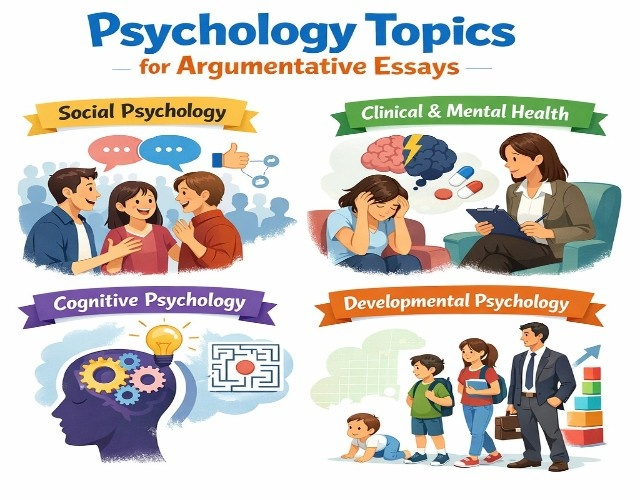
Psychology Topics for Argumentative Essays
Argumentative topics need a clear position you can defend and an opposing view worth acknowledging. If everyone already agrees with you before you write a single sentence, it's not really an argument.
"A strong argumentative psychology topic has two sides worth debating; if everyone already agrees, it's not an argument."
Social Psychology
- Should social media platforms be regulated for mental health impacts? Strong opposing arguments from both free-speech and public-health perspectives make this genuinely debatable.
- Does violent media cause aggression in children? Decades of conflicting research give you strong material from both sides.
- Is conformity more harmful than helpful in group settings? Classic social psychology territory with plenty of Asch and Milgram research to draw from.
- Do social norms suppress individual identity? Useful for examining Goffman, social comparison theory, and identity development.
- Is peer pressure a stronger influence than parental guidance during adolescence? Research-rich topic with clear opposing evidence available.
- Does social media create unrealistic beauty standards that harm self-image? A growing body of experimental research presents two clear sides around causation vs. correlation.
- Is online bullying more psychologically damaging than in-person bullying? Different mechanisms, different evidence, genuinely arguable.
- Do people behave differently online than in person, and does it matter? Disinhibition effect vs. authentic self-expression debate.
- Is group polarization making society more divided? Relevant, well-researched, and connects to both social and political psychology.
- Should psychological profiling be used in criminal sentencing? Raises questions about reliability, bias, and justice that have strong evidence on multiple sides.
Clinical and Mental Health
- Is addiction a disease or a choice? One of the most debated questions in clinical psychology has robust evidence on both sides.
- Should antidepressants be prescribed as a first-line treatment for depression? Strong arguments from the biological and psychological therapy camps.
- Does the mental health system overdiagnose children with ADHD? Controversial and well-researched, with clear competing perspectives.
- Should therapy be mandatory for violent offenders? Raises ethics, efficacy, and rights, plenty to argue.
- Is social media addiction a clinically valid disorder? Relatively new debate with growing literature and no consensus yet.
- Should mental health days be recognized as legitimate sick days in schools? Policy-based argument with psychological evidence available.
- Is the DSM too broad in its diagnostic categories? An insider debate in clinical psychology with strong positions on both sides.
- Should patients have the right to choose their own psychiatric treatment? Autonomy vs. professional judgment is a legitimate clinical debate.
- Does therapy work better than medication for anxiety disorders? Strong competing clinical evidence; researchable and focused.
- Is trauma-informed care the most effective approach in clinical settings? Growing adoption but genuine debate about implementation and evidence base.
Cognitive Psychology
- Are lie detector tests reliable enough to use as legal evidence? Good mix of cognitive science and real-world application.
- Do cognitive biases make us fundamentally irrational decision-makers? Kahneman's work gives you solid foundation; counter-arguments exist from adaptive rationality research.
- Should memory be considered reliable enough to use in eyewitness testimony? Loftus's research makes this extremely arguable.
- Is multitasking a myth? Counterintuitive claim with solid cognitive science backing it up.
- Does playing video games improve or harm cognitive development? Conflicting studies on both sides make for a genuinely even debate.
- Should schools teach cognitive bias awareness as part of the curriculum? Connects research on bias to practical educational policy.
- Is intelligence more determined by genetics than environment? Classic nature vs. nurture debate with a long evidence trail.
- Does bilingualism genuinely delay cognitive decline in old age? Debated in the neuroscience literature, good for a focused empirical argument.
Developmental Psychology
- Does birth order significantly affect personality development? Classic debate with mixed research.
- Is authoritative parenting the best style for healthy child development? Clear theoretical positions from Baumrind onward.
- Should children under 12 have unrestricted access to smartphones? Growing research base, strong opinions on both sides.
- Is childhood trauma the primary cause of adult mental health issues? Nature vs. nurture framing makes this genuinely complex.
- Do gender stereotypes in toys affect long-term development? Accessible research and a clear debate structure.
- Should competitive sport be encouraged in early childhood development? Benefits vs. pressure, good developmental psychology debate.
- Is screen time in early childhood harmful to language development? Active research area with conflicting findings.
- Should sex education include psychological aspects of relationships, not just biology? Policy-based argument with developmental psychology evidence.
| Remember! Use a psychology essay writing guide to plan, research, and write essays that are clear, coherent, and academically strong. |
Psychology Topics for Analytical Essays
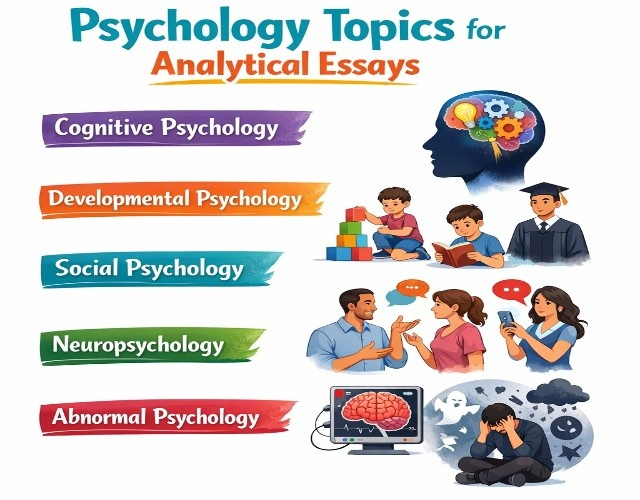
Analytical essays ask how and why something works. You're not arguing for a position; you're examining evidence, breaking down mechanisms, and explaining what the research shows.
Analytical psychology topics ask 'how' and 'why'; they need enough research evidence to actually break something down.
Cognitive Psychology
- How do cognitive biases affect everyday decision-making? Rich research base; analyzes specific biases with real examples.
- How does memory encoding affect long-term retention? Classic cognitive topic with clear processes to analyze.
- Why do humans rely on heuristics even when they lead to errors? Connects to dual-process theory, easily structured analytically.
- How does sleep deprivation affect cognitive performance? Strong experimental literature available.
- What role does attention play in the development of false memories? Specific enough to write a tight analytical essay.
- How does the spacing effect improve long-term learning? Well-supported by experimental research; useful for educational contexts.
- How does working memory capacity affect academic performance? Cognitive load theory provides a clear analytical framework.
- What cognitive mechanisms explain the Dunning-Kruger effect? Well-documented, counterintuitive, and analytically rich.
- How does confirmation bias shape the way people process news? Timely and well-researched.
- How does childhood language acquisition support or challenge nativist theory? Chomsky vs. empiricist debate has strong analytical structure.
Developmental Psychology
- How does childhood attachment style affect adult relationships? Bowlby and Ainsworth give you a strong theoretical foundation.
- How does poverty affect cognitive and emotional development in children? Well-researched with clear causal mechanisms.
- What are the psychological effects of parental divorce on adolescents? Large research base, multiple variables to analyze.
- How does play contribute to social and cognitive development in early childhood? Piaget and Vygotsky provide a clear analytical framework.
- How do peer relationships change during adolescence and why? Developmental milestones provide natural structure.
- How does parenting style influence emotional regulation in children? Connects Baumrind's typology to emotional development research.
- What psychological factors explain why adolescents take more risks than adults? Prefrontal cortex development and reward processing give a clean analytical path.
- How does cultural context shape identity formation in adolescence? Erikson's framework, plus cross-cultural research, makes this analytically strong.
- How does early childhood trauma alter stress response systems? Neuroscience and developmental psychology overlap here productively.
- What are the long-term psychological effects of growing up in a single-parent household? Large dataset available; multiple variables to examine.
Social Psychology
- How does groupthink develop in organizational settings? Janis's research provides a strong analytical structure.
- What are the psychological mechanisms behind the bystander effect? Darley and Latané's work is well-documented.
- How does social comparison theory explain self-esteem fluctuations? Festinger's framework makes this easy to structure.
- How does implicit bias form and persist? Allows analysis of both formation mechanisms and the IAT debate.
- What psychological factors explain obedience to authority? Milgram's research offers deep analytical material.
- How does deindividuation change behavior in crowd situations? Festinger and Zimbardo provide a clear analytical framework.
- How does stereotype threat affect academic performance in minority students? Steele and Aronson's work is well-documented and impactful.
- How does social identity theory explain intergroup conflict? Tajfel and Turner give a strong theoretical base.
- What psychological mechanisms explain why people donate to charity? Altruism, social norms, and moral identity converge interestingly here.
- How does the foot-in-the-door technique work psychologically? Small but well-contained analytical topic with clear experimental literature.
Neuropsychology
- How does the brain process trauma, and what are the long-term effects? Draws on neuroscience and clinical psychology equally.
- What neurological mechanisms explain phobia development? Fear conditioning and amygdala function give a clear analytical path.
- How do neuroplasticity and brain development differ between children and adults? Growing research area with clear mechanisms.
- What is the role of the prefrontal cortex in impulse control? Specific and well-researched.
- How does chronic stress change brain structure and function? Cortisol, hippocampus, and stress research is extensive.
- How do mirror neurons contribute to empathy and social cognition? Contested but analytically interesting research area.
- What neurological processes underlie addiction? Dopamine reward pathways provide a clear analytical structure.
- How does the brain consolidate memories during sleep? Sleep and memory consolidation research is well-established.
Abnormal Psychology
- How do biological and environmental factors interact in the development of schizophrenia? The diathesis-stress model provides a clear analytical framework.
- What psychological mechanisms explain obsessive-compulsive disorder? Cognitive-behavioral models give a strong analytical structure.
- How does borderline personality disorder develop, and what treatments are most effective? DBT research makes this analytically rich.
- What factors predict recidivism in individuals with antisocial personality disorder? Criminal psychology meets clinical research.
- How does post-traumatic stress disorder alter brain function and daily life? Neuroscience and clinical psychology converge clearly.
Psychology Topics for Reflective Essays
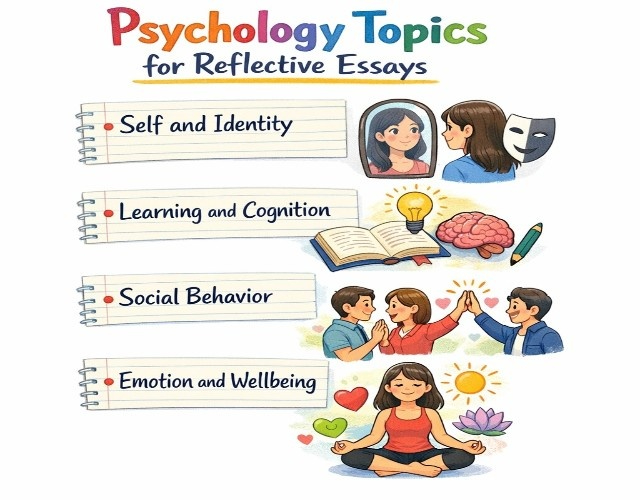
Reflective essays combine your personal experience with psychological theory. The best ones sit at the intersection of something you've genuinely encountered and a concept you can connect it to.
If your course doesn't allow personal reflection, most of these can be reframed analytically, shifting from "reflect on your experience of X" to "analyze the psychological research on X."
The best reflective psychology topics sit at the intersection of personal experience and psychological theory, one without the other is just opinion or just summary.
Self and Identity
- How has your own experience of stress shaped your understanding of stress response theory? Connect lived experience to Selye's GAS model or modern stress research.
- Reflect on a time your self-esteem was affected by social comparison. What does Festinger's theory say about it? Personal and theoretical simultaneously.
- How has a significant relationship shaped your understanding of attachment theory? Bowlby and Ainsworth come alive in a personal context.
- Reflect on a moment when your self-concept changed, how does identity theory explain the shift? Erikson's or Tajfel's frameworks apply well.
- How has your cultural background influenced your understanding of mental health? Cross-cultural psychology and collectivism vs. individualism apply here.
- Reflect on a time your perception of yourself differed from how others saw you, what does the Johari Window say about this? Accessible psychological model for self-reflection.
- How has your relationship with failure shaped your understanding of growth mindset? Dweck's research connects directly to personal academic experience.
Learning and Cognition
- Reflect on a learning experience that challenged your beliefs, how does cognitive dissonance theory explain it? Festinger's framework applies naturally.
- How has a teacher or mentor influenced your learning style, and what does motivational theory say about it? Self-determination theory provides a clear lens.
- Reflect on a time you overcame a fear: how does systematic desensitization or exposure theory explain the process? Behavioral theory meets personal narrative.
- How has your educational experience shaped your understanding of intrinsic vs. extrinsic motivation? Highly relatable for student audiences.
- Reflect on a time when you procrastinated significantly: what psychological mechanisms were at work? Temporal discounting and self-regulation theory apply well.
Social Behavior
- Reflect on a time you observed conformity in a group: what psychological mechanisms do you now recognize? Connects personal observation to Asch and normative social influence.
- How did a childhood experience influence your current emotional regulation style? Connects developmental theory to personal history.
- Reflect on a time you made a decision under social pressure: which psychological theories apply? Opens up conformity, obedience, and groupthink.
- Reflect on a time you experienced or witnessed the bystander effect. Darley and Latané come alive in a personal context.
- How has observing a family member's mental health struggle affected your understanding of stigma? Connects to labeling theory and mental health research.
- Reflect on a group project gone wrong: how do social loafing and groupthink explain what happened? Relatable to most students.
- How has media consumption shaped your self-image, and what does social comparison theory say about it? Directly applicable to most students.
Emotion and Wellbeing
- Reflect on how your perspective on a person changed after learning more about them: what does this reveal about impression formation? First impressions, halo effect, and schema theory.
- How has experiencing or witnessing failure shaped your understanding of attribution theory? Weiner's attribution model works well in reflective essays.
- Reflect on a time you felt genuine empathy: what does psychological research say about how empathy develops? Connects personal experience to empathy research.
- How has a significant loss shaped your understanding of grief, and how does Kübler-Ross's model apply? Sensitive but rich theoretical connection.
- Reflect on a time you felt significant anxiety: how does cognitive appraisal theory explain your response? Lazarus's model provides a structured reflective framework.
Psychology Topics for Case Study Essays
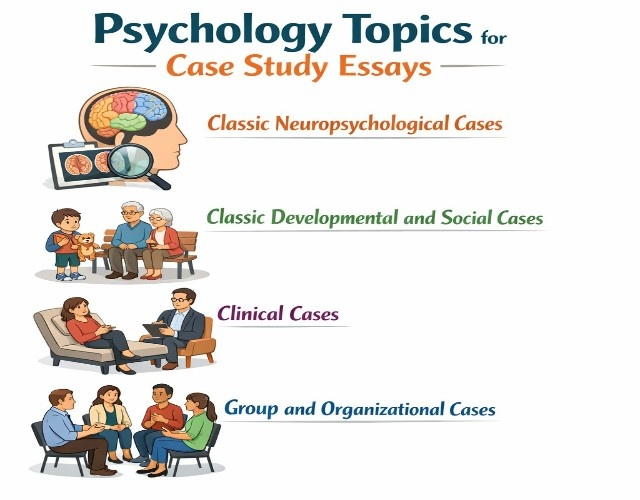
Case study essays focus on one individual, group, or event in depth. There needs to be enough documented material. Famous cases are famous for a reason; the documentation exists.
"A case study essay only works if enough documented information exists; famous cases in psychology are famous for a reason."
Classic Neuropsychological Cases
- Phineas Gage and the neuroscience of personality change. One of the most documented cases in psychology history connects to frontal lobe function.
- H.M. (Henry Molaison) and the study of memory formation. Foundational case for understanding the hippocampus and long-term memory.
- Patient Tan (Broca's aphasia) and the discovery of language processing. Connects to localization of function in the left hemisphere.
- Clive Wearing and the extreme limits of anterograde amnesia. Deeply documented; connects to episodic vs. procedural memory.
- Patient E.V.R. and the role of emotion in decision-making. Damasio's somatic marker hypothesis; connects emotion to cognition
Classic Developmental and Social Cases
- Genie Wiley and critical periods in language development. Tragic but extraordinarily well-documented; connects to Chomsky's language acquisition theory.
- The Stanford Prison Experiment and the psychology of authority. Zimbardo's study, including methodological controversies, makes for a rich case study.
- The Milgram obedience experiments as a case study in compliance. Situational influence on behavior; methodological ethics debate.
- The Bobo Doll experiments and social learning theory. Bandura's research directly supports or challenges aggression theories.
- Anna O. and the development of psychoanalytic theory. Freud and Breuer's early case; connects to psychodynamic history.
- Little Albert and classical conditioning in emotional responses. Watson and Rayner's foundational (and controversial) study.
- The case of Kitty Genovese and the bystander effect. Original case study that inspired Darley and Latané's research.
Clinical Cases
- Sybil and the controversy around dissociative identity disorder. Good for examining both the diagnosis and the methodological concerns.
- David Reimer and the nature vs. nurture debate on gender identity. One of the most discussed cases in developmental psychology.
- Chris Sizemore (Eve White) and the evolution of DID diagnosis. Historical perspective on how clinical understanding develops.
- The Rosenhan experiment ("On Being Sane in Insane Places"). Treats the experiment as a case study of psychiatric labeling and diagnostic reliability.
- John Nash and the lived experience of schizophrenia. Well-documented through autobiography and clinical records.
- Sigmund Freud's case of Dora, examining the early psychoanalytic method. Good for analyzing both psychodynamic theory and its limitations.
- The case of "Anna O." and the development of the talking cure. Foundational for understanding how psychotherapy began.
Group and Organizational Cases
- The Jonestown massacre as a case study in cult psychology and obedience. Documented group behavior under extreme situational pressure.
- NASA's Challenger disaster and organizational groupthink. Janis's groupthink theory applied to a real-world institutional failure.
- The Abu Ghraib scandal as a case study in deindividuation. Connects Zimbardo's situationist theory to a contemporary event.
- Enron's collapse as a case study in organizational psychology and moral disengagement. Bandura's moral disengagement framework applies directly.
Let a Pro Handle Your Psychology Essay
You've found the topic, now let our writers do the heavy lifting.
3-hour rush delivery available when deadlines are tight
Easy Psychology Essay Topics (Good Starting Points for Any Level)
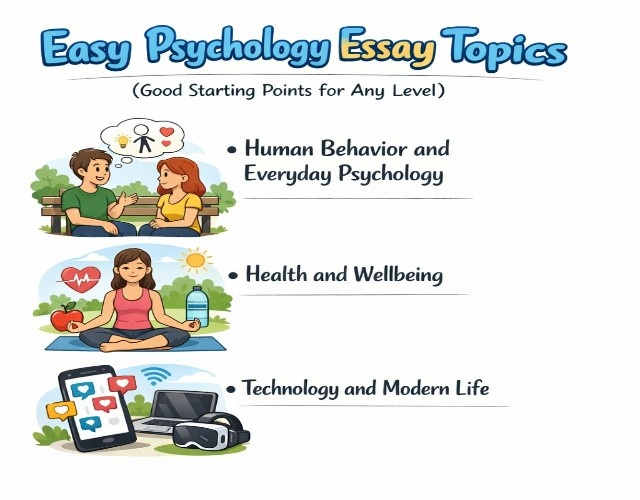
Easy doesn't mean shallow. It means the research is accessible, the scope is manageable, and you won't spend three days just trying to find sources.
"Easy doesn't mean shallow; it means the research is accessible and the scope is manageable for the word count."
Human Behavior and Everyday Psychology
- The psychology of procrastination. Huge research base, relatable premise, easy to connect theory to real behavior.
- How does color affect mood? Classic environmental psychology topic with accessible studies.
- The bystander effect in everyday life. Darley and Latané's research is well-documented and easy to apply.
- Why do people believe in conspiracy theories? A growing body of accessible research on motivated reasoning and epistemic anxiety.
- The psychology of first impressions. Thin-slicing, snap judgments, and the halo effect are well-covered in accessible sources.
- How does music affect emotional states? Lots of experimental research, highly relatable topic.
- What is the placebo effect, and how does it work? Well-documented; covers the mind-body connection without requiring specialist knowledge.
- The psychology of habit formation. Duhigg's popular work, plus academic research, makes sourcing straightforward.
- How does sleep affect mental health? Extensive research, clear causal relationships to discuss.
- Why do humans fear public speaking more than death? Connects to social anxiety and threat appraisal; well-researched and accessible.
- The psychology of laughter and humor. Social bonding and stress relief research is surprisingly rich and accessible.
- How does exercise affect mental health? Strong experimental literature, practical angle students can relate to.
- What is impostor syndrome and who experiences it? Growing research base, highly relatable for student audiences.
- The psychological effects of social isolation. Well-researched, especially post-2020.
- How does gratitude practice affect wellbeing? Positive psychology research base; Seligman's work is accessible.
- Why do people conform to fashion trends? Social influence, identity, and conformity all apply, a light topic with real theory.
- The psychology of gift-giving. Social norms, reciprocity, and attachment theory apply in accessible ways.
- Why do people get road rage? Frustration-aggression hypothesis, anonymity, and deindividuation all apply.
- How does humor function as a coping mechanism? Accessible positive psychology and stress research.
- What makes a joke funny? The psychology of humor. Incongruity theory and relief theory provide approachable frameworks.
Health and Wellbeing
- The psychology of eating disorders. Large accessible research base; manageable for a focused essay.
- How does chronic pain affect mental health? The biopsychosocial model applies directly; well-researched.
- What is the relationship between self-esteem and academic performance? Classic educational psychology topic with a large dataset.
- How does mindfulness reduce stress? Growing experimental literature; accessible and practical.
- The psychological effects of caffeine on mood and performance. Manageable scope, accessible research, and relatable to students.
- Why do people resist going to therapy even when they need it? Stigma, self-reliance, and cultural norms, accessible research available.
- How does nature exposure affect mental health? Attention restoration theory and stress recovery research are accessible.
- The psychology of body image in men. Underexplored but growing research base; good original angle.
Technology and Modern Life
- How does smartphone use affect attention spans? A growing research area, directly relevant to student life.
- The psychology of social media "likes" and validation-seeking behavior. Dopamine, social approval, and variable reward schedules apply.
- How does online anonymity change behavior? Disinhibition effect research is accessible and well-documented.
- The psychology of online dating. Parasocial relationships, mate selection, and self-presentation all apply.
- Does doomscrolling affect mental health? Recent research area, highly relatable, manageable scope.
- The psychology of video game addiction. Accessible and growing research connects to reward systems and escapism.
| Once you've landed on your topic, psychology essay examples can show you how strong essays are structured before you start writing. |
Bonus: Psychology Topics by Sub-Fields
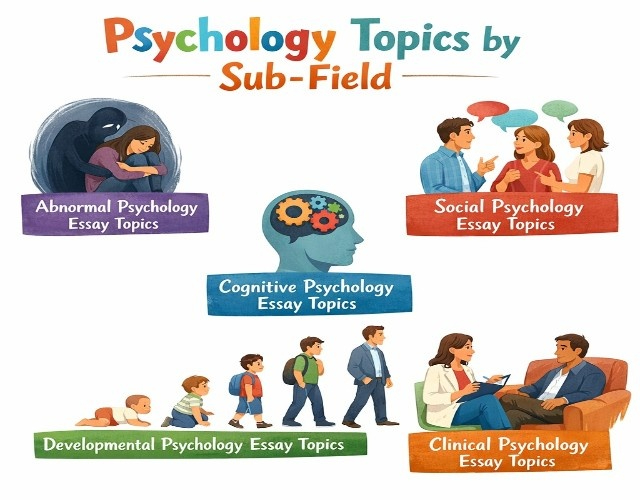
If your assignment asks you to work within a specific area of psychology, here's a quick-reference list of topics by sub-field.
Abnormal Psychology Essay Topics
- The role of genetics vs. environment in the development of bipolar disorder
- How childhood trauma contributes to the development of borderline personality disorder
- What distinguishes normal grief from clinical depression?
- The psychological impact of long-term institutionalization
- How does anxiety manifest differently across cultures?
- What are the most effective treatments for PTSD, and why?
- How do eating disorders develop in adolescents?
- The relationship between substance use and underlying mental health conditions
Social Psychology Essay Topics
- How does prejudice develop and persist despite education?
- The role of social media in the spread of misinformation
- How do in-group and out-group dynamics fuel conflict?
- What makes propaganda psychologically effective?
- The psychology of altruism, are humans naturally helpful?
- How does social class shape psychological development?
- What role does empathy play in reducing discrimination?
- The psychology of mob mentality
Cognitive Psychology Essay Topics
- How does divided attention affect memory formation?
- What is the role of schemas in shaping perception?
- How does emotion influence rational decision-making?
- The psychology of creativity, what makes someone creative?
- How does cognitive load theory apply to classroom learning?
- What is the relationship between language and thought?
- How do intrusive thoughts develop in OCD?
- The limits of working memory and their implications for learning
Developmental Psychology Essay Topics
- How does early childhood neglect affect emotional development?
- The role of play in cognitive development across cultures
- How does gender socialization differ by culture?
- The psychological effects of helicopter parenting
- How do adolescents develop moral reasoning?
- What factors predict healthy aging in older adults?
- The psychological impact of growing up with a chronic illness
- How does sibling rivalry shape personality?
Clinical Psychology Essay Topics
- How effective is cognitive-behavioral therapy for depression?
- What ethical issues arise in clinical psychology practice?
- The role of the therapeutic alliance in treatment outcomes
- How does stigma affect help-seeking behavior?
- What are the psychological effects of solitary confinement?
- The challenges of diagnosing personality disorders
- How does cultural background affect the experience and expression of mental illness?
- What is the evidence base for mindfulness-based cognitive therapy?
Tips For Picking a Psychology Essay Topic That Actually Works
Before you pick anything from the lists below, run any candidate topic through three quick checks.
Match it to your essay type first.
An argumentative topic needs a debatable claim, two reasonable sides, not just a fact everyone accepts. A reflective topic needs personal relevance. An analytical topic needs enough research evidence that you can actually break something down. If you grab a topic without thinking about the type first, you'll often find it doesn't fit the task once you're 500 words in.
Check if the research is there.
Before committing, search Google Scholar or PsycINFO for your topic. If you can't find three credible academic sources in five minutes, the topic is probably too narrow or too obscure for an essay. Save the more niche angles for when you have more time.
Narrow it down
"Social media" is a field, not a topic. "How Instagram use correlates with self-esteem in teenage girls" is a topic. The more specific your focus, the easier it is to build a coherent argument and stay within your word count.
The best psychology essay topic is the one you can argue in the word count you have, not the most impressive-sounding one.
Conclusion
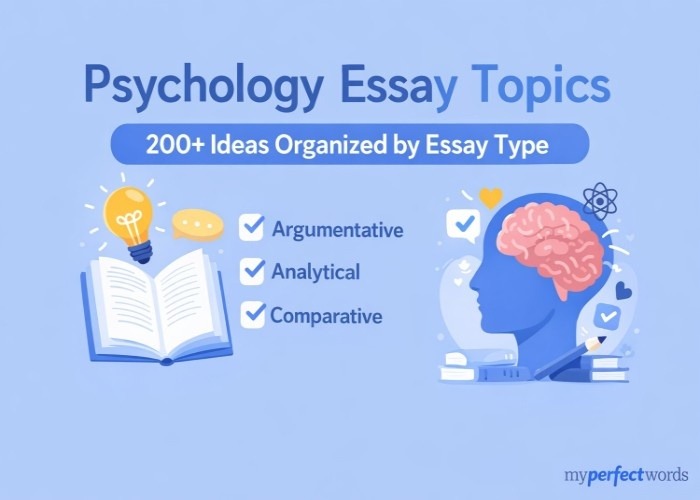
Choosing the right psychology essay topic is the first step toward writing a strong and engaging paper. With over 200 psychology essay topics organized by essay type, you now have a wide range of ideas to match your academic level, assignment requirements, and personal interests.
Whether you’re working on an argumentative, research, or analytical psychology essay, selecting a focused topic makes research easier and strengthens your overall argument.
Use this list to find inspiration, narrow your focus, and start building a well-structured psychology essay backed by credible evidence and critical thinking.
Submit a Psychology Essay You're Proud Of
Hand it to a human expert and get it done right.
- Subject-matched writers with psychology expertise
- Every paper Turnitin and Originality.ai clean
- Rush options from 3 hours available
- Free revisions until you're satisfied
Your deadline. Your grade. Zero AI shortcuts.
Get Expert Help