-20338.jpg)
Understanding the AP Lang Rhetorical Analysis Essay Format
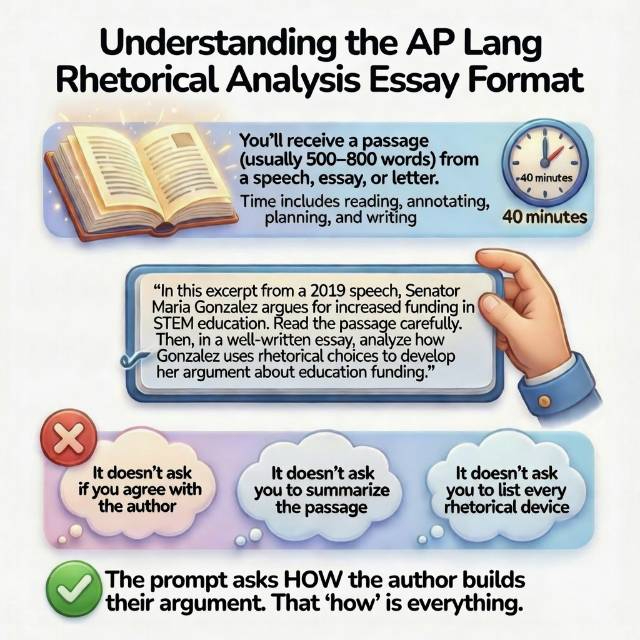
The rhetorical analysis is the second essay on your AP Language exam. You'll receive a passage (usually 500-800 words) from a speech, essay, or letter. Your job is to analyze how the author uses rhetorical strategies to achieve their purpose.
You have 40 minutes for this essay. That includes reading, annotating, planning, and writing.
The passage will come with a prompt that looks something like this:
"In this excerpt from a 2019 speech, Senator Maria Gonzalez argues for increased funding in STEM education. Read the passage carefully. Then, in a well-written essay, analyze how Gonzalez uses rhetorical choices to develop her argument about education funding."
Notice what the prompt does NOT ask you to do:
- It doesn't ask if you agree with the author
- It doesn't ask you to summarize the passage
- It doesn't ask you to list every rhetorical device
The prompt asks how the author builds their argument. That "how" is everything.
| For a comprehensive understanding of rhetorical analysis fundamentals, check out our guide on how to write a rhetorical analysis essay. |
The AP Lang Rhetorical Analysis Rubric Breakdown
This is where most students get confused. The rubric has three rows, but they're not weighted equally. Understanding this rubric is the difference between a 3 and a 6.
The 6-Point Scale
Rubric Row | Maximum Points | What It Measures |
Thesis | 1 point | Do you have a defensible thesis about the author's rhetorical choices? |
Evidence and Commentary | 4 points | Can you support your claims with specific evidence AND explain how it works? |
Sophistication | 1 point | Do you demonstrate complex understanding beyond the obvious? |
Total: 6 points possible
Notice that Evidence and Commentary is worth 4 out of 6 points. This is where you'll win or lose your score. You can have a perfect thesis and still score a 3 if your evidence and commentary are weak.
Thesis Row (1 Point)
To earn this point, your thesis must:
- Make a defensible claim about the author's rhetorical choices
- Respond directly to the prompt
- Appear somewhere in your introduction
What earns the point: "Through her use of personal anecdotes, statistical evidence, and appeals to shared American values, Gonzalez establishes both emotional connection and logical credibility to convince her audience that STEM funding is essential for national progress."
What doesn't: "Gonzalez uses many rhetorical strategies to make her argument." (Too vague) "Gonzalez is correct that we need STEM funding." (That's your opinion, not analysis)
You'll notice the winning thesis names specific strategies and connects them to what the author achieves. That's the formula.
| For more on crafting effective thesis statements, see our rhetorical analysis essay outline guide. |
Evidence and Commentary Row (4 Points)
This is the heart of your essay. Here's how the scoring works:
4 points (highest):
- Multiple pieces of specific evidence from the passage
- Consistent and insightful commentary that explains how the evidence supports your thesis
- Clear connection between rhetorical choices and their effects
- Evidence is integrated smoothly (not just listed)
3 points:
- Adequate evidence
- Commentary is sometimes clear but often underdeveloped
- Some connection between choices and effects, but not consistent
2 points:
- Limited evidence
- Little to no commentary
- Mostly summary instead of analysis
1 point:
- Minimal or no evidence
- No meaningful commentary
- May only address prompt superficially
| The key difference between 4 and 3: Commentary depth. |
Let's see this in action:
2-point approach (summary): "Gonzalez uses statistics in her speech. She mentions that 'STEM jobs have grown 79% since 2000.' This shows that STEM is important."
3-point approach (basic analysis): "Gonzalez strengthens her argument by including the statistic that 'STEM jobs have grown 79% since 2000.' This data helps prove her point that STEM education matters."
4-point approach (insightful commentary): "Gonzalez strategically opens her second paragraph with the statistic that 'STEM jobs have grown 79% since 2000,' immediately grounding her emotional appeals in concrete data. By quantifying the job market shift, she transforms her argument from abstract educational theory into urgent economic reality. This number doesn't just support her claim that STEM funding matters; it suggests that communities without STEM education are already falling behind in a rapidly evolving economy."
See the difference? The 4-point version doesn't just say what the evidence is. It explains why the author chose this strategy, what effect it creates, and how it serves the larger argument.
| Want to see more examples of high-scoring rhetorical analysis? Check out our rhetorical analysis essay examples with scoring breakdowns. |
Sophistication Row (1 Point)
This is the hardest point to earn, and many students won't get it. But if you're aiming for a 6, you need to understand what "sophistication" means to AP readers.
You can earn this point by doing ONE of the following:
- Explaining the significance of the rhetorical situation (historical context, audience, occasion)
- Exploring complexities or tensions in the author's argument
- Using a coherent line of reasoning that illuminates the argument's structure
- Employing vivid and persuasive style in your own writing
What sophistication is NOT:
- Using big vocabulary words
- Listing 15 different rhetorical devices
- Writing a longer essay
| What sophistication IS: "While Gonzalez appeals primarily to logos through data, her strategic placement of personal anecdotes reveals an awareness that her predominantly conservative audience may distrust government statistics. By opening with her own daughter's STEM success story before introducing policy numbers, she establishes ethos as a concerned parent rather than a distant politician, effectively preempting skepticism of her later statistical claims." |
This demonstrates sophistication because it:
- Recognizes the rhetorical situation (conservative audience)
- Identifies a strategic choice (personal story before data)
- Explains the sophisticated reasoning behind that choice
- Shows understanding of how arguments actually persuade people
| For a deeper dive into rhetorical appeals, see our guide on ethos, pathos, and logos. |
Write Your AP Lang Rhetorical Analysis in 40 Minutes
Time management is critical. You cannot write a strong essay if you're rushing. Here's the timing breakdown that works:
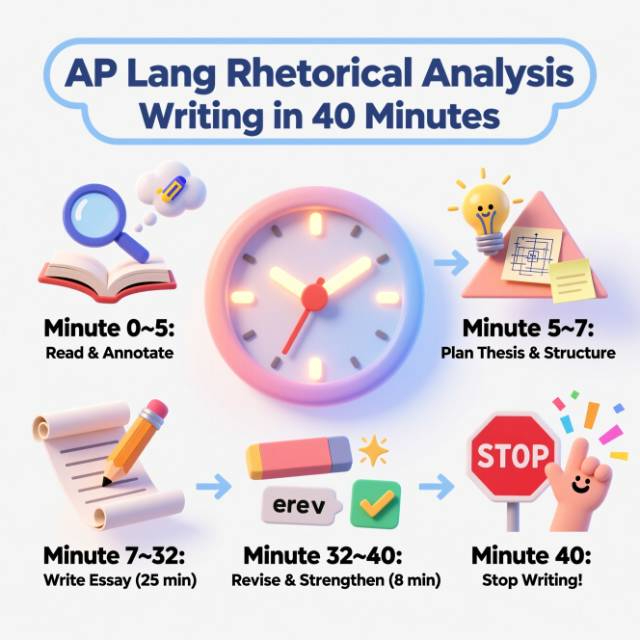
Minute 0-5: Read and Annotate
Goal: Understand the author's argument and identify 3-4 major rhetorical strategies.
Don't try to mark every single device. Focus on:
- What is the author's main claim or purpose?
- Who is the audience?
- What's the context (occasion, time period, setting)?
- What 3-4 big strategies stand out? (Don't obsess over naming them)
Annotation Strategy:
- Underline the thesis/main claim
- Circle 3-4 strong examples of rhetorical choices
- Note audience clues in margins
- Mark clear shifts in tone or strategy
You're not writing yet. You're just understanding what you're working with.
Minute 5-7: Plan Your Thesis and Structure
Goal: Write down your thesis and decide your 2-3 body paragraph topics.
Your thesis should follow this pattern: "Through [strategy 1], [strategy 2], and [strategy 3], [Author] [achieves purpose] for [audience]."
| Example: "Through personal anecdotes, statistical evidence, and appeals to shared values, Gonzalez persuades her audience that STEM funding is both personally relevant and nationally critical." |
Then plan your paragraphs:
- Body 1: Personal anecdotes (ethos/pathos)
- Body 2: Statistical evidence (logos)
- Body 3: Shared values (pathos/ethos)
Don't write full sentences yet. Just note what each paragraph will cover.
Minute 7-32: Write Your Essay (25 minutes)
Goal: Get your analysis on paper with clear evidence and strong commentary.
Introduction (3 minutes):
- Context: Who wrote this, when, why?
- Thesis: Your claim about their rhetorical choices
- Keep it short (4-5 sentences max)
Body Paragraphs (18 minutes, ~6 minutes each):
Each body paragraph should follow this structure:
- Topic sentence - What strategy are you analyzing?
- Evidence - Specific quote or example from text
- Commentary - HOW does this work? WHY did author choose this? WHAT effect does it create?
- Second evidence - Another quote or example
- Second commentary - Again, explain the how/why/what
- Connection back to thesis - How does this support your overall claim?
Conclusion (4 minutes):
- Restate thesis in different words
- Briefly mention how the strategies work together
- End with insight about the argument's effectiveness
Don't waste time on a fancy conclusion. A strong body paragraph beats a weak conclusion every time.
Minute 32-40: Revise and Strengthen (8 minutes)
Goal: Make your essay better, not just fix typos.
First pass (5 minutes): Strengthen commentary
- Find every piece of evidence
- Check: Did I explain HOW it works?
- Add one more sentence of analysis where commentary is thin
- Replace weak verbs ("shows," "uses") with precise ones ("establishes," "undermines," "amplifies")
Second pass (3 minutes): Fix errors and polish
- Read introduction and thesis aloud - does it make sense?
- Check that you spelled the author's name correctly every time
- Fix obvious grammar errors
- Make sure every quote has quotation marks
You're not rewriting. You're making targeted improvements where it matters.
Minute 40: Stop Writing
Put your pen down. Seriously. An incomplete essay that's well-written in the sections you did complete scores better than a rushed, sloppy ending.
Common Mistakes in AP lang Exams That Cost Points
These mistakes show up in every scoring session. Fix these and you'll immediately improve.
Mistake #1: Listing Devices Instead of Analyzing Effect
What students do: "The author uses metaphor, anaphora, and parallelism in this section."
What you should do: "By repeating the phrase 'we must' at the start of three consecutive sentences, Gonzalez creates a sense of urgency and shared responsibility. This anaphora transforms her policy suggestions from debatable proposals into moral imperatives that her audience cannot ignore."
AP readers don't care that you know the word "anaphora." They care that you understand why repetition works in this context.
Mistake #2: Weak Commentary That Just Restates
Weak: "This statistic supports her argument that STEM funding is important."
Strong: "This statistic doesn't just support her point - it reframes the debate. By showing that STEM jobs grew 79% while other sectors remained flat, Gonzalez transforms education funding from a feel-good investment into an economic survival strategy. Her audience isn't just convinced; they're scared of being left behind."
| The difference? The weak version says "this proves her point." The strong version explains the specific mental shift this creates in the audience. |
Mistake #3: Focusing on What the Author Says, Not How
What's not analysis: "Gonzalez talks about her daughter's experience in robotics club. She explains how the program changed her daughter's career path and gave her confidence. This shows that STEM programs are valuable."
What is analysis: "By opening with her daughter's story rather than with statistics or policy arguments, Gonzalez immediately personalizes an abstract debate. Before her audience can retreat into political skepticism about government spending, they're already emotionally invested in a teenager's success.
The strategic placement of this anecdote;
- Before any mention of budgets or legislation
- Lets her establish credibility as a concerned parent rather than a distant politician."
The first version summarizes content. The second analyzes rhetorical strategy.
Mistake #4: Forgetting About the Audience
Every rhetorical choice is made for a specific audience. If you don't mention who the author is trying to persuade and why certain strategies work on that audience, you're missing sophistication points.
Generic: "Gonzalez uses emotional appeals to make her argument stronger."
Audience-aware: "Writing for a predominantly conservative audience skeptical of government spending, Gonzalez carefully grounds her emotional appeals in traditional family values and personal responsibility rather than government mandates. Her emotional language focuses on parents' desires for their children's success, a value that transcends political divisions."
Mistake #5: Treating the Essay Like a Book Report
You're not summarizing what happens in the passage. You're analyzing how the author persuades.
Wrong: "First, Gonzalez talks about her daughter. Then she gives statistics about STEM jobs. After that, she discusses education policy. Finally, she ends with a call to action."
Right: "Gonzalez structures her argument to build trust before making demands. The personal anecdote establishes her as a relatable parent, the statistics ground her claims in data, and only after securing both emotional connection and logical credibility does she ask her audience to support specific funding measures."
Mistake #6: Using Vague Language
Vague: "This makes the reader feel emotion."
Specific: "This creates a sense of urgency and moral obligation in readers who might otherwise dismiss education funding as a distant policy issue."
Vague: "The author's tone is persuasive."
Specific: "The author shifts from an informal, conversational tone in her opening anecdote to measured, data-driven language in her body paragraphs, strategically adjusting her voice to match what each section demands."
AP readers are looking for precise analysis, not general observations.
Mistake #7: Running Out of Time and Rushing the End
This happens when you spend too much time on annotation or write three weak paragraphs instead of two strong ones.
Prevention:
- Stick to the 5-25-8-2 timing breakdown
- If you're running short on time at minute 30, write a strong third body paragraph instead of a weak conclusion
- Practice timed essays until you can consistently finish in 40 minutes
| If you're looking for more practice material, check out our collection of rhetorical analysis essay topics. |
Bottom Line: Key Takeaways
You now understand what AP readers want. Here's your action plan:
This week: Find a past AP prompt, set a 40-minute timer, and write using the 5-25-8-2 breakdown. Score yourself honestly using the rubric.
Next two weeks: Write 2-3 timed essays weekly. Focus on your weakest rubric row. If your commentary is thin, do the "So what?" exercise. If your thesis is vague, practice writing thesis statements for 10 different prompts.
One month before exam: Do full practice exams under test conditions. Time all three essays. Build your stamina. Review your scored essays and identify patterns in your mistakes.
Week before exam: Review the rubric one more time. Practice the 5-25-8-2 timing with one or two more essays. Get comfortable with the format. Trust your preparation.
The AP Lang rhetorical analysis is completely learnable. It's not about innate writing talent. It's about understanding the rubric and practicing until analysis becomes automatic. You've got the tools. Now practice.
Ready to See a Perfect Score? Get a professionally written AP Lang rhetorical analysis essay that demonstrates every scoring element. Get your model essay and improve your score with proven examples.