What Does "Capstone" Mean?
The word "capstone" comes from architecture. It's the final stone placed at the top of an arch or wall, the piece that locks everything else into place and signals the structure is complete. Programs use this metaphor deliberately.
Your capstone isn't just another assignment. It's the piece that holds your whole degree together. The idea is that by the time you reach it, you've accumulated enough knowledge and skill that you can actually do something meaningful with it.
What Is a Capstone Project? (The Definition)
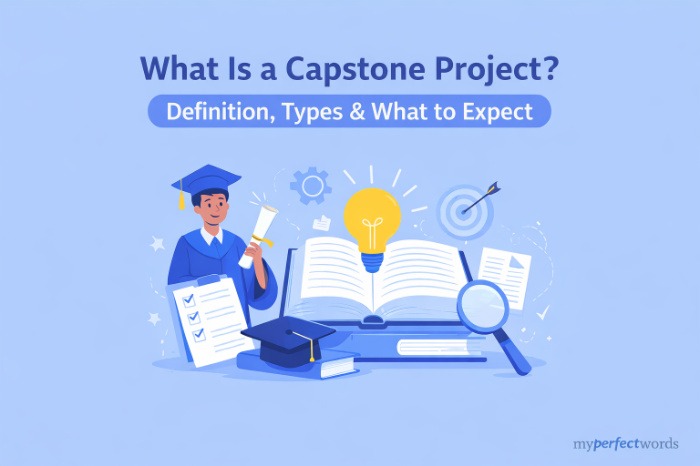
A capstone project is a multi-phase, semester-long (or longer) academic assignment that requires you to identify a real-world problem, apply the knowledge and skills from your program, and produce a substantial, demonstrable result, typically a research paper, case study, presentation, or portfolio.
It's different from a regular course assignment because the scope is much larger, the stakes are higher, and the outcome is meant to reflect your readiness for professional practice. You're not just showing that you understood the material. You're showing that you can use it.
For graduate students, especially, a capstone is the defining output of your degree. Your program director, advisor, and often an external committee will evaluate it. It's the last major hurdle before you're done.
What Types of Capstone Projects Are There?
Capstone projects look different depending on your program. Here are the five most common types:
Type | What It Involves |
Research Paper / Thesis-Style | Literature review, original research question, methodology, findings, and analysis. Common in academic and research-oriented programs. |
Case Study | Deep analysis of a real organization, policy, or situation using your program's framework. Common in MBA, MPA, and law programs. |
Portfolio | A curated collection of your work across the program, with reflection and analysis. Common in education, design, and communications. |
Group / Team Project | Collaborative capstone where teams tackle a client problem or design challenge. Common in business and engineering programs. |
Internship or Practicum | Field-based work combined with a reflective paper or presentation. Common in nursing, social work, and clinical programs. |
The type required depends entirely on your program. Your department will specify which format applies; you don't get to choose.
According to Coursera's overview of capstone programs, program-specific requirements vary widely even within the same degree type.
How Is a Capstone Different from a Thesis?
This is the question almost every new grad student asks, and it's worth getting right.
Capstone | Thesis | |
Focus | Applied, practical | Theoretical, original research |
Goal | Demonstrate professional competency | Contribute new knowledge to the field |
Research | Often uses existing research to solve a problem | Requires original research and methodology |
Output | Project, case study, portfolio, or report | Scholarly manuscript for an academic audience |
Advisor role | Guiding, often less intensive | Closely involved throughout |
Audience | Program faculty, sometimes industry | Academic community |
The short version: a thesis is about generating new knowledge. A capstone project is about applying the knowledge you already have. Both are serious, time-consuming commitments, but they demand different things from you.
If your program offers a capstone vs. thesis track, your choice should reflect whether you're headed toward practice or academia.
Don't Let Your Capstone Stall Your Degree MyPerfectWords has helped countless students get their capstone done right. No AI. No stress.
What Does a Capstone Project Involve? (The General Process)
Most capstone projects follow a similar progression, even if the specific requirements vary by program. Here's what the journey typically looks like:
Topic Selection. You start by identifying a problem, question, or area worth exploring. This is harder than it sounds. The topic has to be specific enough to be manageable but substantial enough to fill a full project.
If you want guidance on narrowing it down, our guide on capstone project topics walks through this step by step.
Proposal. Before you do any real work, you need approval. Your proposal outlines what you plan to do, why it matters, and how you'll do it. Committees take proposals seriously; a weak proposal can stall your whole project.
If you're not sure how to structure yours, take a look at our breakdown of how to write a capstone project proposal.
Research and Outlining. Once your proposal is approved, you move into research and structuring your project. This is where the actual work begins, gathering sources, analyzing data, and building your argument or framework.
A clear capstone project outline at this stage saves you significant time later.
Writing and Development. You write, build, or produce the capstone itself. For most programs, this means drafting, getting advisor feedback, revising, and refining until the committee is satisfied.
Presentation or Defense. Most programs require a final presentation or formal defense. You'll present your work to faculty, a committee, or sometimes an external panel and respond to questions.
Who Has to Do a Capstone Project?
Capstones aren't exclusive to graduate school, but they're most common there. Here's a breakdown of where you're likely to encounter one:
Undergraduate level: Many bachelor's programs, particularly in honors tracks, education, nursing, and business, require a capstone or senior thesis in the final year.
Graduate level: Capstones are standard in a wide range of master's programs, including MBA, MSN (Nursing), EdD (Education), MPA (Public Administration), MEd, MSIT, and MPH (Public Health), among others.
National University notes that graduate-level capstones typically carry more weight in program assessment than undergraduate versions.
At the graduate level, the rigor is substantially higher. You're expected to demonstrate a command of your field, engage with current literature, and produce something that reflects professional-level thinking. It's not a research paper turned up to eleven; it's a different category of work.
What Makes a Capstone Project Challenging?
Knowing what to expect helps. Here are the things that trip people up most often:
- Scope management. Capstone projects are open-ended by design, which means it's easy to start too broad and run out of time, and then narrow down. Defining your scope early and sticking to it is critical.
- Topic selection. Finding a topic that's specific, researchable, program-relevant, and personally sustainable over several months is genuinely difficult. Most students underestimate this step.
- Advisor dynamics. Your relationship with your advisor shapes the whole experience. Slow feedback cycles, misaligned expectations, or unclear guidance can derail your timeline.
- Time pressure. Capstones run alongside other coursework, jobs, and life. Managing a long-horizon project while keeping up with everything else is one of the real challenges.
- Original contribution. Many programs expect you to add something, a new analysis, a novel application, a fresh perspective, not just summarize what's already out there. Figuring out what your contribution is takes real intellectual effort.
If any of these feel familiar, or you're realizing your timeline is tighter than you thought, that's a normal response to a genuinely hard project.
Ready to Get Your Capstone Done?
Join thousands of students who trusted MyPerfectWords with their final project.
- Human-written from scratch, every page passes AI detection.
- Writers with Master's and PhD credentials in your field.
- Free revisions until you're satisfied.
- Serving students since 2010 with a 4.8/5 satisfaction rating.
Get started in minutes.
Place an Order