What Is a Capstone Project Outline?
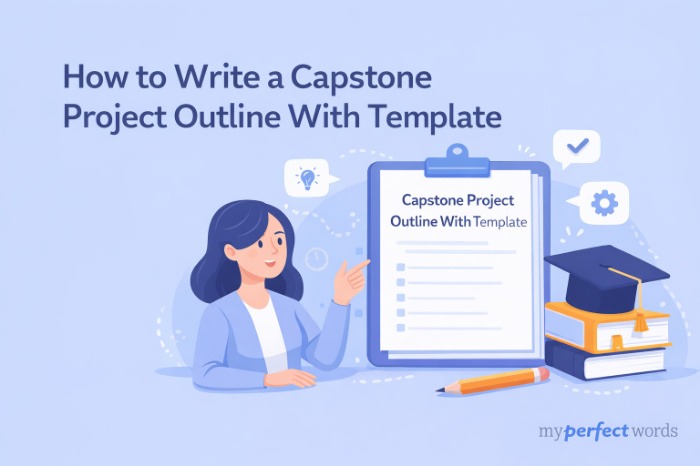
A capstone project outline is the structural framework for your capstone paper; it maps every major section before you write a single word, giving you and your advisor a clear picture of where the project is headed.
It matters for three practical reasons. First, it locks you into a research direction early, so you're not drifting mid-project. Second, it keeps your advisor aligned with your approach before you've invested 40 hours writing. Third, it prevents scope creep, one of the most common reasons capstone projects run over deadline.
Think of it as the blueprint your whole project is built on; skip it, and you'll be rewriting instead of refining.
Your outline isn't the same as your capstone project. So, if you want to what is a capstone project check out our guide. This is the section-by-section skeleton your actual paper hangs on.
What Goes in a Capstone Project Outline?
Most graduate capstone projects follow a standard set of sections. Here's what each one covers:
1. Title Page
Your project title, name, program, institution, and date. Keep it clean. Your program will have a specific format, so check before you finalize it.
2. Introduction
This is where you state your research question or problem, define the scope of your project (what you'll cover and what you won't), and explain why the work matters in your field. A strong introduction sets up every section that follows.
3. Literature Review
A summary of the existing scholarship in your topic area. This shows your committee that you've engaged with the field and that your project addresses a genuine gap. Graduate programs expect this; don't treat it as optional.
4. Methodology
How you'll actually conduct the research or complete the project. This varies by capstone type: qualitative interviews, quantitative surveys, mixed methods, a practicum log, and a case study analysis. What goes here depends on your program's format.
5. Expected Results/Projected Outcomes
What outcomes do you anticipate finding, and why? At the outline stage, this doesn't need to be definitive; it just needs to show that your methodology will produce something meaningful.
6. Discussion/Analysis
How do you plan to interpret and analyze your findings in relation to your research question? The framework or theory you'll use belongs here.
7. Conclusion
A summary of your expected contributions, the implications for practice or policy in your field, and the recommendations you anticipate making.
8. References/Bibliography
The citation style depends on your program. APA is most common for graduate work, but check your program handbook; some fields use Chicago, MLA, or a discipline-specific style.
Keep each section description tight at the outline stage. You're mapping what goes where. The step-by-step guide below covers how to build each section.
How to Write a Capstone Project Outline: Step-by-Step
Step 1: Confirm Your Capstone Format
Research paper, case study, practicum report, or applied project? The format determines how much weight each section carries and whether you need additional components that your program requires. Check your program handbook before you build a single header.
Step 2: Define Your Research Question First
Your outline is only as strong as your research question. Write it out in one sentence before filling in any section. If you can't state your question in a sentence, your scope isn't clear yet, and that's going to cause problems the moment you start writing.
Everything in your outline should connect back to that one question. If a section can't answer "how does this relate to my research question?" it probably doesn't belong.
Step 3: Draft Your Section Headers
Use the standard sections above as your starting point. Add or remove based on your program's specific requirements; some programs require an executive summary, an abstract, or a detailed project timeline. Don't assume the generic template is complete until you've compared it against your program handbook.
Step 4: Add Bullet Notes Under Each Section
You don't need full sentences yet. Jot down 3-5 bullet points per section covering what you plan to include. This is your working outline, not your finished paper. Getting ideas out in bullet form is faster and easier to restructure than full paragraphs.
Step 5: Check for Logical Flow
Read through your section notes in order. Does each section set up the next? Introduction leads into Literature Review, which justifies your Methodology, which connects to your Expected Results. If something feels out of place, move it now; it's far easier to restructure an outline than a drafted chapter.
Step 6: Get Advisor Sign-Off Before You Write
Your outline is your first real checkpoint. Most advisors will flag structural issues at the outline stage, and that's exactly what you want. A 30-minute conversation about your outline is much easier to fix than a revision request after you've written 60 pages.
Skip the Outline Stress, We've Got You Our graduate-level writers handle everything from outline to final submission. Countless students helped since 2010. Your capstone is next.
Capstone Project Outline Template
This is the section most students come here for. Copy it, fill in your details, and adapt it to your program's requirements.
CAPSTONE PROJECT OUTLINE TEMPLATE
Title: [Your Project Title]
Student: [Your Name] | Program: [Your Program] | Institution: [Institution]
I. INTRODUCTION
- Research question/problem statement: [State in 1–2 sentences]
- Scope: [What your project covers and what it excludes]
- Significance: [Why this problem matters in your field]
II. LITERATURE REVIEW
- Key themes in existing research: [List 3–5 themes]
- Gaps your project addresses: [1–2 sentences]
- Primary sources you'll draw on: [List or describe]
III. METHODOLOGY
- Research approach: [Qualitative / Quantitative / Mixed / Applied]
- Data sources or methods: [Interviews / Surveys / Case studies / Practicum log]
- Timeline: [Estimated timeline per phase]
IV. EXPECTED RESULTS/PROJECTED OUTCOMES
- What you expect to find: [2–3 bullet points]
- How results connect to your research question: [1–2 sentences]
V. DISCUSSION/ANALYSIS PLAN
- Framework for analysis: [Theory / Model you'll use]
- How you'll interpret findings: [2–3 bullet points]
VI. CONCLUSION
- Summary of expected contributions: [1–2 sentences]
- Implications for practice/policy/field: [1–2 sentences]
- Recommendations you anticipate making: [List]
VII. REFERENCES
- Citation style: [APA 7th/MLA/Chicago, confirm with program]
- Estimated number of sources: [Target number per program requirements]
You can use this template as-is or adjust it to match your program's required format. The goal is a document you'd be comfortable handing to your advisor as a starting point.
Common Capstone Outline Mistakes to Avoid
Even organized students run into these. Here's what to watch for:
- Skipping the outline and writing straight into the paper. It feels faster at the time, but you'll spend more time revising the structure mid-draft than you would have spent on a solid outline upfront.
- Making the research question too broad to outline properly. If your research question touches three different fields or five different problems, your outline will be a mess. Narrow the question first.
- Copying the outline structure from a thesis. A capstone and a thesis aren't the same thing. Many capstone projects include an applied or practicum component that a traditional thesis doesn't, and the weight given to each section differs. Use a capstone-specific template.
- Ignoring your program's specific section requirements. Generic templates are a starting point, not a finished product. Some programs require an abstract, a conceptual framework section, or a limitations section that a general template won't include.
- Treating the outline as fixed. Your outline is a planning tool, not a contract. Update it as your research develops, just flag major structural changes with your advisor rather than quietly rewriting the whole thing.
Capstone Outline vs. Capstone Proposal: What's the Difference?
Students confuse these two documents all the time, and it makes sense; both deal with your capstone project structure. But they serve completely different purposes.
Your outline is the internal structure of your capstone paper. It's the map of what you'll write, section by section. Your proposal is the approval document you submit to your advisor or committee before you begin the project. It makes the case for your research question, explains your methodology at a higher level, and gets you formal permission to proceed. |
The typical sequence looks like this: you draft and submit your proposal, get it approved, and then use your outline to start building the actual paper.
For a full breakdown of what goes into the approval document, see our guide on the capstone project proposal.
Your Capstone Doesn't Have to Be This Hard
Get a fully written, human-crafted capstone from $11/page.
- Graduate-level writers with subject-specific expertise.
- Outline, draft, or full project, we cover every stage.
- 4.8/5 rating from verified student reviews.
- 100% original work with AI detection proof included.
3-hour rush available for urgent deadlines.
Place an Order