Understanding an Expository Essay About a Book?
Let's clear up the confusion first. An expository essay about a book is NOT a book report, and it's NOT a book review.
A book report summarizes what happens in the book, who the characters are, what the plot is, and how it ends. A book review gives your opinion about whether the book is good or bad. An expository essay about a book does neither of these things.
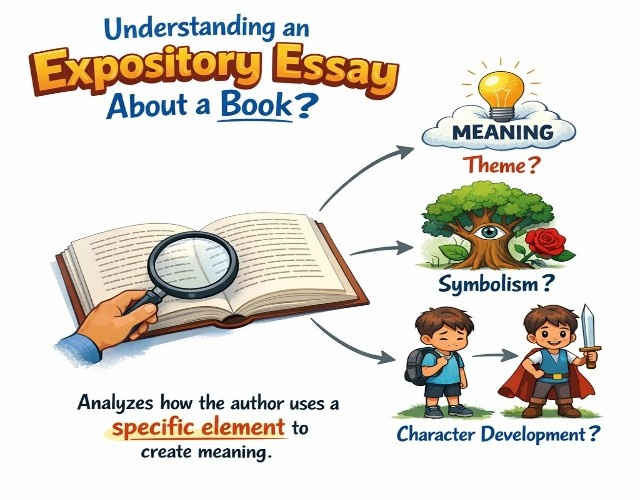
An expository essay about a book analyzes how the author uses a specific element, like theme, symbolism, or character development, to create meaning.
You're explaining the author's craft. How do they build a theme throughout the story? What techniques do they use? What effect do those techniques create?
Here's what you focus on in an expository essay about a book:
- Theme development: How does the author explore ideas like justice, identity, or power?
- Character arc: How does a character change? What drives that change?
- Writing style and techniques: Sentence structure, word choice, narrative perspective
- Symbolism: What do recurring objects or images represent?
- Historical or cultural context: How does the setting shape the story's meaning?
- Author's purpose: What message is the author trying to convey?
The key is analysis, not summary. You explain HOW the author achieves something specific, backed by evidence from the text.
Expository Essay About a Book vs. Other Essay Types
Students often confuse expository essays about books with other types of writing. Here's the difference:
| Type | Purpose | Focus | Example |
|---|---|---|---|
| Book Report | Summarize | What happens | "Harry defeats Voldemort in the final battle." |
| Book Review | Evaluate | Your opinion | "This book is engaging because the plot twists keep you guessing." |
| Literary Analysis | Interpret | Deeper meaning | "Orwell uses irony to criticize totalitarianism." |
| Expository Essay About a Book | Explain/Analyze | How the author achieves something | "Orwell develops the theme of surveillance through the recurring symbol of Big Brother's eyes." |
The expository essay sits between literary analysis and a book report. You're analyzing the author's techniques like you would in literary analysis, but you're explaining them clearly rather than interpreting hidden meanings.
Why does this distinction matter? Because if you write a book report when your teacher expects an expository essay, you'll fail the assignment. Clarity here prevents wasted effort.
Choosing a Book for Your Expository Essay
Step 1: Check Assignment Requirements
Before you pick a book, check what your teacher requires:
- Length specifications: Some assignments require books over 200 pages
- Genre restrictions: Fiction only? Can you use nonfiction?
- Approved book lists: Many teachers provide specific titles
- Time period requirements: Does it need to be a classic? Contemporary?
Don't waste time picking a book only to find out it doesn't meet the requirements.
Step 2: Pick a Book You've Read (or Can Read Thoroughly)
You need deep familiarity with your book. Skimming won't work for this essay type because you need to cite specific passages and analyze how techniques develop throughout the story.
Pick a book you've already read, or one you can realistically finish before the deadline. Trying to analyze a book you barely remember or haven't finished is a recipe for a weak essay.
What Makes a Good Book Choice
Not every book works well for an expository essay. Here's what to look for:
Good characteristics:
Books that work well:
Books to avoid:
If your book is just "stuff happens," you'll struggle to write an analytical essay. Pick something with layers. |
Need more topic ideas? Check out our expository essay topics guide for hundreds of options across all subjects.
Writing an Expository Essay About a Book: Step by Step
Step 1: Read and Analyze the Book Thoroughly
You can't write an analytical essay without deep knowledge of your book. Read actively, not passively.
What to do while reading:
- Read with a pen or highlighter: Mark interesting passages, patterns, or recurring symbols
- Take notes in the margins: Write quick observations about techniques you notice
- Mark quotable passages: Star sections you might cite in your essay
- Ask questions: "Why does the author keep mentioning this?" or "What's the significance of this scene?"
What to look for:
- Themes: What big ideas does the author explore? Justice? Identity? Power?
- Character development: How do characters change from beginning to end? Why?
- Symbols: What objects, colors, or images repeat throughout? What might they represent?
- Author's style: How do sentence structure and word choice create a specific tone?
- Historical or cultural context: How does the time period or setting shape events?
Create a reading journal. After each chapter, write 3-4 sentences about what stood out. This gives you material to work with when you start writing.
Step 2: Choose Your Specific Focus
This is where most students struggle. They know they need to analyze the book, but they don't know what aspect to focus on.
Start broad, then narrow down. Here's the process:
The narrowing process:
1. Book: 1984 See how that works? You go from "the whole book" to "one specific thing the author does." |
Common focus areas you can use:
- Theme analysis: How does the author develop a specific theme throughout the book?
- Character study: How does a character evolve? What does their arc reveal?
- Symbolism: What does a recurring symbol represent? How does the author use it?
- Writing technique: How does the author's style contribute to meaning?
- Historical context: How does the time period shape the story's themes?
Red flag: If your focus is "What happens in the book," you're writing a book report, not an expository essay. Your focus should always be on HOW the author achieves something, not WHAT happens.
Step 3: Create Expository Essay About the Book Outline
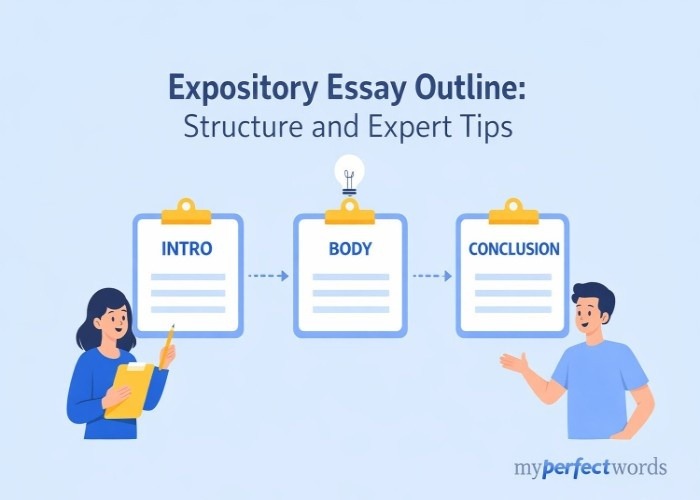
Once you have your focus, outline your essay. Most expository essays about books follow the standard 5-paragraph structure.
Standard structure:
Introduction:
Body Paragraph 1:
Body Paragraph 2:
Body Paragraph 3:
Conclusion:
Each body paragraph should prove one part of your thesis. Don't mix multiple ideas in one paragraph. |
Need more detailed help with outlining? Check out our expository essay outline guide for templates and examples.
Step 4: Write Your First Draft
- Use quotes to SUPPORT your analysis, not replace it
- Always cite page numbers
- Explain every quote, don't assume the meaning is obvious
- Keep quotes short (1 to 3 sentences max)
After each quote, ask yourself: "So what? What does this prove about my thesis?" That's your analysis.
Step 5: Revise and Proofread
Your first draft won't be perfect. That's normal. Revision is where you turn a rough draft into a strong essay.
Revision checklist:
- Is your thesis clear and specific?
- Does each body paragraph support your thesis?
- Do you have more analysis than plot summary?
- Are all quotes properly cited with page numbers?
- Do you have smooth transitions between paragraphs?
- Does your introduction hook the reader?
- Does your conclusion provide closure without just repeating the introduction?
Common mistakes to fix:
- Too much plot summary: Cut any paragraph that just describes what happens
- Quotes without analysis: Every quote needs explanation
- Vague thesis: "This book has many themes" tells the reader nothing
- Personal opinion instead of analysis: "I think Gatsby is sad" vs. "Fitzgerald depicts Gatsby's isolation through..."
- Missing citations: Every quote needs a page number
Read your essay out loud. If something sounds awkward or confusing, rewrite it.
Struggling to Narrow Your Focus? Our expert writers transform books into brilliant expository essays. Stop stressing; let professionals do it right.
Expository Essay About a Book Examples
Let's look at three examples showing different focus areas. These demonstrate how to structure your analysis.
Example 1: Theme Analysis
Book: To Kill a Mockingbird Focus: How Harper Lee uses Scout's perspective to develop the theme of moral education
Thesis Example: "Harper Lee uses Scout Finch's first-person narration to show how childhood innocence gives way to moral understanding when confronted with injustice."
Sample Body Paragraph:
Scout's narration reveals her evolving moral awareness through her observations of Atticus during the trial. Early in the novel, she sees her father as ordinary, noting "Atticus was feeble: he was nearly fifty" (Lee 89). However, after witnessing Atticus defend Tom Robinson despite community backlash, Scout begins to understand courage differently. She later reflects, "It was times like these when I thought my father, who hated guns and had never been to any wars, was the bravest man who ever lived" (Lee 112). This shift from physical bravery to moral courage shows Scout's growing understanding that real strength comes from standing up for what's right, even when it's unpopular. Lee uses this perspective shift to demonstrate how children learn ethics through witnessing principled action.
Example 2: Character Development
Book: The Great Gatsby Focus: How Fitzgerald develops Jay Gatsby's character through symbolism
Thesis Example: "Fitzgerald uses the green light symbol to trace Gatsby's character arc from hopeful dreamer to tragic figure consumed by impossible nostalgia."
Sample Body Paragraph:
The green light at Daisy's dock evolves from representing Gatsby's hope to symbolizing his delusion. When Nick first observes Gatsby reaching toward the light, he describes him as "trembling" with anticipation (Fitzgerald 20), suggesting genuine belief in achieving his dream. Gatsby sees the light as achievable, something he can reach if he tries hard enough. However, after their reunion, the light loses its mystique. Nick notes, "Now it was again a green light on a dock. His count of enchanted objects had diminished by one" (Fitzgerald 93). The light's transformation from magical beacon to ordinary dock light parallels Gatsby's realization that his idealized version of Daisy never existed. Fitzgerald uses this symbol to show how Gatsby's dream was always about the pursuit, not the reality.
Example 3: Author's Purpose
Book: 1984 Focus: How Orwell uses irony to convey his warning about totalitarianism
Thesis Example: "Orwell employs situational irony, particularly in the Ministry of Truth's role in fabricating lies, to demonstrate how authoritarian regimes invert language and reality."
Sample Body Paragraph:
The Ministry of Truth's function creates the novel's central irony: the department responsible for truth manufactures lies. Winston's job involves rewriting historical records to match the Party's current narrative, making him complicit in destroying factual reality. Orwell writes, "Day by day and almost minute by minute the past was brought up to date" (Orwell 40), emphasizing the constant manipulation of truth. The irony deepens when Winston realizes, "Who controls the past controls the future: who controls the present controls the past" (Orwell 37). By naming a propaganda machine the "Ministry of Truth," Orwell shows how totalitarian regimes don't just hide their deception, they openly practice doublethink, forcing citizens to accept obvious contradictions. This irony serves as Orwell's warning that authoritarianism doesn't just suppress truth; it destroys the very concept of objective reality.
Free Downloadable Resources
Common Expository Book Essay Mistakes to Avoid
1. Writing a Plot Summary Instead of Analysis
This is the biggest mistake students make. Your essay should analyze HOW the author achieves something, not summarize WHAT happens.
Wrong: "Romeo and Juliet fall in love at a party. They get married secretly. Then they both die because of a misunderstanding about poison."
| Right: "Shakespeare uses the rushed timeline, from meeting to marriage to death in just five day, to show how impulsive passion leads to tragedy. The characters never pause to consider consequences, mirroring how young love often prioritizes intensity over wisdom." |
See the difference? The first just tells what happens. The second explains what the author's choices reveal.
2. Vague Thesis Statements
Your thesis needs to make a specific claim about the author's technique.
Wrong: "This essay will discuss themes in 1984."
| Right: "Orwell uses the symbolism of Big Brother's ever-watching eyes to demonstrate how constant surveillance destroys individuality by eliminating private thought." |
The second thesis tells the reader exactly what you'll analyze and what you'll prove.
3. Using Quotes Without Analysis
Don't drop quotes into your essay and move on. Every quote needs an explanation.
Wrong: Gatsby says, "Can't repeat the past? Why of course you can!" This shows he's hopeful.
| Right: Gatsby insists, "Can't repeat the past? Why of course you can!" revealing his fundamental delusion. His confidence in reversing time demonstrates that he's built his entire identity on an impossible fantasy, setting up his inevitable tragedy. Fitzgerald uses this moment to show how Gatsby's dream was always doomed, not because Daisy changed, but because Gatsby refuses to accept that the past is gone. |
The second example explains what the quote reveals about the character and connects it to the author's larger purpose.
4. Giving Personal Opinion
This isn't a book review. Don't share whether you liked the book or found it boring.
Wrong: "I think this book is boring because nothing exciting happens."
| Right: "Hemingway's minimalist style emphasizes the emotional restraint of his characters. He writes, 'He was an old man who fished alone in a skiff in the Gulf Stream, and he had gone eighty-four days now without taking a fish' (Hemingway 9), using simple language to reflect the protagonist's stoic acceptance of hardship." |
Focus on what the author does, not what you feel about it.
5. Insufficient Evidence
You need specific quotes and examples, not vague references.
Wrong: "The author uses lots of symbolism throughout the book to show different themes."
| Right: "Fitzgerald uses three distinct color symbols, the green light (hope), the yellow car (corruption), and the white dresses (false purity), to develop his critique of the American Dream's moral bankruptcy." |
Specific evidence proves you've done a close reading of the text.
Conclusion
Writing an expository essay about a book comes down to understanding this key distinction: you're analyzing the author's craft, not summarizing the plot or sharing your opinion.
Start by reading your book thoroughly, taking notes on techniques you notice. Choose one specific focus, a theme, symbol, character arc, or writing technique, and narrow it down to a clear thesis. Create an outline that supports your thesis with evidence from the text. Write body paragraphs that prioritize analysis over summary, always explaining what your evidence proves about the author's technique.
Your essay should teach your reader something new about how the book works, not what happens in it, but how the author makes it happen. That's what separates an expository essay about a book from everything else.
Ready for an A+ Expository Essay About a Book Essay?
Transform your book into a polished expository essay with expert help.
- Experienced writers who understand literary analysis
- Deep textual analysis, not plot summaries
- Properly cited evidence from the book
- Guaranteed plagiarism-free, original work
Get the grade you deserve without the struggle.
Get Started Now