Understanding an Expository Essay About Yourself?
An expository essay about yourself explains who you are using facts, examples, and reflection. It's informational writing that helps readers understand your experiences, qualities, or perspectives through clear explanation rather than storytelling or persuasion.
The purpose is straightforward: inform the reader about a specific aspect of yourself. You're not trying to entertain with a dramatic narrative or convince anyone of an opinion. You're explaining and clarifying with evidence.
Before starting your essay, learn the key principles and techniques. Check out our complete expository essay guide for tips, examples, and step by step instructions.
Need Help Getting Started?
Our expert writers create authentic, compelling essays about yourself that stand out.
Writing about yourself doesn't have to be awkward. Let us help you present your best self.
When Do You Write an Expository Essay About Yourself?
You'll write these essays in several common situations:
College Applications: Many schools ask applicants to explain their background, goals, or significant experiences. These prompts want exposition about who you are, not just what you've done. Scholarship Essays: Committees want to understand your character, challenges you've overcome, or why you deserve financial support. They're looking for clear explanations backed by examples. Class Assignments: English teachers often assign personal expository essays to develop self-reflection and expository writing skills. These might ask you to explain your values, goals, or defining characteristics. Professional Contexts: Job applications sometimes request personal statements. Conference speakers need bios. Graduate programs want to know about your research interests and background. |
Write an Expository Essay About Yourself (Step by Step)
Step 1: Choose Your Essay About Yourself Focus
Don't try to cover your entire life in one essay. Pick one significant experience, period, quality, or theme that reveals something meaningful about who you are.
Choose something specific enough to explain in detail. If you can't imagine writing three concrete examples about your topic, it's probably too general.
Need fresh ideas? Check our expository essay topics guide.
Step 2: Brainstorm and Reflect
Before writing, gather your thoughts. Ask yourself questions that reveal specific details:
Self Reflection Questions:
- What three words do people who know me well use to describe me?
- What experience or moment changed how I see myself or the world?
- What challenge taught me something I use regularly now?
- What am I genuinely proud of accomplishing?
- When did I surprise myself with my own capabilities?
- What value or principle guides my decisions?
Create a "brag sheet" listing accomplishments, interests, challenges overcome, and values. Don't worry about humility during brainstorming. You'll shape the tone during writing.
Choose information relevant to your focus topic. If you're explaining how debate taught you critical thinking, you don't need to mention your part-time job unless it connects to that theme.
Step 3: Gather Facts and Evidence
Expository writing requires specifics. Instead of saying "I'm a hard worker," explain: "I worked 20 hours weekly while maintaining a 3.8 GPA and serving as yearbook editor."
Types of Evidence:
- Specific achievements (awards, grades, recognitions)
- Concrete actions you took (started a club, taught yourself coding, organized an event)
- Measurable results (raised $5,000, tutored 15 students, increased membership by 40%)
- Particular moments that demonstrate qualities (the day you confronted a bully, the time you admitted a mistake)
Avoid generalizations. "I love helping others" is vague. "I spent my summer teaching English to elderly immigrants at the community center" is specific and provable.
Step 4: Create a Layout
Structure prevents rambling. Use the standard five-paragraph format as your foundation:
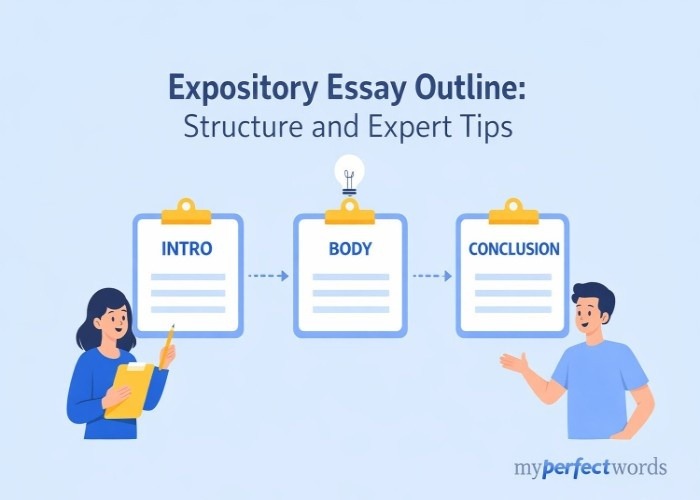
Introduction: Hook, context, thesis (main point about yourself) Body Paragraph 1: First piece of evidence or example Body Paragraph 2: Second piece of evidence or example Body Paragraph 3: Third piece of evidence or deeper analysis Conclusion: What this means, implications for your future For longer essays, expand body sections or add paragraphs. But keep each paragraph focused on one idea. |
An expository essay outline helps you organize before writing. It's easier to rearrange bullets than to restructure full paragraphs.
Step 5: Write Your Introduction
Your introduction needs to grab attention while establishing your topic and thesis.
Hook Strategies:
- Start with a specific moment: "I stood in front of 200 people, notes trembling in my hands, and forgot my opening line."
- Ask a relevant question: "What does it mean to be resilient?"
- Share an interesting fact about yourself: "I've moved seven times in ten years."
- Begin with a brief scene: "The rejection email arrived three minutes before my calculus test."
After the hook, provide context readers need to understand your essay. Then state your thesis: the main point you're explaining about yourself.
Step 6: Develop Your Body Paragraphs
Each body paragraph should prove or illustrate your thesis. Follow this structure:
|
Remember! Balance confidence with vulnerability. Admitting challenges makes you relatable. Showing how you handled them demonstrates character.
Step 7: Write Your Conclusion
Your conclusion should reflect on the significance of what you've explained. Don't just summarize. Consider:
- What do these experiences reveal about your values or goals?
- How have they shaped who you're becoming?
- What future implications do they have?
- What have you learned that guides your decisions now?
Step 8: Revise and Edit
First drafts are rarely final drafts. Revision improves clarity and impact.
- Read Aloud: Listen to how your sentences sound. If something feels awkward to speak, it probably reads awkwardly too.
- Check for Clarity: Does each paragraph have one clear main idea? Can someone unfamiliar with you understand your points?
- Remove Generalizations: Replace vague statements with specific details.
- Add Specific Details: Trade "my hometown" for "Madison, Wisconsin" and "a club" for "the robotics team."
- Proofread: Check grammar, punctuation, and spelling. These basics matter because they show care and attention to detail.
- Get Feedback: Ask someone who knows you to read it. Do they recognize you in the essay? Does it sound like something you'd actually say?
Struggling With Your Personal Essay?
Let our expert writers handle the heavy lifting while you focus on your studies.
Join thousands of students who've trusted us with their success.
Expository Essay About Yourself Examples
Seeing examples helps you understand what works. Below, we've organized sample essays by length so you can see how to adapt the structure based on word count.
200 Word Example
Who I Am Today
I'm a first-generation college student who learned resilience through my family's immigration experience. Moving to the US at age 12 meant starting over: new language, new school, new cultural expectations. I spent my first year mostly silent, afraid of mispronouncing words. But I discovered that math doesn't require translation. Numbers became my language, leading me to excel in STEM subjects.
Today, I'm studying computer science with a 3.9 GPA. I tutor other immigrant students in mathematics, remembering how isolated I felt. My background taught me that adaptability matters more than perfection. I still make grammatical mistakes in English, but I also built a mobile app with 50,000 downloads. That app helps immigrant families find local resources in multiple languages.
My experience shaped my core value: use your skills to help others who face what you faced. I'm not defined by where I started, but by how I chose to use that start to understand others' struggles.
500 Word Example
Learning Leadership Through Failure
I always thought leaders were born confident, never doubting themselves. Then I became student council president my junior year and learned that real leadership often starts with failure.
My first project was reorganizing the school's recycling program. I had grand plans: color-coded bins, student ambassadors, weekly collection schedules. I presented my 15-page proposal to the principal, confident he'd be impressed. Instead, he asked one question: "Did you talk to the janitors who actually handle the recycling?"
I hadn't. I'd created an elaborate system without consulting the people who would implement it. That moment taught me that good ideas mean nothing without practical execution and input from everyone affected.
I spent the next week interviewing custodial staff, cafeteria workers, and facilities managers. They explained what actually works in a school building. Together, we designed a simpler system: three clearly labeled bins per hallway, with collection aligned to their existing schedule. Implementation took three weeks instead of my projected six months. Recycling rates increased by 40%.
That experience changed how I lead. Now I start projects by asking who has ground-level knowledge. When organizing the senior class fundraiser, I spoke first with past organizers to learn what mistakes to avoid. When planning school events, I consult with students who'll attend, not just committee members. This approach makes me a better leader because I'm building on collective wisdom instead of assuming I have all the answers.
Leadership isn't about having perfect vision. It's about recognizing your blind spots and finding people who can see what you miss. My failure with the recycling project taught me to value collaboration over individual brilliance. I'd rather implement a good idea well with team input than fail at an "amazing" idea I developed alone.
This lesson extended beyond school. In my part-time job at a community center, I proposed changes to the children's programming. Before creating a plan, I asked parents what they needed, teachers what was practical, and kids what sounded fun. The resulting program enrolled 30% more families than the previous year.
I'm not naturally humble. Learning to seek input required fighting my instinct to prove I was smart enough to solve problems alone. But understanding that leadership means empowering others to contribute their expertise made me more effective. My greatest achievement as student council president wasn't my ideas but creating systems where everyone's knowledge improved our school.
Downloadable Resources for Expository Essay About Yourself Examples
Want to read more sample expository essays about other topics, too? Check out our blog about expository essay examples.
Tips for Writing an Excellent Expository Essay About Yourself
| Tip | Why It Matters | Example |
|---|---|---|
| Be honest & authentic | Readers spot fake instantly, and exaggeration undermines credibility | Don't claim to "love helping others" if volunteering once made you realize you prefer working alone |
| Be specific | Concrete details make you memorable and prove your points | "4.0 GPA in AP Calculus" instead of "good student" |
| Show, don't tell | Proving qualities through actions is more convincing than claiming them | Tell the story of organizing a food drive instead of stating "I'm compassionate" |
| Choose a theme | A coherent focus beats scattered achievements | "How moving six times taught me adaptability" works better than listing random experiences |
| Balance confidence & vulnerability | Mentioning challenges makes you relatable; showing growth demonstrates maturity | "I failed chemistry my first semester but sought tutoring and finished with a B+ by year's end" |
| Use your authentic voice | Essays that sound like you stand out from generic writing | Write how you'd explain yourself to someone in conversation |
| Be concise | Word limits are real; every sentence should earn its place | If removing a sentence doesn't weaken your essay, it didn't belong there |
Common Essay About Yourself Mistakes to Avoid
Trying to Cover Your Entire Life
You can't explain everything meaningful about yourself in 500 or even 1000 words. Pick one theme or period and explore it deeply.
Being Too Vague or General
"I'm a hard worker who cares about others" tells nothing. Prove these qualities through specific examples.
Bragging Without Context
Listing accomplishments without explanation sounds like resume padding. Show what you learned or how achievements connect to who you are.
Being Self Deprecating Without Growth
Mentioning weaknesses or failures works only when you show how you addressed them or what you learned. Self-criticism alone just makes you look insecure.
Using Clichés
"I'm a people person," "I think outside the box," "I give 110%", these phrases mean nothing because everyone uses them.
Ignoring the Prompt
If asked about a challenge, don't write about your greatest achievement. Answer what's actually asked.
Making Up Information
Lying catches up with you. If you claim to volunteer weekly but can't name the organization's director in an interview, you've undermined your credibility.
Focusing Only on Obstacles
Essays about hardship work show resilience, but don't make your entire essay about what you've suffered. Show how you've grown or what you've done with that experience.
Writing What You Think They Want to Hear
Trying to guess what will impress readers often backfires. Write your truth, not what you imagine an admissions officer wants.
Conclusion
Writing an expository essay about yourself means choosing a specific focus, gathering concrete evidence, and explaining clearly what your experiences reveal about who you are. You're not writing your life story or trying to impress anyone with exaggerations. You're giving an honest, specific explanation of an aspect of yourself that matters.
Start by picking one theme or experience worth exploring. Gather specific details that prove your points. Structure your essay logically with an introduction that hooks readers, body paragraphs that provide evidence and explanation, and a conclusion that reflects on significance. Be authentic, specific, and clear.
Remember: you're enough as you are. You don't need to invent a better version. You need to explain your actual self clearly and thoughtfully. That's what makes an expository essay about yourself effective.
Struggling to Write Your Best Essay?
Get professional help from experienced writers who understand what makes essays stand out.
- Every essay written from scratch based on your requirements
- Direct communication with your assigned writer
- Unlimited revisions until you're completely satisfied
- Money back guarantee if you're not happy with the result
Place your order in minutes and get your essay when you need it.
Order Now