The Basics Of an Expository Essay About Person
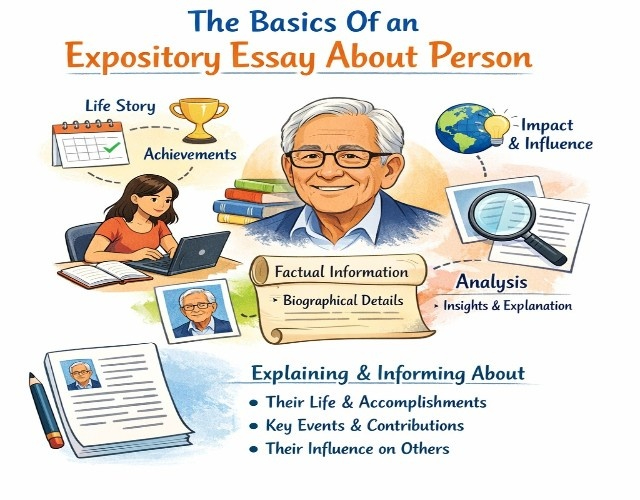
An expository essay about a person explains and informs readers about someone's life, accomplishments, or influence through factual information and analysis. You're not telling a story or sharing personal feelings. You're presenting facts, providing evidence, and helping readers understand why this person matters.
The key characteristics include:
- Factual foundation: Every claim needs evidence from credible sources
- Informative purpose: You're teaching, not entertaining or persuading
- Objective tone: Present information without emotional bias
- Focused scope: Cover specific aspects, not the entire life
You'll typically write this type of essay in academic settings when your instructor wants you to demonstrate research skills and explain a person's importance.
For more context on how expository essays work across different topics, check out our guide to expository essay topics guide.
How it differs from a biography:
Students often confuse these two formats, but they serve different purposes. A biography tells the complete chronological story of someone's life, birth, childhood, education, career, death, often in book-length format. An expository essay focuses on explaining specific aspects or impact in 500-1500 words, organized by themes rather than timeline.
For example, a biography of Marie Curie would cover her entire life chronologically. An expository essay might focus specifically on her groundbreaking research methods or her impact on women in science.
Aspect | Expository Essay | Biography |
Purpose | Explains specific aspects or impact | Tells complete life story |
Scope | Focused on selected elements | Comprehensive coverage |
Structure | Organized by themes or significance | Chronological timeline |
Tense | Present tense for facts, past for events | Primarily past tense |
Length | Usually 500-1500 words | Often book-length or multiple pages |
Choosing a Person to Write Expository Essay About
Your choice of subject can make or break your essay. You need someone with enough available information and interesting aspects to explore.
Start with your assignment constraints. Does your professor require a historical figure, a contemporary person, or someone from a specific field? Some instructors let you write about family members or personal connections, while others want famous public figures.
Good subjects share these qualities:
Sufficient research material: You need at least 3 to 5 credible sources. Famous figures have abundant information, but lesser-known people can work if you have access to interviews, documents, or firsthand accounts.
Clear significance: The person should have made identifiable contributions or had a measurable impact. This gives you concrete points to explain rather than vague descriptions.
Genuine interest: You'll research and write about this person for days or weeks. Choose someone whose story actually interests you.
Appropriate complexity: Avoid subjects that are too simple (not enough to analyze) or too complex (can't be covered adequately in your word limit).
Red flags to avoid: extremely private individuals with limited public information, people whose main claim to fame is controversy without factual documentation, and overdone subjects everyone writes about (unless you have a unique angle).
For more ideas on interesting people to write about, see our expository essay topics guide.
Starting an Essay About a Person
Your opening needs to hook readers while establishing your subject and thesis. You have several effective approaches.
- Surprising fact approach: "Before Sandra Day O'Connor became the first woman on the Supreme Court, she couldn't get a job at a law firm despite graduating third in her class from Stanford Law School."
- Achievement highlight: "Jonas Salk's decision to refuse patenting his polio vaccine saved the American economy an estimated $7 billion and made the vaccine accessible worldwide."
- Defining moment: "On December 1, 1955, Rosa Parks' refusal to give up her bus seat changed the course of American civil rights history."
- Impact question: "What drives someone to spend 30 years living among chimpanzees to understand animal behavior? Jane Goodall's dedication transformed primatology."
- Context setting: "In 1960s America, when women held less than 4% of elected offices, Shirley Chisholm fought her way to Congress and then ran for president."
Research and Information Gathering About a Person
Solid research separates good expository essays from weak ones. You can't explain someone's significance without factual evidence.
Primary sources give you direct access to the person's own words and actions:
- Autobiographies and memoirs
- Interviews (video, audio, or transcribed)
- Speeches and public statements
- Letters, diaries, or personal documents
- Original works (if they're an artist, scientist, or writer)
Secondary sources provide analysis and context:
- Scholarly biographies by credible historians
- Academic journal articles
- Documentary films with citations
- News articles from reputable outlets
- Published papers or critical analyses
Where to search: Your school library's database gives you access to peer-reviewed sources. Google Scholar finds academic papers. The Library of Congress and similar archives hold historical documents. University websites often have digitized collections.
What to collect:
- Basic facts: Birth/death dates, education, career trajectory, major achievements
- Specific evidence: Statistics, quotes, documented events with dates
- Impact information: How their work influenced others, changed fields, affected society
- Different perspectives: What various sources say about their significance
- Context: Historical or cultural circumstances that shaped their life
Create a simple organizational system. Use a spreadsheet or document with columns for: source citation, type of information, specific fact or quote, and which part of your essay it supports.
Dealing with limited information: If you're writing about someone less famous, you might need to get creative. Can you interview people who knew them? Do local historical societies have documents? Are there newspaper archives? Sometimes the challenge becomes part of your angle, explaining someone who deserves more recognition.
Always fact check across multiple sources. If one source claims something significant that others don't mention, verify it before including it. For essays about living people, prioritize recent sources since circumstances change.
Structure Your Expository Essay About a Person
How you organize information determines whether readers can follow your explanation. Standard structure works, but you'll apply it specifically to person focused content.
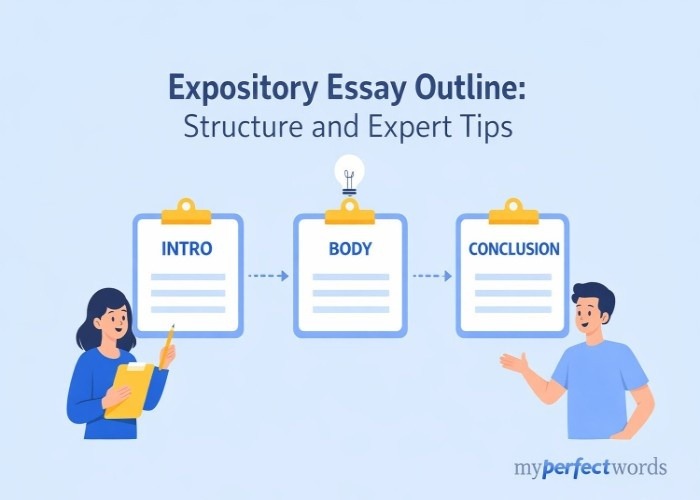
Introduction (1 paragraph, 100 to 150 words):
- Hook that grabs attention
- Brief context about the person
- Thesis statement explaining their significance or what aspects you'll cover
Body paragraphs (3 to 5 paragraphs, 150 to 300 words each): Each paragraph covers one main aspect with:
- Topic sentence stating the point
- Evidence from your research
- Explanation of significance
- Smooth transition to next point
Conclusion (1 paragraph, 100 to 150 words):
- Summarize key points about the person's significance
- Connect back to thesis
- Final thought about their lasting impact
For detailed structure templates, our expository essay outline guide shows you exactly how to organize each section.
Step by Step Writing Process for Essay About a Person
Breaking the writing into clear steps makes the process manageable.
Step 1: Choose your focus
Decide which aspects of the person's life you'll cover. You can't explain everything in 1,000-1,500 words. Select 3-4 main points that best demonstrate their significance.
Create a focus statement: "This essay explains how Ruth Bader Ginsburg's legal work advanced women's rights through three landmark cases."
Step 2: Create a thesis statement
Your thesis tells readers what they'll learn about this person's significance.
Strong examples:
Weak examples:
|
Step 3: Outline your essay about a person
List each section with 2-3 key points per paragraph. Include which sources support each point. This takes 20 minutes but saves hours of confused writing later.
Step 4: Write the introduction
Start with your hook strategy, add context, and end with your thesis. Don't overthink it, you can revise later. The important thing is getting words on the page.
Step 5: Write body paragraphs
Take each outline point and expand it with evidence and explanation. Follow this pattern:
- State the point (topic sentence)
- Provide evidence (facts, quotes, examples)
- Explain why it matters (analysis)
- Connect to next point (transition)
Keep paragraphs short, 2 to 4 sentences work well. If a paragraph exceeds 6 sentences, split it.
Step 6: Write the conclusion
Summarize your main points without repeating the introduction word-for-word. Restate why this person's contribution matters. End with a final thought about their lasting influence.
Step 7: Revise and edit
- First pass: Check that each paragraph supports your thesis and flows logically.
- Second pass: Verify all facts and citations. Did you cite properly? Are sources credible?
- Third pass: Proofread for grammar, spelling, and typos. Read aloud, your ear catches mistakes your eyes miss.
Give yourself time between writing and editing. Fresh eyes spot problems better.
Expository Essay About a Person Examples
Seeing good examples helps you understand what works. Here are three approaches:
Example 1: Historical Figure (Nikola Tesla's Innovation Methods) Excerpt: "Nikola Tesla's approach to invention relied on detailed mental visualization before physical creation. Unlike Thomas Edison, who tested thousands of materials through trial and error, Tesla claimed to build complete machines in his mind, testing modifications mentally before constructing physical prototypes. This method, while unusual, produced over 300 patents including the AC electrical system."
What makes it effective:
|
Example 2: Contemporary Figure (Malala Yousafzai's Advocacy Strategy)
Excerpt: "Malala Yousafzai transformed personal experience into global advocacy through strategic media engagement. After surviving an assassination attempt in 2012, she leveraged international news coverage to establish the Malala Fund, which has invested over $2 million in education programs across 12 countries. Her approach combines personal testimony with concrete organizational action."
What makes it effective:
|
Example 3: Personal Connection (Community Leader Profile) Excerpt: "Maria Rodriguez's food bank program demonstrates how local leadership addresses systemic problems. Starting with 12 families in 2018, the program now serves 340 households weekly through partnerships with three grocery chains and eight churches. Rodriguez's model proves that community-level solutions can operate efficiently without federal funding."
What makes it effective:
|
Free Downloadable Resources for an Essay About a Person
For more complete examples across different person types, visit our expository essay examples page.
Common Mistakes to Avoid in Essay About a Person
Knowing what not to do saves you from major revisions.
Writing a biography instead of an exposition
Students chronologically cover birth, childhood, education, career, and death. That's a biography. Focus on explaining specific aspects that demonstrate significance instead.
Getting too emotional or personal
Statements like "She was an incredible inspiration to me" or "His story touched my heart" belong in personal essays, not expository writing. Present facts and let readers draw their own conclusions.
Using opinion without evidence
"He was the best president," or "She changed everything," are claims that need factual support. What specific policies? What measurable changes? Evidence makes claims credible.
Covering too much
Trying to explain someone's entire life in 1,000 words results in superficial coverage. Select 3-4 significant aspects and cover them thoroughly rather than mentioning everything briefly.
Insufficient research and facts
An essay full of generalities ("He did many important things") fails to inform. Include specific dates, statistics, quotes, and documented events.
Poor organization
Jumping randomly between different aspects of someone's life confuses readers. Decide on your organizational method and stick to it.
Plagiarism or improper citation
Copying phrases from sources, even accidentally, violates academic integrity. When in doubt, paraphrase or quote properly with citations.
Boring, list like writing
"First he did X. Then he did Y. Next he did Z." Add variety to sentence structure and explain why each action mattered, don't just list chronological events.
Not explaining significance
Facts alone aren't enough. After stating what someone did, explain why it mattered and what impact it had.
Tips for Writing About Different Types of People
Different subjects require adjusted approaches.
1. Historical figures present specific challenges. You're working with events that happened decades or centuries ago, so context matters immensely.
Explain the time period's circumstances, what was normal then that seems unusual now? Use multiple sources since historical accounts can be biased. Avoid anachronism (judging historical actions by modern standards). Focus on how historians assess significance rather than imposing current values.
2. Public figures (contemporary) require careful source selection. Media portrayal and actual facts don't always align. Prioritize primary sources (their actual work, speeches, documented actions) over opinion pieces. Recent information matters, circumstances change quickly.
Separate someone's public image from verifiable achievements. Entertainment and sports figures need special care since much coverage focuses on personality rather than measurable impact.
3. Family members or personal connections challenge objectivity. You can write excellent essays about people you know, but you must present them like any other subject, factually, with evidence, without excessive emotion. Interview them or people who know them to gather quotes and specific examples.
Use external sources when possible (news articles, awards, public records). Explain their significance to their community or field, not just to you personally. The essay should work for readers who've never met this person.
4. Professionals in your field connect to your academic interests. This works well for major-specific assignments.
Research their methodologies, contributions to the field, and influence on current practices. Cite their published work or research.
Connect their contributions to concepts you're learning in class. Show why understanding this person helps you understand your field better.
Conclusion
Writing an expository essay about a person requires clear focus, thorough research, and an organized presentation of facts. Choose a subject with sufficient available information and interesting aspects to explore.
Structure your essay around specific elements of their significance rather than trying to cover their entire life story. Use credible sources to support your claims, maintain objectivity in your tone, and explain why the person matters rather than just listing what they did.
The difference between a good essay and a great one comes down to depth and analysis. Don't just tell readers facts they could find on Wikipedia.
Explain connections, demonstrate impact, and help readers understand why this person's contributions matter. With solid research and thoughtful organization, you can write an expository essay that informs effectively and earns strong grades.
Get Help Writing an Expository Essay About a Person Craft a well structured, informative essay with professional guidance Unlimited Revisions and Zero AI guaranteed