Quick-Reference Physics Formulas Table
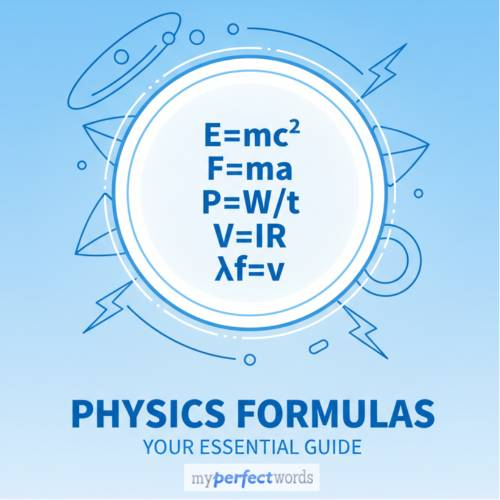
If you're short on time, this table has the formulas that show up most often in physics homework.
Formula Name | Equation | What It's For |
Newton's Second Law | F = ma | Force, mass, and acceleration |
Weight | W = mg | Gravitational force on an object |
Velocity (kinematics) | v = u + at | Final velocity with constant acceleration |
Displacement | s = ut + ½at² | Distance traveled under acceleration |
Kinetic Energy | KE = ½mv² | Energy of a moving object |
Gravitational PE | PE = mgh | Stored energy based on height |
Work | W = Fd cosTheta | Energy transferred by a force |
Power | P = W/t | Rate of energy transfer |
Ohm's Law | V = IR | Voltage, current, and resistance |
Electric Power | P = IV | Power in a circuit |
Ideal Gas Law | PV = nRT | Gas pressure, volume, and temperature |
Heat Transfer | Q = mcDeltaT | Heat gained or lost by a substance |
Wave Speed | v = fLambda | Speed, frequency, and wavelength |
Period and Frequency | T = 1/f | Time per cycle vs. cycles per second |
Planck's Equation | E = hf | Energy of a photon |
These 15 formulas cover the majority of what you'll run into at the high school and intro college level. The sections below go deeper into each category.
Mechanics Formulas
Newton's Second Law (F = ma) is the foundation of mechanics if you only memorize one formula, make it this one.
F = ma (Newton's Second Law)
- F = net force (in Newtons, N)
- m = mass (in kilograms, kg)
- a = acceleration (in m/s²)
- When you'd use it: Any problem that gives you mass and asks about force or acceleration. "A 5 kg box is pushed with a net force of 20 N. Find its acceleration" that's F = ma.
- Common mistake: Using total weight instead of net force. If there's friction, you need to subtract it first.
|
W = mg (Weight)
- W = weight (force of gravity, in Newtons)
- m = mass (kg)
- g = gravitational acceleration (9.8 m/s² on Earth)
- When you'd use it: Converting between mass and gravitational force. Weight and mass are not the same thing mass is how much stuff is in an object, weight is the force gravity pulls on it.
- Common mistake: Plugging weight in where mass is required. Always check what the problem is actually asking for.
|
p = mv (Momentum)
- p = momentum (kg·m/s)
- m = mass (kg)
- v = velocity (m/s)
- When you'd use it: Collision problems, or any time a problem mentions "momentum" or "conservation of momentum."
|
J = FDeltat (Impulse)
- J = impulse (N·s)
- F = force (N)
- Deltat = time interval (s)
- When you'd use it: Impulse and momentum are linked impulse equals the change in momentum. Useful when you're given a force acting over a short time.
|
W = Fd cosTheta (Work)
- W = work done (Joules)
- F = force applied (N)
- d = displacement (m)
- Theta = angle between force and displacement
- When you'd use it: When a force is applied at an angle (like pushing a box across the floor with a rope at 30°). If the force is perfectly horizontal, cosTheta = cos(0°) = 1 and you can simplify to W = Fd.
- Common mistake: Forgetting the cosine when the force isn't parallel to the direction of motion. Always check the angle.
|
P = W/t (Power)
- P = power (Watts)
- W = work done (Joules)
- t = time (seconds)
- When you'd use it: Any question asking "at what rate" something is done, or anytime "power" shows up in the question.
|
Kinematics Formulas (Motion)
The key to kinematics is identifying which three of the five variables you have then picking the formula that has those three.
The five kinematic variables are: initial velocity (u), final velocity (v), acceleration (a), displacement (s), and time (t). Every kinematic formula uses four of these five. Figure out which one you're missing, and that's your clue for which equation to use.
The 4 Kinematic Equations
Equation | Missing Variable |
v = u + at | s |
s = ut + ½at² | v |
v² = u² + 2as | t |
s = ½(u + v)t | a |
- u = initial velocity (m/s)
- v = final velocity (m/s)
- a = acceleration (m/s²)
- s = displacement (m)
- t = time (s)
When you'd use each one: Start by listing what the problem gives you and what it's asking you to find. Match that to the equation that contains exactly those variables.
Free-fall acceleration: When an object is in free fall (only gravity acting on it), its acceleration is g = 9.8 m/s² (downward). Just substitute a = 9.8 m/s² into whichever kinematic equation you're using.
| Common mistake: Mixing up initial and final velocity. In these equations, u is always where you start, and v is always where you end up. Getting them reversed flips your answer. |
Energy Formulas
Energy formulas are all about one rule: energy can't be created or destroyed, just converted from one form to another.
KE = ½mv² (Kinetic Energy)
- KE = kinetic energy (Joules)
- m = mass (kg)
- v = velocity (m/s)
- When you'd use it: Any moving object. Rollercoasters, thrown balls, sliding boxes if it's moving, it has kinetic energy.
- Common mistake: Forgetting to square the velocity. The "²" does a lot of work in this formula. Double the velocity and the kinetic energy quadruples.
|
PE = mgh (Gravitational Potential Energy)
- PE = potential energy (Joules)
- m = mass (kg)
- g = 9.8 m/s²
- h = height above reference point (m)
- When you'd use it: Any time an object has height a ball about to roll down a ramp, a diver at the top of a platform.
|
PE = ½kx² (Elastic Potential Energy / Hooke's Law)
- k = spring constant (N/m)
- x = compression or stretch distance (m)
- When you'd use it: Any spring problem. The stiffer the spring (higher k), the more energy stored for the same stretch.
|
Conservation of Energy: KE1 + PE1 = KE2 + PE2
- When you'd use it: Any time energy is being converted from one type to another without friction. A ball dropped from a height converts all PE into KE by the time it hits the ground.
- Common mistake: Forgetting that this equation assumes no energy loss. If there's friction, you need to account for it.
|
Work-Energy Theorem: W = DeltaKE - When you'd use it: When work is done on an object, it changes that object's kinetic energy. This ties mechanics (force/work) to energy.
|
Thermodynamics Formulas
The Ideal Gas Law covers most thermodynamics homework if you remember to convert Celsius to Kelvin first.
Q = mcDeltaT (Heat Transfer)
- Q = heat transferred (Joules)
- m = mass (kg)
- c = specific heat capacity (J/kg·K). This is a property of the material, given in problems
- DeltaT = change in temperature (K or °C, since it's a change)
- When you'd use it: Problems with heating or cooling substances. "How much heat does it take to raise 2 kg of water by 10°C?"
- Common mistake: Using the wrong specific heat capacity. Water is c = 4,186 J/kg·K. Other materials have different values; always check.
|
PV = nRT (Ideal Gas Law)
- P = pressure (Pascals)
- V = volume (m³)
- n = number of moles
- R = gas constant (8.314 J/mol·K)
- T = temperature (must be in Kelvin)
- When you'd use it: Any problem involving a gas at different pressure, volume, or temperature conditions.
- Common mistake: Using Celsius instead of Kelvin. You must convert: K = °C + 273.
|
DeltaU = Q - W (First Law of Thermodynamics)
- DeltaU = change in internal energy
- Q = heat added to the system
- W = work done by the system
- When you'd use it: Problems about gas cycles, heat engines, or any system where you're tracking energy in and out.
|
DeltaL = aL0DeltaT (Thermal Expansion)
- DeltaL = change in length (m)
- a = coefficient of linear expansion (depends on material)
- Lo = original length (m)
- DeltaT = temperature change
- When you'd use it: Problems about solids expanding when heated, like bridges or rails.
|
Electricity and Magnetism Formulas
Ohm's Law (V = IR) is to electricity what F = ma is to mechanics it unlocks most of the problems you'll face.
V = IR (Ohm's Law)
- V = voltage (Volts)
- I = current (Amperes)
- R = resistance (Ohms, Omega)
- When you'd use it: Almost every basic electricity problem. Solve for any of the three variables when you know the other two.
|
Electric Power Three ways to write it, depending on what you know:
- P = IV (when you know current and voltage)
- P = I²R (when you know current and resistance)
- P = V²/R (when you know voltage and resistance)
- When you'd use it: Any problem asking for power consumption in a circuit.
|
F = kq1q2/r2 (Coulomb's Law)
- F = electrostatic force (N)
- k = Coulomb's constant (8.99 × 10⁹ N·m²/C²)
- q1, q2 = magnitudes of the two charges (Coulombs)
- r = distance between charges (m)
- When you'd use it: Force between two point charges.
|
E = F/q (Electric Field)
- E = electric field strength (N/C)
- F = force on a test charge (N)
- q = test charge (C)
|
Series vs. Parallel Resistance
- Series: R_total = R1 + R2 + R3 ...
- Parallel: 1/R_total = 1/R1 + 1/R2 + 1/R3 ...
- Common mistake: This is the most frequently confused formula in electricity. The series adds directly. Parallel uses the reciprocal formula. Get these backwards, and every circuit problem falls apart.
|
F = qvB sinTheta (Magnetic Force)
- F = magnetic force (N)
- q = charge (C)
- v = velocity of the charge (m/s)
- B = magnetic field strength (Tesla)
- Theta = angle between velocity and magnetic field
- When you'd use it: Problems involving charged particles moving through magnetic fields.
|
Waves and Optics Formulas
Wave problems all come back to one relationship: speed = frequency × wavelength.
v = fLambda (Wave Speed)
- v = wave speed (m/s)
- f = frequency (Hz, cycles per second)
- Lambda = wavelength (m)
- When you'd use it: Any wave sound, light, or otherwise. You'll often be given two of these and asked to find the third.
|
T = 1/f (Period and Frequency)
- T = period (seconds per cycle)
- f = frequency (cycles per second)
- When you'd use it: Converting between how often a wave oscillates and how long each oscillation takes. Period and frequency are reciprocals.
- Common mistake: Confusing which is which. Frequency is how many cycles per second. Period is how many seconds per cycle.
|
n1 sinTheta1 = n2 sinTheta2 (Snell's Law)
- n = index of refraction (different for each medium)
- Theta = angle of incidence or refraction (measured from the normal)
- When you'd use it: Any problem about light bending as it passes from one medium to another (air to water, glass, etc.).
|
1/f = 1/do + 1/di (Mirror/Lens Equation)
- f = focal length of the mirror or lens
- do = distance from object to mirror/lens
- di = distance from image to mirror/lens
- When you'd use it: Problems involving mirrors, lenses, or images formed by optical systems.
|
Modern Physics Formulas
E = mc² is the most famous formula in physics but in homework, you'll use Planck's equation (E = hf) far more often.
E = mc² (Mass-Energy Equivalence)
- E = energy (Joules)
- m = mass (kg)
- c = speed of light (3 × 10⁸ m/s)
- When you'd use it: Nuclear reactions and problems involving mass-energy conversion. In standard high school physics, this is more conceptual than computational you'll know it for tests but won't do much with the math.
|
E = hf (Planck's Equation)
- E = energy of a photon (Joules)
- h = Planck's constant (6.626 × 10⁻³⁴ J·s)
- f = frequency of light (Hz)
- When you'd use it: Any problem involving photons, the photoelectric effect, or quantum energy calculations. This is the formula you'll actually compute with in quantum-related problems.
|
Lambda = h/mv (de Broglie Wavelength)
- Lambda = wavelength of a particle (m)
- h = Planck's constant
- m = mass of the particle (kg)
- v = velocity (m/s)
- When you'd use it: Problems dealing with wave-particle duality, showing that particles like electrons also have wavelength properties.
|
N = N0e^(-Lambdat) (Radioactive Decay)
- N = remaining amount of substance
- N0 = initial amount
- Lambda = decay constant (specific to each isotope)
- t = time elapsed
- When you'd use it: Half-life problems and radioactive decay calculations.
|
If you're new to quantum concepts, our guide to quantum physics for beginners walks through the foundations before you tackle the formulas.
How to Actually Use Physics Formulas in Homework
The formula is only half the work; knowing which formula to pick is the real skill in physics homework tests.
Here's a simple process that works for most problems:
Step 1: List what you know. Read the problem and write down every value you're given. Assign each one to a variable. Identify what you're solving for. Step 2: Match your knowns to the right formula. Look at your list of known variables. Which formula uses exactly those variables plus the one you're missing? That's your formula. If you cover the topics you'll encounter in physics homework, the variable-matching method will carry you through most of them. Step 3: Check units before calculating. Physics problems love unit traps. Make sure your values are in compatible units before you plug them in. Celsius versus Kelvin, grams versus kilograms, centimeters versus meters, unit errors kill otherwise correct answers. Step 4: Double-check significant figures. Your answer should match the precision of the values you were given. Three sig figs in, three sig figs out. |
For the full problem-solving methodology, check out our guide on how to solve physics problems. And before you submit, run through our physics homework checklist to catch the common errors that cost students easy points.
Improve Your Physics Understanding
Learn physics concepts through clear explanations and expert support
- Help with difficult physics concepts
- Assignment and homework guidance
- Support for formulas and calculations
- on time delivery
Build strong physics knowledge with professional assistance.
Get Started Now