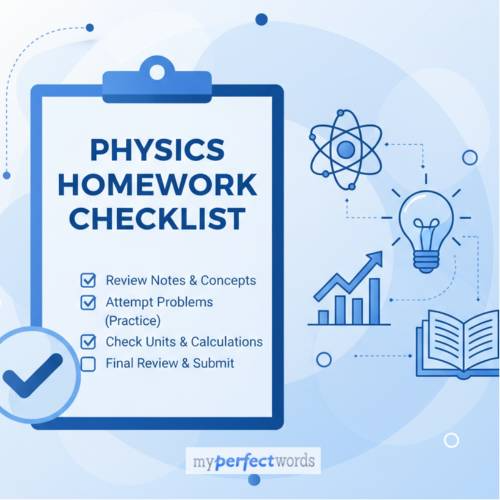
3 Phases for Physics Homework Checklist
Phase 1: Before You Start (Pre-Homework Checklist)
Five minutes spent reading the assignment saves thirty minutes of solving the wrong problem.
This phase sounds obvious, but most students skip it. They see a problem and start solving. Then halfway through, they realize the question asked for velocity in km/h, and they've been working in m/s the whole time.
Before you touch a single calculation, run through this:
- Read the entire assignment. All of it. Don't start Problem 1 without knowing what Problems 2 through 10 ask.
- Confirm what type of answer each problem needs. Is it a numerical value? A derived formula? A graph? A diagram? A written explanation? The format matters.
- Check your formula sheet and notes are accessible. Don't waste time hunting for them mid-problem.
- Write down knowns and unknowns for each problem. Before any math: what information does the question give you, and what are you solving for?
- Note any special instructions. Are you required to show all work? Use a specific number of significant figures? Express your answer in particular units? These are often in the instructions, not the problem itself.
| This also tells you if you need to brush up on anything before you start. If Problem 6 asks about a physics homework topic you haven't reviewed recently, you'll know before you're stuck halfway through. |
Phase 2: While You're Working (Mid-Homework Checklist)
Carrying units through your calculation isn't busywork; it's the fastest way to catch a wrong formula before you finish.
While you're actively solving, these habits catch errors in real time instead of after you've written a full page of wrong work:
- Label every variable before you use it. Write v = ?, a = 9.8 m/s², t = 3 s before you plug anything in. It forces clarity and makes your work easier to check later.
- Carry units through every step. Don't just write numbers. Write (20 m/s)(5 s) = 100 m. If your units don't simplify correctly, your formula is wrong.
- Draw a diagram when the problem involves motion, forces, or circuits. A free-body diagram for a forces problem, a circuit layout for an electrical problem, a motion diagram for kinematics, these aren't optional extras. They're how you catch setup errors before they compound.
- Show every step, even the ones that feel obvious. Partial credit exists for a reason. If your final answer is wrong but your method is right, you can still earn significant marks but only if the working is visible.
- Check that your formula actually applies to this scenario. Kinematic equations assume constant acceleration. Ohm's Law applies to linear resistors. Before you use a formula, confirm the scenario matches its assumptions. For help with specific formulas, check our physics formulas guide.
Phase 3: Before You Submit (Pre-Submission Checklist)
Before you submit, ask yourself: if you got this answer back on a test, would it make sense in the real world?
This is the phase students most often skip because they feel done. They're not done. Run through every item below before you click submit or hand in the paper.
- Units are your final answers in the unit that the question actually asked for? Not the unit you were working in. Not the unit in your formula. The unit of the question requested. Convert if needed.
- Do the significant figures match what the problem data gave you? If all your given values have 3 sig figs, your answer shouldn't have 6. Round appropriately.
- Signs positive or negative? Direction matters in physics. Velocity going left might be negative. A force pointing down might be negative. Losing a sign loses marks.
- Is the sanity check physically reasonable? A car travelling at 10,000 m/s is not reasonable. A box with a mass of -5 kg is not possible. If your answer is wildly off or physically impossible, something is wrong even if your algebra looks right.
- Work shown, did you write the formula before plugging in numbers? Most graders want to see F = ma before they see F = (5)(9.8). Writing the formula first shows understanding, not just calculation.
- Completeness have you answered every part of every question? Multi-part questions are a common trap. If Problem 3 has parts (a), (b), and (c), make sure you've answered all three. Scroll back up and check.
Physics Homework Taking Too Long?
Get quick and reliable help for your physics assignments
Save time and learn more with expert physics support.
The 6 Most Common Physics Homework Errors
Most physics homework errors fall into the same six categories and every one of them is preventable with a systematic review.
Here's what to look for specifically:
- Unit errors: Mixing SI and non-SI units mid-calculation, is the most common way to get a wrong answer on a correctly understood problem. Check: are you consistently using metres (not centimetres), kilograms (not grams), and seconds? If the problem gives you mixed units, convert everything to SI before you start calculating. Refer to SI unit standards if you're unsure about unit conventions.
- Significant figure errors: Too many decimal places in your answer, or too few both are technically wrong. Your answer can't be more precise than your least precise given value. Check your sig fig count against the data in the problem.
- Sign errors: This one is brutal because the math can be completely correct while the sign is wrong. Vector quantities have direction, and direction has a sign. Check every velocity, displacement, and force: should it be positive or negative in the context you've set up?
- Missing diagrams: Some problems essentially require a diagram even if the question doesn't explicitly say "draw." Free-body diagrams, circuit diagrams, and ray diagrams help your teacher follow your reasoning. If you encountered advanced topics like quantum physics concepts where the setup is abstract, a diagram shows you understand the physical scenario.
- Wrong formula for the scenario: Memorizing formulas isn't enough. You have to apply them correctly. The most common version: using a kinematic equation that assumes constant acceleration in a scenario where acceleration is changing. Check that the formula's assumptions match your problem's conditions. You can review the fundamentals if a particular formula's application isn't clear.
- Incomplete multi-part answers: Part (a) done, part (b) done, part (c) forgotten. It happens constantly, especially at the end of a long assignment when you're tired. Before you submit, count the parts of every multi-part problem and confirm you've answered each one.
Quick-Reference Physics Homework Checklist (All Three Phases)
Bookmark this. Use it every time.
Before You Start | While You're Working | Before You Submit |
Read the full assignment | Label all variables | Units match what was asked |
Identify the answer format needed | Carry units through every step | Sig figs match given data |
Access formula sheet/notes | Draw diagrams where applicable | Signs are correct for all vectors |
Write knowns and unknowns | Show every step of the work | Sanity check on final answer |
Note special instructions | Confirm the formula applies to the scenario | Formulas written before numbers |
All parts of every question are answered |
Downloadable Physics Homework Checklist
Want a version you can print and keep at your desk or use on your phone during homework sessions? Download our worksheets!
Conclusion,
Physics homework can feel challenging, but having a clear system makes the process much easier. By breaking problems into simple steps, understanding the question, applying the right formula, and reviewing your final answer, you can reduce mistakes and solve problems more confidently.
Small habits like checking units, listing known variables, and drawing quick diagrams can make a big difference in your accuracy.
Using tools like the Physics Homework Checklist, the Common Errors Guide, and the Knowns and Unknowns Worksheet can help you stay organized and develop stronger problem-solving skills over time.
Keep these resources nearby during your homework sessions so you can follow the same reliable process for every physics problem you tackle.
Learn Physics With Expert Guidance
Get professional help to improve your physics performance
- Expert physics writers
- Rush options available for tight deadlines
- Plagiarism-free, AI-free
- unlimited revisions
Expert guidance can make physics clearer and more manageable.
Get Started Now