What Is a PhD Essay? (And Which One Are You Writing?)
A PhD essay can mean two very different things, and confusing them is a fast way to go wrong.
An academic PhD essay is a formal piece of coursework. You're assigned a topic or prompt, you research it, you construct an argument, and you submit it for grading. These essays typically run 900–1,500 words, follow formal academic writing conventions, and require engagement with published peer-reviewed literature.
A PhD application essay, also called a personal statement or statement of purpose, is something you write to get accepted into a doctoral program. The focus is on your research background, academic goals, and fit with the program. The audience is an admissions committee, not a marker.
"Most PhD essay guides focus on admissions, but if you have a coursework assignment, you need a different approach entirely." |
What Makes a PhD Essay Different from Other Essays?
This is where a lot of students get into trouble. They've written good undergraduate essays. They've maybe written solid master's-level work. So they approach a PhD essay the same way, just longer, just more detailed. That rarely works.
PhD essays have different standards at every level. Claims require peer-reviewed evidence, not just logical reasoning. The scope is narrower: you're not surveying a topic, you're making and defending a specific, contestable claim. You're expected to know what scholars have already argued and to position your work in relation to that conversation.
Academic voice is tighter, too. Formal, precise, citation-heavy, no personal anecdotes unless the assignment explicitly calls for them. And the structure of each paragraph matters more: at the PhD level, analysis carries the weight, not just evidence.
"The single biggest mistake PhD students make is writing a longer version of an undergraduate essay instead of making a genuinely original academic argument." |
Step 1: Understand the Assignment Before You Write Anything
Read the brief or prompt three times before you do anything else. Once to understand the task. Once to check the constraints, word count, citation style, formatting requirements, and submission deadline. Once to identify what's actually being evaluated.
Figure out what type of essay is being asked for. Is it analytical (examining something in depth)? Argumentative (defending a position)? A critical review (evaluating existing literature)? The type shapes everything: structure, evidence, tone, scope.
If anything in the prompt is ambiguous, ask your supervisor before you invest hours in the wrong direction. Most markers won't penalise a clarifying question. They will penalise a well-written essay that misses the point.
"One hour spent understanding what's actually required saves five hours fixing a draft written in the wrong direction." |
Step 2: Choose or Narrow Your Topic
If you've been given a fixed topic, your job in this step is to identify the specific angle or argument you'll take within it. A topic is not a thesis. "Climate policy in the EU" is a topic. "The EU's carbon border adjustment mechanism fails to account for differential industrial capacity in accession states" is a thesis. You need to get to the second.
If you're choosing your own topic, apply three criteria: specific enough to argue within your word count, researchable with available literature, and connected to your broader doctoral field or the course's learning outcomes.
If you're still narrowing down, our curated list of PhD essay topics organizes options by discipline, a useful starting point if you're choosing from scratch.
A PhD essay topic isn't a subject; it's a specific arguable claim waiting to be made.
Step 3: Do the Research (Before You Outline)
Start with a proper literature search. That means academic databases, Google Scholar, JSTOR, PubMed, Scopus - not general web searches or Wikipedia. You need peer-reviewed sources, and you need to read them for argument, not just information.
As you read, pay attention to what scholars claim, where they agree, and where they diverge. Note the fault lines in the debate. These gaps are often where your argument will live, the place where existing scholarship doesn't fully answer the question your essay addresses.
Organize your notes around potential arguments, not just topics. "Evidence that supports X" is more useful than "notes on source Y." This makes outlining much faster.
Set a research cutoff. You can always read more, but the essay won't write itself. Once you have enough to build a solid argument with 8–12 credible sources, start outlining.
"Good PhD essay research isn't about reading everything written on a topic - it's about reading enough to make an informed argument." |
Step 4: Build a Strong Thesis Statement
A PhD thesis isn't a statement of your topic. It's a specific, defensible claim that your essay will prove. There's a meaningful difference between the two.
Use this formula as a starting point: [Specific claim] + [because/through/by] + [mechanism or evidence]
Here's what that looks like in practice:
Weak: "Social media affects political polarization." (This is a topic statement: obvious, uncontestable, too broad.) Strong: "Algorithmic content curation on major social media platforms intensifies political polarization by selectively amplifying emotionally charged content over substantively accurate reporting." (This is a thesis: specific, contestable, researchable, and arguable within a focused essay.) |
Your thesis must pass two tests. First: could someone reasonably disagree with it? If not, it's a fact statement, not a thesis. Second: do you have evidence to support it? If not, the topic needs more research or a different angle.
Every section of your essay should serve the thesis. If a paragraph doesn't advance the argument, it doesn't belong.
"Your PhD thesis should be a claim, not a question, and specific enough that a reader immediately understands what you're going to prove." |
Running Out of Time on Your PhD Essay?
Let a PhD-level expert write it for you while you focus on what matters.
Join countless students who've trusted MyPerfectWords since 2010.
Step 5: Create Your Outline
Don't skip this step. An outline isn't a formality; it's the architecture your draft depends on.
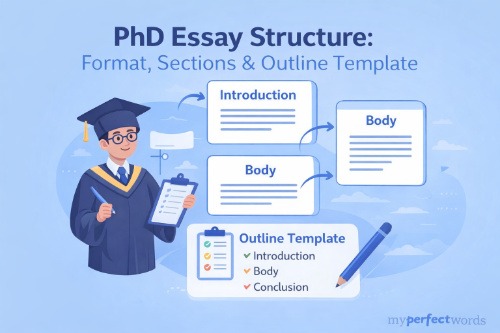
Core structure for most academic PhD essays:
- Introduction: Hook + thesis statement + brief preview of the argument's structure
- Body paragraphs: One argument per paragraph, developed fully before moving on
- Conclusion: Restate your claim, explain its significance, no new information
Each body paragraph follows the same internal logic: topic sentence – evidence – analysis – transition. The analysis is the most important part. Describing what a source says is not enough; you need to explain what it means for your argument.
Plan word count per section before you write. If your essay is 1,200 words, you can't give 400 words to background and hope to make a proper argument in what's left.
For a detailed section-by-section breakdown and a ready-to-use outline template, see our guide to PhD essay structure.
"An outline isn't optional for a PhD essay, it's the difference between a draft you can edit and hours of writing you have to scrap." |
Step 6: Write the First Draft
Write the body sections first, then the introduction. Your thesis and framing often sharpen as you write; the introduction is easier to get right once you know exactly what the essay argues.
Don't edit while you're drafting. The biggest trap in academic writing is stopping to perfect every sentence before the whole argument is on the page. Get through it. You'll fix it later.
Maintain academic voice throughout: precise language, active verbs where possible, passive voice under 20%, no colloquialisms or personal anecdotes. Sentences under 25 words are generally clearer.
Cite as you go. If you leave citations for later, you'll lose track of sources and spend hours reconstructing what came from where.
Aim to write about 10% over your target word count in the first draft. You'll cut during editing, and it's easier to trim than to pad.
"A PhD essay first draft is not meant to be good, it's meant to exist so you have something to improve." |
Step 7: Edit, Proofread, and Format
Edit in this order. Get it backwards, and you waste time polishing sentences in sections you'll cut anyway.
Edit for argument first. Does every paragraph serve the thesis? Is the logic sequence clear? Does each section follow from the last? Are there gaps in evidence? Weak arguments? Anything that's interesting but doesn't advance the central claim?
Edit for clarity, second. Can every sentence be made shorter without losing meaning? Any jargon that needs defining? Any paragraph that tries to do two things should be split?
Proofread last. Grammar, punctuation, citation formatting, consistency of headings, and subheadings. Check citation formatting against your required style, APA Style for social sciences, Chicago Manual of Style for humanities and history.
Ask a peer in your field to read the draft before you submit. They'll catch what you've stopped seeing.
"Most PhD essay editing happens in reverse order, students fix grammar first and forget to check if the argument actually works." |
Common Mistakes to Avoid in a PhD Essay
Most PhD essay problems come back to the same handful of errors.
Thesis too broad. Only catching this after you've already written half the essay. If your claim can't be supported or refuted within your word count, narrow it before you start, not after.
Non-academic sources. Wikipedia, news articles, and personal blogs don't meet the evidentiary standard. Use peer-reviewed journals, academic monographs, and credible institutional reports.
Describing literature instead of arguing with it. Summarizing what scholars say is not analysis. You need to explain what the evidence means for your specific claim.
Weak paragraph structure. Evidence without analysis is incomplete at PhD level. Every paragraph needs a topic sentence, evidence, and your own analytical commentary on what that evidence shows.
Starting to write before the outline is solid. If you're not sure where the argument goes, the draft won't know either.
Leaving editing until the night before. A strong PhD essay usually goes through at least two substantive editing passes. Build time for this.
"The difference between a passing and a failing PhD essay is usually not the research; it's the argument structure." |
Submit a PhD Essay You're Proud Of
Our expert writers handle everything from argument to final formatting.
- PhD-qualified writers matched to your subject area
- Transparent pricing, no surprises
- Fully customized to your brief and assignment requirements
- Free revisions until you're completely satisfied
Countless students helped. Rated 4.8/5.
Order Now