Personal Statement vs. Statement of Purpose: What's the Difference?
Most PhD programs ask for one of these two essay types, some ask for both, and a fair number use the names interchangeably. Before you write a single sentence, check the application portal's specific prompt, which tells you more than any label.
Here's the actual distinction:
A personal statement is narrative in focus. It covers who you are, how you arrived at this point academically, and what drives your intellectual interests. Think character and motivation.
A statement of purpose is research in focus. It covers what specific questions you want to investigate, how your background and training prepare you to investigate them, and why this particular program is the right place to do that work.
The boundary blurs because most programs want both pieces of information, regardless of which label they use. When in doubt, lean toward SOP framing for any PhD application. Committees are primarily asking: "Can this person do doctoral research in our department?" So lead with your intellectual curiosity and research agenda, not your personal backstory.
A quick decision guide: if the prompt says "describe your research interests and goals," write an SOP. If it says "describe your background and what led you to this field," write a personal statement. If the prompt is vague, which it often is, blend both but put research first.
"For most PhD programs, your essay is really a research statement, so lead with your intellectual curiosity, not your life story." |
What PhD Admissions Committees Actually Look For
Understanding the reader changes what you write. PhD admissions committees aren't just gatekeepers; they're faculty members looking for researchers who will contribute to their departmental work and justify the investment of funding, time, and lab space.
Research fit is the most critical factor. Does your specific research interest align with faculty in this department? Committees are looking to fund projects they care about. A well-qualified candidate with misaligned interests is often a harder sell than a slightly less credentialed applicant whose research perfectly complements ongoing departmental work. Intellectual trajectory matters because committees want to see that this PhD is the obvious next step in your development, not a random pivot. Has the applicant followed a coherent path toward this research question? Do their undergraduate thesis, their work experience, and their stated research interests form a logical arc? Preparation means concrete evidence of research capability: prior research experience, relevant technical skills, publications, conference presentations, an independent project, or a strong thesis. Listing credentials isn't enough; you need to show how that preparation relates to what you want to do next. Writing quality counts more than most applicants realize. The essay is a writing sample. It signals how you'll communicate as a scholar, how clearly you think, and how well you'll write your dissertation. Program-specific knowledge is how committees separate applicants who researched the program from those who sent the same essay to twenty schools. Naming specific faculty, referencing recent publications, and connecting your work to their research isn't flattery; it's evidence you've done your homework.
"Committees aren't just asking 'is this person qualified?' they're asking 'does this person belong in our specific program, with our specific faculty?'" |
How to Structure Your PhD Application Essay
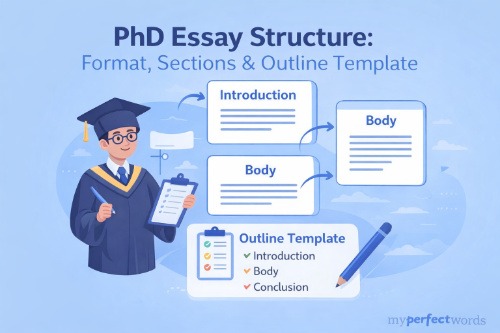
Most strong PhD application essays follow a five-paragraph structure regardless of whether they're framed as a personal statement or SOP. Here's what each paragraph should do.
Paragraph 1: The Opening Hook (50–75 words)
Start specific. A research question, a pivotal observation, a concrete moment of intellectual discovery, something that signals you already think like a researcher.
Strong opening: "When I found that existing models failed to account for [specific gap], I spent six months designing a workaround that eventually became my undergraduate thesis. That problem, and why current methods can't solve it, is what I want to investigate at the doctoral level." Weak opening: "I have always been passionate about neuroscience. Since childhood, I knew I wanted to pursue higher education and contribute to this fascinating field." |
The weak version tells committees nothing specific. Thousands of applicants write some version of that sentence. The strong version shows a specific problem, a response to it, and a clear research direction, all in two sentences.
Paragraph 2: Research Background (100–150 words)
Describe your most relevant academic and research experience. Be specific: name the project, the methods you used, what you found, and what your actual contribution was.
Don't just list what you did. Show how each experience prepared you to pursue the question you opened with. There's a meaningful difference between "I completed a thesis on memory consolidation" and "My thesis on memory consolidation used polysomnography to track slow-wave activity, which led me to question whether current sleep staging criteria are capturing the right variables."
The second version shows preparation, methodological familiarity, and an active research mind. Aim for that.
Paragraph 3: Research Interests and Questions (100–150 words)
State clearly what you want to investigate at the PhD level. "I'm interested in neuroscience" is not a research interest. "I want to investigate how chronic sleep disruption affects memory consolidation in adolescents, specifically whether the disruption window matters as much as duration," is a research interest.
Be specific enough that a faculty member in the department could say "that's what I work on," or at least "I know exactly who she should be working with."
This is also where you connect to the program's faculty. "Professor X's recent work on synaptic tagging aligns directly with this question, particularly the methodology developed in her 2023 paper." Read their recent publications before writing this paragraph.
If you're still figuring out which research questions you want to pursue, our guide to PhD essay topics can help you identify and narrow your focus.
Paragraph 4: Why This Program (75–100 words)
This paragraph must be unique to every program you apply to. No exceptions.
Name specific faculty, labs, courses, research clusters, or methodological resources that match your work. Explain how the program's particular strengths will help you pursue your specific question. Avoid generic praise, "the ranking," "the prestige," "the collaborative environment," because these apply to every program on your list and tell committees nothing.
If you can swap this paragraph into a different school's application without changing anything, rewrite it.
Paragraph 5: Future Goals and Contribution (75–100 words)
Where do you want to take this research after the PhD? Academic research, applied research, industry, policy, clinical practice, be specific. Vague statements like "I hope to contribute to the field" aren't convincing.
Close by connecting your goals back to why this program is the necessary step to get there. You're not just asking for admission, you're showing that the program's resources, faculty, and research culture are specifically what you need to achieve something particular.
"The strongest PhD application essays move in one direction, from past experience, through present interests, toward a specific future contribution." |
Need a PhD Application Essay That Stands Out?
Our expert writers craft application essays that show exactly why you belong in the program.
Join countless students helped since 2010. Rated 4.8/5.
Common Mistakes in PhD Application Essays (and How to Fix Them)
These aren't minor stylistic issues. Each of these mistakes signals something specific to the committee reading your application, and most of them signal the same thing: this applicant hasn't thought critically enough about their research yet.
Mistake 1: The Generic Opening
Starting with "I have always been passionate about [broad field]" doesn't just sound clichéd; it actively signals that you haven't defined a specific research question yet. Every applicant to a PhD program is passionate about their field. That's not differentiating information.
Fix: Open with a specific observation, problem, or moment of intellectual discovery. Show that you already think like a researcher, not like an enthusiastic student.
Mistake 2: Describing Experiences Instead of Demonstrating Preparation
"I completed a thesis on X" tells committees what you did. "My thesis on X showed me that Y was understudied, which is why I want to investigate Z" tells them what you learned and where you're headed. Connect every experience to your current research direction.
Mistake 3: Being Vague About Research Interests
"I'm interested in environmental policy" is a topic area, not a research interest. Push yourself to answer: what specific question do you want answered? What gap exists that your doctoral work could address? That specificity is what committees are looking for.
Mistake 4: No Program-Specific Content
Sending the same essay to fifteen programs with only the university name swapped is transparent to anyone who reads applications regularly. Committees know what tailored essays look like, and they notice when yours isn't one.
Fix: Each essay must reference specific faculty by name and explain why their work relates to yours. That means reading their recent publications, not just their department bio.
Mistake 5: Emphasizing Teaching Over Research
PhD programs train researchers. If your essay spends significant space on your passion for teaching, it may signal to committees that your primary career goal isn't research, which is what they're funding.
Fix: If teaching matters to you, frame it briefly in terms of knowledge dissemination after establishing your research agenda. Lead with research.
"The most common PhD application essay mistake isn't bad writing, it's treating the essay like a personal statement for undergrad." |
Tips for Tailoring Your Essay to Each Program
Research faculty profiles before writing, not after. Read 2–3 recent publications from faculty you'd want to work with and reference them specifically, not just their names, but what their research reveals and how it connects to yours.
Check whether the program uses cohort-based or faculty-specific admissions. In faculty-specific programs, your essay goes directly to a potential supervisor, which raises the bar for specificity.
Keep a simple tracking spreadsheet: program name, target faculty, key research themes, and what you changed in each tailored section. When you're applying to twelve programs, this prevents the nightmare of submitting the wrong essay to the wrong school.
"Tailoring isn't about flattery, it's about proving you actually understand what the program does and why you specifically belong in it." |
PhD Application Essay Format: Length, Tone, and Presentation
Most programs specify a word or page limit in the application portal; follow it exactly. Not approximately. Exactly. Exceeding a word limit signals poor judgment, which is not the impression you want to make.
When no limit is given, aim for 750–900 words. Quality and specificity matter more than length.
Write in first person throughout, use active voice, and be confident without being arrogant. Avoid hedging language like "I hope to perhaps explore." You have a clear direction, so write like it.
For formatting: use 12pt Times New Roman or Georgia, standard one-inch margins, and no subheadings unless the program asks for them. Clean, professional, focused.
One clarification: this article covers the application essay, not the coursework essay you'd write as a doctoral student.
If you need guidance on PhD essay structure for academic assignments, that's a separate guide.
"Your PhD application essay is a professional document, written like someone who already thinks and communicates at a doctoral level." |
Ready to Submit a PhD Essay That Wins?
MyPerfectWords gives you a 100% human-written, AI-detection-verified PhD application essay written by expert academic writers.
- Expert writers with advanced degrees in your target field
- We research your program and faculty to tailor every sentence
- Delivered in as little as 3 hours for urgent applications
- 4.8/5 rating from verified student reviews
Don't risk your PhD application. Get it written right the first time.
Order Now