PhD Essay vs. PhD Thesis: What's the Difference?
Before anything else, let's clear up the confusion that sends most students down the wrong path.
A PhD essay is a short academic paper, typically 900–1,500 words, submitted either as part of your doctoral coursework or as part of an application. It has an argument, structured paragraphs, and a references section. That's it.
A PhD thesis (also called a dissertation) is an entirely different animal. It's the 60,000–100,000 word document you submit at the end of your doctoral program to earn your degree. It has chapters, a literature review, a methodology section, and years of original research behind it.
Most SERP confusion comes from conflating these two. If your program assigned you a 1,200-word essay for a module, you need this guide, not a chapter-by-chapter thesis breakdown.
"A PhD essay and a PhD thesis are not the same thing; one is a focused academic argument, the other is years of original research compressed into chapters." |
The 4 Core Sections of a PhD Essay
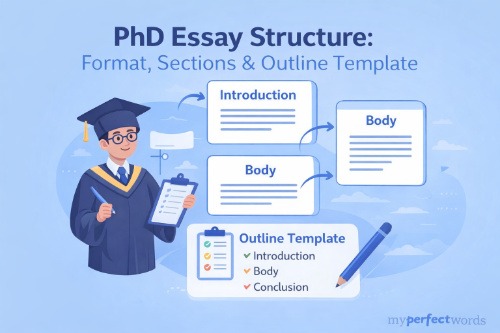
Every PhD essay, whether for coursework or an application, is built on four core sections. Here's what each one does.
1. Introduction (150–200 words)
The introduction has one job: frame the topic and state your argument clearly. That means two or three sentences of background context, a clear thesis statement, and a brief signpost of what the essay will cover.
What it's not: a summary of the topic, a list of everything you'll discuss, or a place to dump everything you know. You're setting up an argument, not writing a table of contents.
A common mistake is writing an intro that reads as a general overview of the subject area. At doctoral level, your reader expects an argument from the first paragraph.
"A strong PhD essay introduction doesn't summarize the topic; it states your position and tells the reader exactly what's coming." |
2. Body Paragraphs (600–900 words)
The body is where your argument develops. For a 1,200-word essay, you're looking at three to five body paragraphs, each covering one distinct argument point.
A reliable structure for each paragraph is TEECL:
- Topic sentence: makes one clear point connected to your thesis
- Explanation: develops the point
- Evidence: a cited source or example
- Comment: connects the evidence back to your argument
- Link: ties the paragraph back to the overall thesis
Every paragraph should start with a topic sentence. Every piece of evidence should be cited. And every paragraph should contain one idea, not two, not three.
The most common body paragraph mistake at doctoral level is packing multiple ideas into a single paragraph with no clear structure. If you can't identify the TEECL structure in a paragraph, rewrite it.
3. Conclusion (150–200 words)
The conclusion synthesizes your argument; it doesn't summarize it. There's a real difference. Summarizing repeats what you said. Synthesizing shows what it means.
Your conclusion should restate your thesis in light of the evidence you've presented, draw together the key threads of your argument, and close with a meaningful statement about the significance or implications of your position.
What to avoid: introducing new information, opening with "In conclusion," or simply restating your introduction. If your conclusion reads like a slightly reworded version of your intro, you haven't synthesized anything.
4. References (Not Counted in Word Count)
Every source you cited in the body must appear in your references section. The format depends on your citation style (more on this below). The list doesn't count toward your word count, but it's still assessed. Messy or incomplete references signal carelessness at the doctoral level.
PhD Essay Formatting Rules
Most PhD essay formatting standards are consistent across programs. Here's what applies by default:
- Font: 12-point Times New Roman
- Spacing: Double-spaced throughout
- Margins: 1 inch on all sides
- Title page: Required in most programs, include essay title, your name, program, institution, and date
- Page numbers: Required
- Headings: Optional in coursework essays, check whether your program requires or discourages them
- Word count: 900–1,500 words (always confirm with your program guidelines)
"Most PhD essay formatting errors come from applying undergraduate habits, single spacing, no title page, inconsistent citations, to a document that demands doctoral standards." |
Which Citation Style Does a PhD Essay Use?
There's no universal answer. The right citation style depends on your discipline and institution:
Discipline | Common Style |
Social Sciences | APA |
Humanities / Literature | MLA |
History / Arts | Chicago |
UK Programs (general) | Harvard |
STEM | APA or program-specific |
APA uses in-text author-date citations. MLA uses author-page citations. Chicago has two systems: Notes-Bibliography (footnotes) and Author-Date. Harvard is widely used across UK programs and is similar to APA in structure.
The rule is simple: check your program's style guide before you start writing, not after. Switching citation styles mid-draft is messy and error-prone.
"Using the wrong citation style in a PhD essay signals a lack of attention to disciplinary norms, always confirm with your program guide before you start writing." |
Your PhD Essay, Written by an Expert
Forget the formatting headaches, get a professionally structured PhD essay from a writer who's done this before.
Your grade deserves expert-level writing.
PhD Essay Outline Template (Ready to Use)
Before you start writing, knowing how to start a PhD essay from scratch helps, but having a clear structural template gets you from blank page to first draft faster.
Here's a template built for a 1,200-word PhD essay. Scale the word counts proportionally for shorter or longer assignments.
PhD Essay Outline Template (1,200 words)
Title: [Your essay title] Program: [Your PhD program] Citation Style: [APA / MLA / Chicago / Harvard]
INTRODUCTION (~150–200 words)
- Hook or framing sentence
- 1–2 sentences of background context
- Thesis statement: [Your argument in one clear sentence]
- Signpost: This essay will argue/examine/analyze [brief preview]
BODY PARAGRAPH 1 (~200 words)
- Topic sentence: [First main argument point]
- Explanation: [Develop the point]
- Evidence: [Cite source]
- Comment: [Connect back to thesis]
BODY PARAGRAPH 2 (~200 words)
- Topic sentence: [Second main argument point]
- Explanation
- Evidence: [Cite source]
- Comment
BODY PARAGRAPH 3 (~200 words)
- Topic sentence: [Third main argument point]
- Explanation
- Evidence: [Cite source]
- Comment
CONCLUSION (~150–200 words)
- Restate thesis (don't copy it verbatim)
- Synthesize body arguments
- Implications or significance
- Closing sentence
REFERENCES
- [Formatted per your citation style]
When choosing from PhD essay topics, keep in mind that the topic directly shapes how you structure your argument. A narrow, focused topic is easier to argue well within a 1,200-word constraint than a broad one.
"A solid PhD essay outline isn't about filling in boxes, it's about knowing exactly where your argument goes before you start writing." |
Common PhD Essay Structure Mistakes (and How to Fix Them)
These are the structural errors that come up most often at doctoral level:
Weak Thesis Statement
Problem: The thesis states a fact rather than an arguable position.
Fix: Your thesis should be a claim that someone could disagree with. "Climate change affects economic policy" is a fact. "Climate change mitigation policies disproportionately burden lower-income nations" is an argument. |
Body Paragraphs With No Topic Sentences
Problem: Paragraphs meander without a clear controlling idea.
Fix: Every paragraph starts with one sentence that makes a specific point. If you can't write a topic sentence, the paragraph doesn't have a clear point yet. |
A Conclusion That Repeats The Introduction
Problem: The conclusion restates the intro using slightly different words.
Fix: After you've argued your case through the body, your conclusion should show what the argument means, synthesize, don't repeat. |
Confusing Structure With Content
Problem: Filling out the structural template without doing the analytical work.
Fix: Structure tells you where things go. You still need to develop an actual argument, cite real evidence, and think critically about the material. |
Wrong Citation Style
Problem: Using APA habits in a program that requires Chicago, or mixing styles.
Fix: Check the program guide before you write. If your PhD application essay has different style requirements from your coursework essays, keep them separate. |
"The most common PhD essay structure mistakes aren't about bad writing, they're about not knowing what each section is actually supposed to do."
Ready for a PhD Essay That Actually Works?
Hand it to a PhD-level writer and get it back structured, cited, and ready to submit.
- Starting from reasonable price for PhD-level work
- Countless students helped since 2010
- 100% Human Writers, verified AI-free
- Money-back guarantee if you're not satisfied
Stop second-guessing your structure. Get it done right.
Place Your Order