What Is a Nursing Essay? (And Why It's Different)
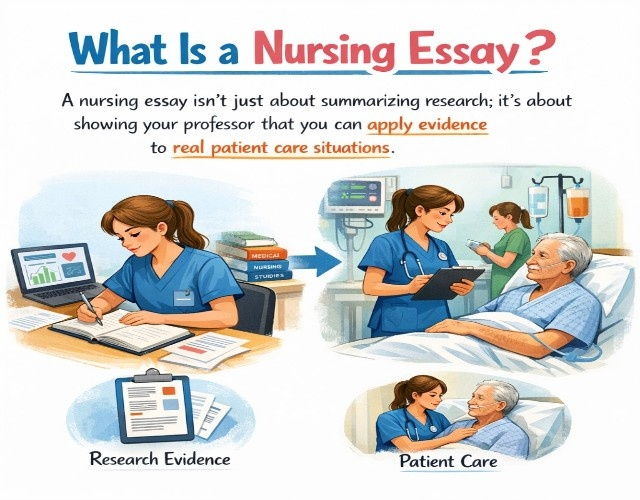
In nursing, you're expected to connect theory to practice, use evidence-based sources, and demonstrate clinical reasoning. You're not just writing about healthcare in the abstract. You're showing that you understand how it works at the bedside.
Here are the main types of nursing essays you'll encounter:
|
Know your type before you write a single word. The approach, structure, and tone differ significantly between them.
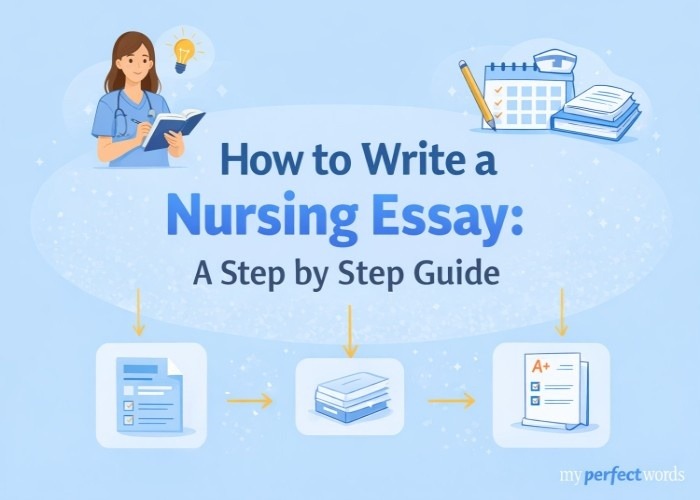
8 Steps to Write a Nursing Essay
Step 1: Understand Your Assignment
Before you type a single word, spend 10 minutes breaking down the brief. Most essay problems start with misreading the question.
| Read it carefully. What type of essay is it? What's the word count? Which referencing style is required, APA, Harvard, or Vancouver? These details are right there in the brief, but it's easy to skim past them when you're stressed. |
Then identify what the question is actually asking. Is it asking you to argue, reflect, analyze, or describe? Those verbs matter. "Critically analyze" is not the same as "describe." If the question asks you to evaluate, you need to take a position, not just present facts.
If you have marking criteria or a rubric, read it before you start. Professors often tell you exactly what earns marks. The rubric is the answer key. Use it.
Step 2: Choose and Narrow Your Topic
A strong nursing essay topic is specific enough to argue in 1,500 words, and concrete enough to connect to real clinical practice.
If your topic is given, narrow it. "Mental health in nursing" is too broad. "Therapeutic communication strategies in acute mental health settings" is workable. The more specific your angle, the easier it is to research, structure, and argue.
If the topic is open, choose something you've encountered clinically or covered recently in your coursework. Familiarity speeds everything up. You already know some of the context, which means you can get into the research faster.
The trap most students fall into is choosing too broad a topic and then trying to cover everything. You end up with a long list of vague points instead of a coherent argument. If you need inspiration, our list of nursing essay topics covers ideas organized by essay type and clinical specialty.
Step 3: Research and Gather Evidence for Nursing Essay
Reliable nursing essays are built on peer-reviewed evidence, not general health websites; your professor will notice the difference.
Use PubMed, CINAHL, or Google Scholar for peer-reviewed nursing and healthcare research. Your institution's library database likely gives you full-text access to most journals you'll need.
| When selecting sources, check the publication date. Most nursing programs ask for sources within the last 5 to 10 years. Older research can still be included if it's foundational or directly relevant, but you'll need to justify it. |
For a typical 1,500 to 2,000-word essay, aim for at least five to eight sources. These should include clinical guidelines, systematic reviews, and journal articles from nursing and healthcare publications. Position statements from organizations like the American Nurses Association also carry weight when you're writing about ethics or professional practice.
One important rule: don't start researching before you have a clear angle. Without a direction, you'll end up with 20 browser tabs and no idea what to do with any of them.
Step 4: Create a Nursing Layout
A 15 minute outline prevents a 3-hour rewrite. Know your structure before you start drafting.
Your basic structure is: Introduction, Body Paragraphs, Conclusion. That's not new. What matters in a nursing essay is what goes inside each section.
Your introduction needs a clear thesis, a specific, arguable statement about your topic. Your body paragraphs each cover one main point, supported by evidence and analyzed in terms of nursing practice. Your conclusion brings it together and reflects on the implications.
For each body paragraph, plan: what's my point, what's my evidence, and how does this connect back to nursing? That third question is where students often drop marks. Just citing research isn't enough. You need to explain what it means for practice.
Step 5: Write the Nursing Essay Introduction
Your introduction should tell the reader exactly what you're arguing and why it matters; leave the mystery for fiction.
It should do three things: give context for the topic, state your thesis or position clearly, and outline what the essay will cover. Aim for around 10% of your total word count. For a 1,500-word essay, that's 150 words.
What doesn't belong in a nursing essay introduction: vague opener sentences like "Nursing is one of the most important professions in the world," dictionary definitions of clinical terms, or your personal opinion stated without evidence.
If you want a strong opening, consider starting with a brief clinical context, a specific statistic, or a focused problem statement. Get to the point fast. Professors read dozens of these essays. An introduction that clearly states what you're arguing and why is already ahead of most.
No Time to Write Nursing Essay Yourself?
Our nursing writers handle essays at every academic level
Join 50,000+ students who've trusted us with their nursing assignments.
Step 6: Write the Body Paragraphs
The best nursing essays don't just report evidence, they interrogate it: why does this matter for the patient at the bedside?
Each paragraph should cover exactly one main point. Don't mix two arguments in one paragraph. It muddies the structure and loses marks.
A structure that works well for nursing essays is PEEL:
|
State your point clearly in the opening sentence. Bring in your peer-reviewed evidence. Explain what the evidence means for nursing practice; don't just describe it, analyze it. Then link back to the essay question or to your broader argument.
For citations, use the referencing style specified in your brief. Most nursing programs use the APA 7th edition. If you need a detailed breakdown of how to format in-text citations, reference lists, and headings, see our nursing essay format guide.
Watch your transitions. If you find yourself reaching for "moreover" or "furthermore," stop. Replace them with a new sentence that makes a direct connection. Your writing will read better for it.
Step 7: Write the Nursing Essay Conclusion
A strong conclusion doesn't just summarize; it answers the unspoken question: so what does this mean for nursing practice?
Your conclusion should do three things: summarize your key arguments in new words, restate your thesis, and reflect on the broader implications for nursing.
What it should never do: introduce new information, simply list what you covered without synthesis, or start with "In conclusion." That phrase signals the writer ran out of ideas. End with a sentence about what your essay means for clinical practice, professional development, or the direction of nursing more broadly.
Keep it to around 10% of your total word count, matching your introduction in length.
Step 8: Format, Reference, and Proofread
Formatting isn't just presentation; an incorrect APA reference page tells your professor you didn't take the assignment seriously.
Most nursing programs use the APA 7th edition. That means double-spaced text, a title page with your name and institution, one-inch margins, in-text citations in author-date format, and a reference list at the end. Student papers in APA 7th edition no longer require a running head; that's a change from the 6th edition, which still trips people up.
| For a complete breakdown of APA formatting requirements, heading levels, and citation structure, see our nursing essay format guide. |
For proofreading: read your essay aloud. You'll catch awkward sentences, missing words, and passive voice overuse faster than you will by reading silently. Check every in-text citation against your reference list; every source cited in the text must appear in the reference list, and vice versa.
Common Nursing Essay Mistakes (And How to Avoid Them)
The single most common mistake nursing students make is describing evidence instead of analyzing it. Description is a C, analysis is an A.
Here are the five mistakes that cost students the most marks:
Describing instead of analyzing.
Summarizing what a study found is not analysis. You need to explain what it means for nursing practice and why it matters.
| Ask yourself, "So what?" after every evidence point. |
Using outdated sources.
Anything over 10 years old will raise eyebrows unless it's a foundational text or you explicitly justify its inclusion. Use the publication date filter in PubMed to screen for recent research.
Mixing essay types.
Starting with a reflective structure and switching to argumentative halfway through is a structural red flag. Decide your type before you outline, and stay consistent.
Missing the word count by more than 10%.
Both under and over. Most programs have a 10% tolerance. Going 200 words under a 1,500-word essay signals you didn't address the question fully.
Paraphrasing without citing.
Even if you rewrite an idea in your own words, if it came from a source, it needs a citation. Missing citations looks like academic dishonesty, even when it isn't.
Conclusion
Writing a strong nursing essay requires more than meeting word count; it demands critical thinking, evidence-based research, and a clear connection between theory and clinical practice.
Whether you’re working on a reflective, argumentative, ethics, theory, or admission paper, understanding the structure and academic expectations is key to success.
By using credible sources, maintaining a professional tone, and applying nursing concepts effectively, you can produce a well-organized and high-scoring assignment.
Use this nursing essay writing guide as your roadmap to improve clarity, strengthen analysis, and confidently tackle any nursing assignment. With the right strategy, your nursing essay can demonstrate both academic excellence and professional competence.
Still Staring at a Blank Page?
Professional writing assistance tailored to your needs
- Expert writers with real nursing backgrounds and advanced degrees
- Every order includes a free plagiarism report
- Unlimited Revisions
- Secure payment, 100% confidential
Get your nursing essay written by a professional today.
Get Expert Help