Understanding a Nursing Theory Essay?
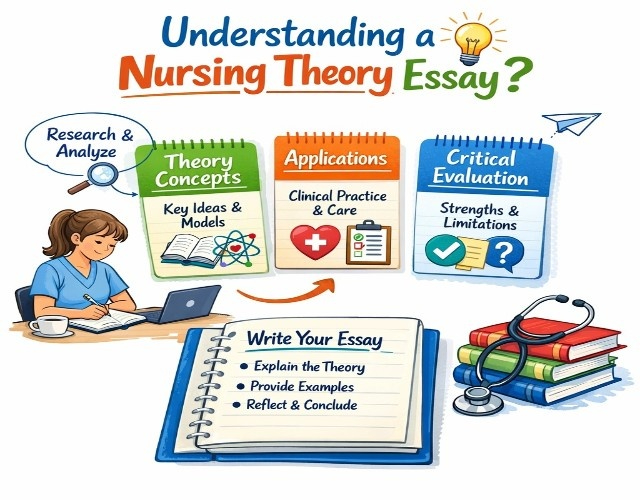
A nursing theory essay is a specific type of academic assignment that asks you to engage with a theoretical framework, not just describe it. You're expected to think like a scholar: introduce a theorist, unpack their ideas, show how those ideas apply in real clinical settings, and honestly assess where the theory holds up and where it doesn't.
This is different from a reflective essay, where the focus is on your own experience. It's also different from a nursing ethics essay, which centers on ethical principles and moral decision-making. Here, the theory itself is the subject.
| Most nursing theory essays are assigned at the BSN or MSN level, and they almost always require APA 7th edition formatting and peer-reviewed citations, particularly citations back to the theorist's original work, not just secondary sources. |
The 4 Part Structure Every Nursing Theory Essay Needs
Every nursing theory essay, regardless of which theorist you're writing about, follows the same four-part logic. Get this right, and the rest falls into place.
Part 1: Introduce the Theorist and the Theory
Start with context. Who is this person, and why does their work matter? You don't need a full biography; a few sentences establishing when and why the theory was developed is enough. Your reader should understand the historical and professional setting that gave rise to the framework.
Then state the theory's core premise in plain terms. If you can't explain it in two sentences, you don't understand it well enough yet. That's your signal to re-read the source material before writing.
Part 2: Explain the Core Concepts
Every major nursing theory addresses the nursing metaparadigm, the four central concepts of person, environment, health, and nursing. Use this as your framework for the "explain" section. How does this particular theorist define each one? Where does their definition differ from the standard?
| Be specific. "Orem sees the person as a self-care agent" is better than "Orem's theory focuses on the individual." Concrete language signals that you understand the theory, not just its name. |
Part 3: Apply the Theory to Clinical Practice
This is where most students lose marks. They explain the theory well, but drift into vague generalities when it comes to application. "This theory can be used in patient care," tells your marker, nothing.
| Pick a specific clinical scenario: a patient with a chronic illness, a postoperative recovery case, or a mental health admission, and show exactly how the theory's concepts would shape your assessment, planning, and intervention. The more specific your scenario, the stronger your application. |
Part 4: Critically Evaluate
A critical evaluation doesn't mean only criticism. You're assessing the theory's value honestly, its strengths, its limitations, and its relevance to modern nursing practice. Does it account for cultural diversity? Is it practical in under-resourced settings? Has it been validated by research?
| Cite evidence when you make evaluative claims. Opinion without evidence isn't critical analysis. |
Most Commonly Assigned Nursing Theories
Your professor may assign a specific theorist or give you a choice. Here are the six you're most likely to encounter, with a quick summary and the essay angle each one lends itself to.
Florence Nightingale: Environmental Theory
| Nightingale argued that a patient's physical environment directly affects recovery. Strong essay angle: historical context plus contemporary relevance, how do her principles (ventilation, cleanliness, light) map onto modern infection control? |
Dorothea Orem: Self-Care Deficit Theory
| One of the most widely assigned theories is that it's concrete and easy to apply to specific patient scenarios. Best for chronic illness, rehabilitation, or disability contexts where patient autonomy is central. |
Hildegard Peplau: Interpersonal Relations Theory
| Focuses on the therapeutic nurse-patient relationship as the foundation of nursing practice. Best used in mental health or psychiatric nursing essays where relational dynamics are central to care. |
Virginia Henderson: Need Theory
| Henderson structured nursing around 14 fundamental human needs. Works well for essays that need a structured, needs-based framework and is particularly applicable to holistic care settings. |
Jean Watson: Theory of Human Caring
| Centers on compassion, dignity, and the spiritual dimension of care. Commonly assigned in ethics-adjacent nursing courses and ideal for essays exploring the humanistic side of nursing practice. |
Madeleine Leininger: Culture Care Theory
| Built around culturally congruent care, the idea is that care must align with a patient's cultural values and beliefs. Often assigned at the DNP level and ideal for essays on health disparities or multicultural practice. |
Looking for specific essay topics around these theorists? Our nursing essay topics guide covers theory-specific ideas you can use.
Get Your Nursing Theory Essay, Written by an Expert
Get a Well-Researched, Professionally Crafted Essay Tailored to Your Assignment
Delivered on your deadline. Every time.
Nursing Theory Essay Example (Annotated)
Below is a short but complete example using Orem's Self-Care Deficit Theory. The annotations show what each paragraph is doing structurally, so you can see how the four-part framework plays out in practice.
Applying Dorothea Orem's Self-Care Deficit Theory to the Management of Type 2 Diabetes
Part 1: Introduce the theorist and theory
Dorothea Orem developed her Self-Care Deficit Theory across three connected frameworks: self-care, self-care deficit, and nursing systems. First published in 1971 and refined through subsequent editions, Orem's work emerged from her observation that patients were often treated as passive recipients of care rather than active participants in their own health. Her central argument is that nursing is required only when individuals cannot meet their own therapeutic self-care demands, a premise that continues to shape chronic disease management today.
Part 2: Explain core concepts through the metaparadigm
Orem conceptualizes the person as a self-care agent with both the capacity and the responsibility to perform self-care activities that maintain life, health, and well-being. The environment is understood as the set of physical, chemical, and social conditions within which self-care occurs, and which can either support or impede it. Health, in Orem's framework, is not merely the absence of disease but a state of structural and functional integrity. Nursing's role is activated only when a self-care deficit exists, that is, when the individual's therapeutic self-care demand exceeds their self-care agency.
Part 3: Apply to a specific clinical scenario
Consider a 58-year-old patient admitted with poorly controlled Type 2 diabetes. Using Orem's framework, the nurse first assesses the patient's universal self-care requisites (nutrition, activity, medication management), developmental requisites (adjustment to a chronic condition), and health-deviation requisites (insulin administration, blood glucose monitoring). A self-care deficit is identified: the patient lacks the knowledge and skills to manage their insulin regimen independently. The nurse implements a partly compensatory nursing system, providing direct assistance while simultaneously educating the patient to build self-care capacity over time.
Part 4: Critical evaluation
Orem's model offers clear operational utility in chronic disease contexts: it structures assessment, guides intervention planning, and centers patient autonomy. Research supports its effectiveness in diabetes education programs (Lorensen et al., 2020). Its limitations are also documented, however. Critics note that the theory's focus on individual self-care capacity may not adequately account for socioeconomic barriers to health, a patient who lacks access to nutritious food or consistent healthcare cannot simply "increase" their self-care agency. Applying Orem's framework requires nurses to supplement it with an understanding of structural determinants of health.
Free Downloadable Resources for Nursing Theory Essay
Quick Tips Before Submitting a Nursing Theory Essay
- Don't summarize, analyze. If a paragraph could appear in a textbook entry for the theory, it's not analytical enough. Every paragraph should apply, argue, or evaluate.
- Use the metaparadigm as a checklist. Person, environment, health, nursing, does your explanation section address all four? If you've skipped one, you've likely missed a key part of the theory.
- Cite the original theorist. Secondary sources are fine for supporting evidence, but your primary references should be the theorist's own published work. Citing only textbook summaries signals that you haven't engaged with the source material.
- Be specific in your clinical application. A real patient scenario, age, condition, and setting, is always stronger than a vague reference to "nursing practice." Specificity is what separates a B from an A.
- Check the rubric before you finalize. Some professors weigh application heavily; others want equal balance across all four parts. If critical evaluation is worth 40% of the marks, structure your word count accordingly.
- Read it aloud before you submit. If a sentence trips you up when you say it out loud, rewrite it. Academic writing should be clear, not convoluted.
Conclusion
Writing a high-quality nursing theory essay requires a clear understanding of key concepts, structured arguments, and practical examples. By focusing on essential elements like theory selection, analysis, and evidence-based discussion, you can create a compelling and academically sound essay.
Get Your Nursing Theory Essay Written by Experts
Professional Support for Accurate, Well-Structured, and High-Scoring Essays
- Thorough analysis of nursing theories and concepts.
- Evidence-based research to strengthen your arguments.
- Proper APA formatting and academic structure.
- Customized content tailored to your assignment requirements
Submit your essay with confidence and achieve top grades by letting experts craft a flawless essay.
Order Now