Understanding a Nursing Ethics Essay?
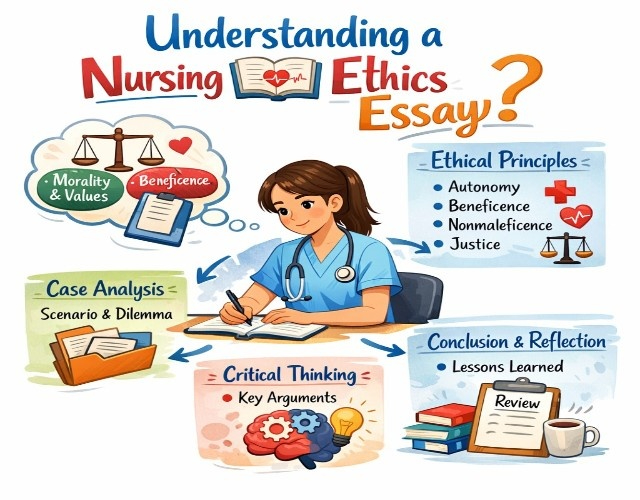
A nursing ethics essay is an academic piece that applies ethical theory to a clinical or professional nursing scenario. Where a nursing theory essay asks you to engage with models like Orem or Roy, an ethics essay focuses specifically on moral reasoning, identifying a dilemma, applying a framework, and defending a position.
| Your professor isn't looking for your personal opinion. They want structured ethical analysis: you identify the competing values at stake, apply recognized principles, and reach a defensible conclusion. |
The benchmark framework in nursing ethics is Beauchamp and Childress's Principles of Biomedical Ethics, four principles that guide ethical decision-making in healthcare settings. Most nursing programs expect you to use this framework, often alongside the ANA Code of Ethics.
The Core Ethical Principles You Need to Know
The Beauchamp and Childress framework gives you four principles to anchor your analysis:
1. Autonomy
Respect for the patient's right to make their own decisions. In practice, this means honoring informed consent and not overriding a patient's choices, even when you disagree with them.
| Example: A patient refuses a blood transfusion for religious reasons. Autonomy means respecting that refusal. |
2. Beneficence
The obligation to act in the patient's best interest. This isn't just about doing something good; it means actively promoting the patient's wellbeing.
| Example: Advocating for better pain management for a patient who can't speak for themselves. |
3. Non-maleficence
The duty to avoid causing harm. You'll often see this in tension with beneficence; sometimes, a treatment that could help also carries the risk of harm.
| Example: Deciding whether to administer a medication with serious side effects. |
4. Justice
Fair and equitable treatment. In clinical settings, this often comes down to resource allocation, who gets care, who has to wait, and whether that's fair.
| Example: Triaging patients during a mass casualty event. |
Nursing programs often add two more principles from nursing-specific ethics literature:
- Fidelity: Keeping promises and honoring your commitments to patients. This includes following through on what you've told a patient you'll do.
- Veracity: Telling the truth. This includes the duty to be honest with patients even when the news is difficult.
The ANA Code of Ethics (2015, revised) is the governing document for ethical nursing practice in the US. When you reference these principles in an essay, tying them back to the ANA Code adds academic weight to your argument.
How to Structure a Nursing Ethics Essay
The structure below works for most nursing ethics assignments, from 1,000-word undergraduate papers to longer postgrad analyses.
1. Introduction
Open with the ethical issue you're addressing. Name the dilemma clearly and state your position; don't leave your reader guessing. Close the introduction with a brief overview of which ethical principles you'll apply.
| What to avoid: Starting too broadly ("Ethics in healthcare is a complex field..."). Get to the specific issue fast. |
2. Background and Context
Provide the clinical or professional context for your dilemma. If you're writing about end-of-life decisions, briefly outline the scenario, what's happening, who's involved, and what's at stake. Keep this section factual.
3. Ethical Analysis
This is the core of your essay. Apply 2 to 3 principles from the Beauchamp and Childress framework to your scenario. For each principle, explain how it applies and what it suggests about the right course of action. Use evidence, peer-reviewed literature, clinical guidelines, and ANA Code provisions.
| A strong ethical argument doesn't just define the principles. It shows how they interact and, where they conflict, explains which principle should take priority and why. |
4. Counter-argument
Acknowledge the strongest case against your position. A good ethics essay shows you've engaged with opposing views, not just built your own case in isolation. This is also where you demonstrate intellectual honesty; you can acknowledge tension without undermining your argument.
5. Conclusion
Restate your position clearly. Summarize how your ethical analysis supports it. End with a brief reflection on what this means for nursing practice, not a vague call to action, but a specific implication.
Nursing Ethics Essay Example (Annotated)
Here's a short excerpt from a nursing ethics essay on patient autonomy and end-of-life care. Annotations show how the argument is constructed.
Should nurses advocate for a patient's right to refuse life-sustaining treatment, even when family members disagree?IntroductionPatient autonomy is a cornerstone of ethical nursing practice, emphasizing the right of individuals to make informed decisions about their healthcare (Beauchamp & Childress, 2019). A critical scenario arises when patients refuse life-sustaining treatment, such as ventilators or resuscitation, and their family members disagree with this decision. Nurses are uniquely positioned at the intersection of patient advocacy, ethical principles, and family dynamics. This essay argues that nurses should advocate for a patient’s right to refuse life-sustaining treatment, guided by ethical principles, legal frameworks, and professional responsibilities. Annotation:
The principle of autonomy holds that competent patients have the right to make informed choices about their own care, even if their decisions contradict medical advice or family wishes (ANA, 2015). In the context of life-sustaining treatment, autonomy dictates that a patient’s preferences must be respected as long as they have decision-making capacity. Nurses have an ethical obligation to advocate for the patient’s choices, ensuring that the patient is informed about potential risks, benefits, and outcomes (Arnold & Boggs, 2020). Family members may disagree due to emotional attachment, fear of loss, or misunderstanding of the patient’s condition. While families’ opinions are important for support, they cannot override a competent patient’s autonomous decision. Nurses must navigate these situations carefully, balancing advocacy with sensitivity and clear communication. Annotation:
Legally, competent adults have the right to refuse medical treatment, including life-sustaining interventions (Varkey, 2021). Nurses are bound by professional standards to uphold these rights while ensuring patients are fully informed. Failure to respect a patient’s decision may result in ethical violations, legal consequences, and harm to the nurse-patient relationship. Documentation is critical; nurses should record patient decisions, education provided, and discussions with family members to maintain accountability and transparency. Professional guidelines, such as those from the American Nurses Association (ANA, 2015), emphasize that nurses must act as patient advocates. This includes protecting patients from undue influence or coercion by family or medical staff. Advocating for autonomy aligns with both legal and ethical responsibilities, reinforcing trust in healthcare systems. Annotation:
While the patient’s decision must be respected, nurses should also facilitate open communication with family members. Providing clear explanations about the patient’s prognosis, treatment options, and reasons for refusal can help reduce conflict and emotional distress. Nurses can act as mediators, helping families understand the patient’s perspective without pressuring the patient to change their decision (Taylor, Renpenning, & Giger, 2020). Engaging families also supports emotional care and ensures that the patient does not feel isolated. However, nurses must maintain the priority of patient autonomy, avoiding situations where family opinions override informed consent. Annotation:
Nurses must advocate for a patient’s right to refuse life-sustaining treatment, even when family members disagree, grounded in ethical principles, legal rights, and professional standards. Autonomy is paramount, and competent patients’ decisions must be respected while families are engaged with sensitivity and clear communication. By balancing advocacy, education, and empathy, nurses uphold ethical integrity, protect patient rights, and maintain trust within the healthcare system. Annotation:
American Nurses Association. (2015). Code of ethics for nurses with interpretive statements. ANA Publishing. Arnold, E. C., & Boggs, K. U. (2020). Interpersonal relationships: Professional communication skills for nurses (8th ed.). Elsevier. Beauchamp, T. L., & Childress, J. F. (2019). Principles of biomedical ethics (8th ed.). Oxford University Press. Taylor, S. G., Renpenning, K. M., & Giger, J. N. (2020). Self-care science, nursing theory, and evidence-based practice. Springer Publishing Company. Varkey, B. (2021). Principles of clinical ethics and their application to practice. Medical Principles and Practice, 30(1), 17–28. https://doi.org/10.1159/000509119 |
Need an ethics essay written from scratch?
Our nursing writers research, analyze, and write your ethics essay for you.
100% Human. Turnitin-Safe. Deadline-Ready.
Short Nursing Ethics Essay Example
| Upholding Integrity in Care Nursing is more than a profession; it is a commitment to ethical responsibility and compassionate care. Nurses frequently face complex situations where they must balance patient rights, confidentiality, and professional duties. Central to nursing ethics are principles such as beneficence, non-maleficence, autonomy, and justice. Upholding these principles ensures patients receive safe, respectful, and equitable care. For instance, respecting a patient’s autonomy means honoring their decisions even when they differ from medical advice, while beneficence drives nurses to act in the best interest of the patient. Ethical challenges, such as end-of-life decisions or informed consent, demand critical thinking, empathy, and adherence to professional standards. Ultimately, nursing ethics is the backbone of trust between healthcare providers and patients, reinforcing the noble purpose of the profession. |
Free Downloadable Resources for Nursing Ethics Essay
Tips for Writing a Strong Nursing Ethics Essay
Name the principles explicitly.
Don't just describe the situation and hope your reader infers the ethical framework. Write "this reflects the principle of non-maleficence" and explain why.
Apply, don't just define.
A common mistake is spending too much of your word count explaining what autonomy means and not enough showing how it applies to your specific scenario. Your professor already knows the definition. They want to see you use it.
Reference the ANA Code.
Even if your program doesn't require it, citing the ANA Code of Ethics (including specific Provision numbers) shows you're grounding your argument in professional nursing standards, not just bioethics theory.
Use peer-reviewed sources for evidence.
Ethics isn't purely philosophical in nursing; there's a strong evidence base. Look for literature on clinical ethics, nursing advocacy, and the specific dilemma you're analyzing.
Engage with counter-arguments.
A one-sided essay is less convincing, not more. Show you've considered the opposing view and explain why your position is stronger.
Keep your conclusion specific.
"Nurses must uphold ethical standards" is not a conclusion. "This analysis suggests that nurses in ICU settings need clearer protocols for documenting advance directives to support consistent application of patient autonomy." That's a conclusion.
| If your assignment focuses on a nursing theory rather than an ethical dilemma, see our nursing theory essay guide instead. |
Conclusion
Mastering nursing ethics is crucial for writing high-quality essays that demonstrate understanding of patient-centered care, ethical principles, and real-life scenarios. Using nursing ethics examples and understanding concepts like beneficence, autonomy, and justice can strengthen your essay arguments.
Struggling With an Ethical Dilemma Essay?
Get expert help to craft a perfect nursing ethics essay.
- Accurate analysis of ethical principles and dilemmas.
- Proper APA formatting for academic credibility.
- Evidence-based research to strengthen your arguments.
- Customized content tailored to your assignment requirements.
100% human writing, AI detection proof
Get Expert Help