-20610.jpg)
Understanding Medical School Essays
Medical school essays are a crucial part of your application, giving admissions committees insight into who you are beyond GPA and MCAT scores. These essays evaluate your motivation for medicine, personal values, communication skills, and readiness for the challenges of medical training.
What Are the Different Types of Medical School Essays?
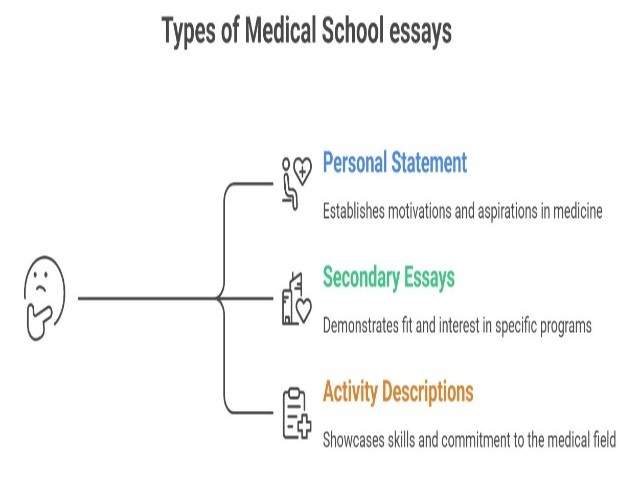
Most people search "how to write a medical school essay," thinking about the personal statement. That's understandable; it's the first one you write, and it gets the most attention. But here's what you're actually signing up for when you apply to medical school:
The Personal Statement (Primary Application)
This is the main essay. It goes to every school you apply to through AMCAS, AACOMAS, or TMDSAS. It's open-ended, no prompt except "tell us about yourself and why you want to be a doctor." AMCAS gives you 5,300 characters. TMDSAS gives you 5,000. This is the one you'll spend the most time on.
Secondary Essays
After schools receive your primary application, most send you secondary prompts, school-specific questions about topics like diversity, adversity, research, or why you want to attend their program specifically. You'll write anywhere from 15 to 30+ of these, depending on how many schools you apply to. Most are 150–500 words each.
Activity/Work Experience Descriptions
AMCAS gives you 15 activity entries with 700 characters each. Three of them can be designated as "most meaningful," which unlocks an extra 1,325 characters for a short essay-style explanation. These aren't essays in the traditional sense, but they're written narrative components that matter.
Most applicants don't realize they'll write 15 to 30 separate pieces of writing before they're done; the personal statement is just the first.
| The good news: once you nail your personal statement, the rest gets easier. It's the foundation everything else builds on. |
How to Write Your Medical School Essay (Personal Statement)
Your personal statement has one job: show admissions committees who you are as a person, not just what you've done.
That sounds simple, but it trips up almost everyone. The instinct is to list your achievements, shadowing hours, research, volunteer work, and clinical experience. Admissions committees already have your activity list. They don't need it in paragraph form. What they need is to understand the person making those choices.
The strategic approach: qualities first
Before you write a single word, identify 2 to 3 core qualities you want an admissions committee to walk away with. Not what you've done, who you are. Are you someone who's drawn to complexity? Someone who builds trust quickly with patients? Someone who sees medicine as a way to address systemic inequity?
| Pick your qualities. Then choose the experiences that best demonstrate them. |
Basic structure that works
Most strong personal statements follow a loose arc:
|
Your personal statement isn't a resume in paragraph form; it's the one place you get to show an admissions committee the person behind the application.
For a complete deep dive on strategy, structure, and what makes the personal statement work, read our medical school personal statement guide.
How to Write Medical School Secondary Essays
Once you submit your primary application, schools start sending secondaries, and they come fast. Most expect a response within 2 weeks, so it's not unusual to be juggling 5 to 10 secondary requests at once during peak application season.
The 6 most common secondary essay types:
- Why this school: What specifically draws you to this program? (Requires real research into each school)
- Diversity/background: What perspective do you bring that makes the class stronger?
- Adversity or challenge: A setback you faced and what you learned
- Why medicine: Similar to PS but more concise; don't just repeat your statement
- Research/activities: A deeper look at your most meaningful experiences
- Optional/additional information: Anything you want to explain that didn't fit elsewhere
The key rule for secondaries: don't repeat your personal statement. Your primary already introduced you. Secondaries should fill in the gaps it left, new stories, different angles, and more specific perspectives.
The pre writing strategy that saves you:
Write drafts of the most common secondary types before they arrive. The "why medicine," "diversity," and "challenge" prompts appear at nearly every school. If you have solid drafts ready, you're adapting instead of writing from scratch under time pressure.
| The best secondary essays don't repeat your personal statement; they fill in the gaps it left. |
Not sure what to write about? Our medical school essay topics guide covers the most common prompts with strategic direction for each.
Step by Step: How to Write a Medical School Essay (From Blank Page to Submission)
Here's the process that works, broken into the steps that actually matter.
Step 1: Brainstorm your story
Start with qualities, not experiences. Write down 5 to 10 traits you want an admissions committee to associate with you. Then narrow it to 2 to 3 that feel most authentic and most distinctive to your specific path.
Step 2: Build your experience inventory
List every meaningful moment from your pre-med years, not just clinical hours, but the patient conversations that stayed with you, the research setbacks that changed how you think, the volunteer shifts that were harder than expected. You're looking for specific, visual moments, not resume bullet points.
Step 3: Pick your angle and opening hook
Your opening should drop the reader into a scene. A specific moment. Something you can see. "On my third week in the emergency department" beats "I've always been passionate about medicine" every time.
Step 4: Draft fast
Write the whole thing without stopping to self-edit. Get the full story out. Perfectionism at the draft stage is the enemy; you can't fix a blank page.
Step 5: Revise for structure
Read back through: does your essay arc from opening to experiences to why medicine to future direction in a way that feels earned? Does every paragraph earn its spot? Cut anything that doesn't serve the narrative.
Step 6: Read aloud
This is the most underrated step. If you'd never say it that way to a friend, don't say it that way to an admissions committee. Stiff, formal language is a signal that you're performing rather than speaking.
| Read your essay aloud. If it doesn't sound like you, rewrite it. |
Step 7: Get feedback
Your pre-med advisor, a physician mentor, or a professional editor who knows medical admissions. The goal is someone who can tell you whether your story is landing, not just whether your grammar is clean.
Step 8: Final polish
Check your character counts for the specific application system you're submitting through. Review formatting. Make sure your intro hasn't shifted away from the story you meant to tell. For full technical specs, see our medical school essay format guide.
Need Someone to Write Medical School Essay For You? Our human writers have helped 50,000+ students craft essays that get noticed.
Don't risk your application on generic writing.
What Do Medical School Admissions Committees Actually Look For?
They're reading hundreds of essays. Yours needs to be memorable, not clever memorable, but human memorable.
Here's what they're actually evaluating when they read your application:
Authentic motivation.
Not "I want to help people" (everyone says that). They want to see the specific moments that convinced you medicine was right for you, and why those moments mean what you say they mean.
Self-awareness.
Can you reflect honestly on your experiences? Can you identify what you learned, not just what you did? The best essays show a person who thinks clearly about themselves.
Communication skills.
Your essay is a direct sample of how you'll communicate with patients, colleagues, and families. If it's unclear or hard to follow, that's a signal.
Maturity.
Applicants who write about their accomplishments without connecting them to growth, uncertainty, or change tend to sound young. The ones who get interviews write about the moments that challenged them.
An admissions committee can tell within the first paragraph whether this essay was written by a person or assembled from advice articles.
| The clearest marker: specificity. An essay only you could have written, with your specific patient, your specific setback, your specific moment, is an essay that's hard to forget. |
See how these principles show up in real writing in our medical school essay examples.
Common Medical School Essay Mistakes to Avoid
Most of these aren't about writing quality. They're about the approach.
Starting with a dramatic hospital scene.
It's the most common opening in the stack. A dying patient. An ER at 2am. A moment of medical heroism. Admissions readers have seen it thousands of times. If you open this way, you're starting from behind.
Writing a resume in paragraph form.
"I shadowed Dr. X for 200 hours. I also volunteered at Y for two summers. I participated in Z research program." This isn't a personal statement. It's a list with transitions.
Telling instead of showing.
"I am deeply compassionate." Okay, show it. Give the specific moment that demonstrates it. Let the reader reach that conclusion themselves.
Using vague language.
"I've always wanted to help people." "Medicine has been my passion for as long as I can remember." These phrases are invisible. Every applicant could have written them.
Making it about the patient.
Your essay should be about you. It's fine to start with a patient interaction, but you need to pivot quickly to what that moment revealed about you, not what it revealed about the patient's strength or struggle.
Ignoring the secondaries until it's too late.
Pre-med students spend months on the personal statement, then face 20 secondary requests in three weeks. Start pre-writing common secondary types at least a month before schools send them.
The most common mistake isn't bad writing, it's writing an essay that could have been written by anyone.;
Medical School Essay Tips From Admissions Insiders
Start earlier than you think you need to.
| The fall or winter before your application cycle is not too early for your personal statement. Drafts get better over time. Revision requires distance. Give yourself both. |
Write your personal statement before touching the secondaries.
| Your PS is the foundation of your narrative. Once you know what story you're telling there, secondary essays become much easier to write without repeating yourself. |
Keep a story bank.
| As you go through clinical rotations, shadowing, and volunteer work, jot down the moments that stick with you. Not summaries, specific sensory details. That conversation in the waiting room. The attending who handled a difficult family in a way you've thought about since. These are your raw materials. |
Apply in the first wave.
| Medical school admissions at most programs are rolling. An equally strong applicant who submits in June gets a better outcome than one who submits in October. Your essays matter most when the interviewing slots are still full. |
Don't write what you think they want to hear.
| Admissions committees read enough essays to spot performative language immediately. The applicants who stand out aren't necessarily the most impressive on paper; they're the ones who wrote something true. |
The applicants who get in first aren't the ones with the best stats; they're the ones who submitted early and wrote with purpose.
Wrapping Up!
Following a clear medical school essay writing guide can significantly improve the strength and impact of your application. From understanding the prompt to structuring your response and refining your final draft, every step plays a role in presenting a compelling and authentic narrative.
Strong medical school essays highlight your motivation for medicine, showcase meaningful experiences, and demonstrate the personal qualities admissions committees value most.
By focusing on clarity, reflection, and proper formatting, you can craft an essay that stands out in a competitive admissions process. A well-written medical school essay not only supports your academic profile but also increases your chances of securing interviews and admission offers.
Ready to Submit an Essay That Actually Gets Read?
Let our expert writers help you craft a compelling, admissions-ready medical school essay that increases your interview chances.
- Personalized personal statements and secondary essays
- Strategic storytelling aligned with medical school criteria
- Thorough editing for clarity, structure, and impact
- 100% original, plagiarism-free content delivered on time
Your application is too important to leave to chance.
Get Medical School Essay Help
-20611.jpg)