Understanding Medical School Personal Statement
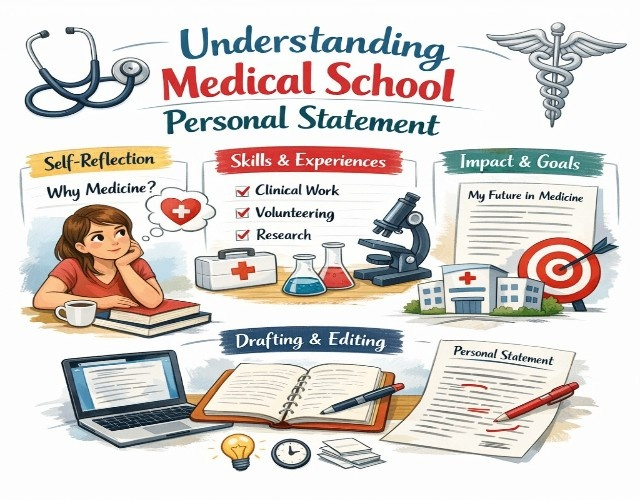
A medical school personal statement is a key part of your application that gives admissions committees insight into who you are beyond your grades and test scores. It allows you to showcase your motivation for pursuing medicine, highlight relevant experiences, and demonstrate qualities such as empathy, resilience, and leadership.
What Does a Medical School Personal Statement Actually Do?
Most applicants think of the personal statement as a place to summarize their achievements. That's a mistake that shows up in a lot of rejected applications.
Your personal statement isn't a summary of your application; it's the argument that ties everything together. Admissions committees already have your activities section, your transcripts, and your letters of recommendation. What they don't have yet is you, your reasoning, your self-awareness, and your specific motivation for medicine.
The personal statement also isn't the place to brag. Committees are reading thousands of these. Impressive activities are expected. What they're evaluating is whether you understand yourself well enough to explain why medicine, why now, and why you specifically.
| One more technical note: if you're applying through TMDSAS (Texas schools), your limit is 5,000 characters. AACOMAS (osteopathic schools) matches AMCAS at 5,300 characters. |
If you're still getting oriented to the full set of essays you'll need to write, our complete guide to writing medical school essays covers every component, from primaries to secondaries.
What Admissions Committees Are Actually Looking For
Here's what most applicants miss: admissions committees aren't just reading for a good story. They're reading for evidence that you have the qualities medicine requires.
Think about what you'd need to succeed in 30 years of practicing medicine, not just medical school, but the actual career. Empathy. Resilience. Intellectual curiosity. The ability to sit with uncertainty. A service orientation that goes beyond "wanting to help people."
This is the qualities-first framework, and it changes how you approach the entire essay. Instead of asking "what experience should I write about?" start with "what qualities do I want a committee to associate with me?" Then find the experiences that prove those qualities. That shift alone puts you ahead of 90% of applicants.
The applicants who get interviews aren't the ones with the most impressive stories; they're the ones who reflect most clearly on what those stories taught them.
Committees can spot a checklist application immediately. The applicant who spent a summer shadowing, volunteered at a free clinic, and did research, but can't tell you why those experiences solidified their decision, is a red flag, not a green light.
And if you're worried your story isn't dramatic enough? That's not the problem. The problem would be if your reflection isn't specific enough. We'll get to that.
Before You Write: How to Find Your Story
Most applicants open a blank document and start typing. That's why most first drafts read like a timeline.
| Start with qualities instead. Take 20 minutes and write down three or four qualities you genuinely believe you'll bring to medicine. Not aspirational ones, qualities you've actually demonstrated. Empathy? Resilience? Curious about systems? The ability to stay calm under pressure? |
Now, for each quality, list two or three moments from your life that prove it. Not a general period of time, a specific moment. A conversation. A decision. A patient interaction that made you understand something differently.
That's your raw material
Start by listing the qualities you want a committee to see in you, then find the stories that prove them.
Here's the "What Did I Learn?" test: for every experience you're considering, finish this sentence: "This experience taught me." If you can't complete it with something specific, that experience probably shouldn't anchor your essay. If you can, you've got something worth building around.
Your unifying theme, the thread that runs through the whole essay, should come from this exercise. It's not "I want to help people." It's something like: "I've learned that good medicine requires holding someone's fear alongside the clinical facts, and I saw that play out in three very different settings."
| If your story feels ordinary, that's a framing problem, not a story problem. Ordinary experiences told with genuine reflection beat dramatic experiences told without it, every time. If you're still working out what angle to take, our guide to medical school essay topics walks through the most effective themes and how to develop them. |
Structuring Your Medical School Personal Statement
Once you have your story, you need a structure that lets it breathe. Here's one that works:
Hook/Scene:
Open in the middle of a specific moment. Not "I have always wanted to be a doctor." A scene. A place. Something that happened.
Journey/Reflection:
Move from that opening into the broader arc. What led you here? What did you learn along the way? Pick two or three experiences (not more) and connect them to the qualities and theme you've identified.
Evidence of Preparation
Show you understand what medicine actually requires. This is where your clinical and volunteer experiences matter, but only in how they changed your thinking, not as a list.
Future Vision
Close with something specific. Not "I look forward to helping patients." The specific kind of physician you're becoming. What problem do you want to work on? What you're bringing to medicine that it needs.
The strongest personal statements end not with "I want to be a doctor" but with a specific vision of the physician you're on your way to becoming.
A few things to avoid: don't recap your activities section (they have it), don't start with a dictionary definition or a statistic, and don't end with a platitude. The closing paragraphs are often where great essays lose their grip.
This section covers narrative structure only. For character limits and technical formatting rules across AMCAS, TMDSAS, and AACOMAS, see our medical school essay format guide
Want Someone Else to Handle Your Medical School Personal Statement?
Get professional guidance to showcase your passion, experiences, and strengths with confidence.
100% human-written, zero AI content
Writing Your Medical School Personal Statement: Step by Step
Once your outline is ready, writing becomes execution. Here's how to move from blank page to solid draft:
Step 1: Brainstorm (30 to 60 minutes).
Use the qualities-first exercise above. Don't write the essay yet, just identify your three or four qualities and the specific moments that prove each one.
Step 2: Write a theme sentence.
Before you outline anything, write one sentence that captures the central argument of your essay. "I became committed to medicine through X, which taught me Y, and shaped the kind of physician I want to become." If you can't write that sentence, you're not ready to draft yet.
Step 3: Create a Layout first.
Map each paragraph to a quality and an experience. Know what each paragraph is doing before you write it.
Step 4: Draft without editing.
Write the whole thing before you change anything. The goal of the first draft is to get the story out. You can fix the language later.
Step 5: Revise for focus.
Cut anything that doesn't serve your central theme. If a paragraph is just describing what happened, without connecting to a quality or advancing your argument, it needs to go or be rewritten.
Step 6: Read it aloud.
If it sounds like a formal essay, rewrite it to sound like you. The best personal statements don't sound polished; they sound like a person who knows exactly why they're going to medical school.
Step 7: Get real feedback.
Show it to your prehealth advisor, a mentor who knows admissions, or a service where reviewers have been on the other side of this process. At MyPerfectWords, our writers are MDs and former admissions officers who work on these every cycle.
| On timeline: start brainstorming in the fall or winter before you apply. Aim to have a final draft by mid-May at the latest. AMCAS opens in late May, and early submission gives you a real advantage in the rolling admissions process. |
Crafting a Strong Medical School Personal Statement Opening Line
Your first sentence either earns attention or loses it. Three types of openings that work:
Scene-based
Drop the reader into a specific moment. "At 2 a.m., the ER was quiet except for a man in Bay 3 who kept asking if his son knew he was there." The reader is immediately somewhere.
Reframed observation
An unexpected connection or shift in perspective that signals you think differently. This works when it's genuinely specific, not a generic insight.
Specific tension
A moment where two things you believed came into conflict. These openings work because they immediately establish complexity.
What to avoid:
|
Medical School Personal Statement Samples
The Clinical Experience That Confirmed My CallingThe first time I held a patient’s hand in the emergency department, I realized medicine was not only about diagnosis but about presence. I was volunteering in a busy urban hospital when an elderly woman arrived with chest pain. While physicians moved quickly around her, she looked frightened and alone. I stayed by her side, explaining what I understood and offering reassurance. Later, her daughter thanked me, not for medical expertise, but for compassion. That moment solidified what years of curiosity about science had begun. As a biology major, I was fascinated by the complexity of the human body, but clinical exposure showed me the human side of illness. Research in cardiovascular physiology sharpened my analytical thinking, yet volunteering in hospice care deepened my empathy and listening skills. Medicine, to me, is where scientific reasoning meets human connection. I have seen how physicians balance urgency with empathy and precision with patience. Through shadowing and clinical volunteering, I learned that being a doctor requires resilience, humility, and constant growth. I am pursuing medicine not only to treat disease but to support patients through vulnerability. I am ready to dedicate myself to rigorous training, lifelong learning, and compassionate care as I work toward becoming a physician. |
The Most Common Medical School Personal Statement Mistakes
Mistake 1: The resume recap.
Your activities section already lists your experiences. The personal statement is where you reflect on them, not where you repeat them.
Mistake 2: The generic opening.
"I have always wanted to be a doctor since I was five." Committees read this in approximately 40% of applications. It signals that you haven't found your specific story yet.
Mistake 3: Vague motivation.
"I want to help people" is true for teachers, social workers, and firefighters, too. What specifically draws you to medicine? What does medicine offer that nothing else does?
Mistake 4: Describing instead of reflecting.
"I volunteered at the hospital and saw many patients." Great. What did that teach you? How did it change how you see medicine? The experience is the setup, the reflection is the point.
Mistake 5: Using AI.
Admissions committees are reading for voice. AI-generated text has patterns, and they're getting better at spotting them. Beyond detection, AI can't reflect your actual experiences or genuine reasoning. It gives you generic content when specific content is exactly what gets interviews.
Mistake 6: Trying to cover too much.
A focused essay built around two or three meaningful experiences consistently beats one that lists seven experiences at the surface level. Depth beats breadth here.
| If you can swap your name out of your personal statement and it could have been written by any other applicant, start over. |
Want to see exactly what strong versus weak looks like in practice? Our medical school essay examples article breaks down real statements with an analysis of what worked and what didn't.
Final Thought
A well-written medical school personal statement is a powerful component of your application. It allows you to showcase your motivation for medicine, highlight meaningful clinical and research experiences, and demonstrate the empathy, resilience, and commitment required to succeed in medical training. A clear structure, authentic storytelling, and strong reflection can help your personal statement stand out to admissions committees.
By focusing on your unique journey and aligning your experiences with the values of medical schools, you can craft a compelling and interview-worthy essay. A polished medical school personal statement not only strengthens your application but also significantly increases your chances of securing medical school interviews and admission offers.
Ready to Get Your Personal Statement Done Right?
Let our expert writers help you craft a compelling, interview-winning personal statement that stands out to admissions committees.
- Personalized, story-driven content tailored to your journey
- Strategic structure aligned with medical school expectations
- Professional editing for clarity, tone, and impact
- 100% original, plagiarism-free writing with timely delivery
Place your order today. Delivered always on time
Order Now
-20610.jpg)
-20611.jpg)