-20611.jpg)
Personal Statement Topics: 8 Categories That Work
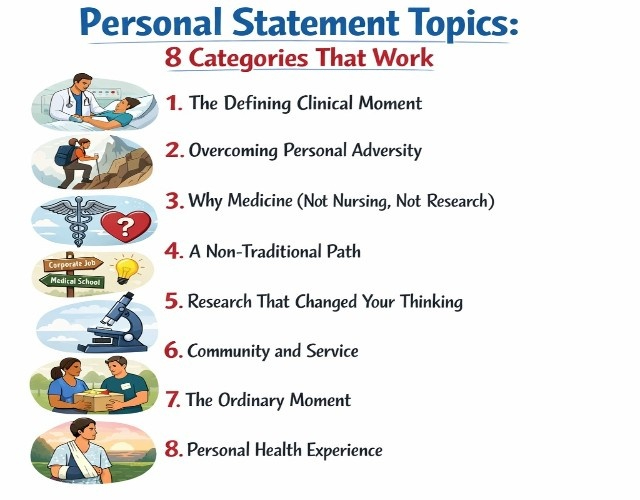
The personal statement isn't a place to list what you've done. It's a place to explain who you are and why medicine is the answer, not healthcare broadly, not research, not nursing, but the specific, complex work of being a physician.
| Before picking a topic, understand this: the category matters less than the specificity. Two applicants can write about the same type of experience and produce essays that are completely different in quality and memorability. What separates them is almost always how deeply one of them went into the specific detail of a single moment. |
Here are the 8 categories that produce strong personal statements, and what each one needs to avoid becoming generic.
1. The Defining Clinical Moment
A patient encounter or shadowing experience that made medicine feel real and necessary. What works here is the specificity of the moment, the patient's description, the exact decision you witnessed, the thing you couldn't stop thinking about on the drive home. The generic version is a summary of a rotation with no person at the center of it.
2. Overcoming Personal Adversity
A significant challenge, illness, financial crisis, or academic setback that built your capacity for empathy or persistence. What works here is a clear line from the experience to a specific insight about medicine. The generic version catalogues the difficulty without showing what you learned that made you a better future physician.
3. Why Medicine (Not Nursing, Not Research)
The specific reasoning behind wanting to be a physician, not just a member of the healthcare team. What works here is a direct, honest answer to the question admissions officers are always asking in the back of their minds. The generic version says "I want to help people" and stops there, which is true of virtually every profession.
4. A Non Traditional Path
Career changers, first-generation college students, immigrants whose background illuminates their commitment in a way a traditional path can't. What works here is using your prior experience as evidence, not as something that needs explaining or apologizing for, but as a perspective no one else at that table has. The generic version is defensive instead of confident.
5. Research That Changed Your Thinking
A scientific experience that forced you to sit with uncertainty or complexity in a way that deepened your understanding of medicine. What works here is the intellectual honesty; something didn't go the way you expected, and that was the point. The generic version is a CV summary that describes what the research was without explaining what it meant to you.
6. Community and Service
Sustained work with underserved populations or health advocacy tied to a problem you've looked at up close. What works here is the word "sustained", the essay should show commitment over time, not a one-time experience. The generic version is a log of volunteer hours with no specific person or challenge at the center.
7. The Ordinary Moment
An unexpectedly mundane experience, translating at a clinic for a parent, sitting with a dying neighbor, watching a sibling navigate a diagnosis, that reveals character more clearly than a dramatic one. What works here is the counterintuitive nature of the story itself. The generic version over-explains the significance instead of trusting the reader to feel it.
8. Personal Health Experience
Navigating the medical system as a patient or caregiver, and how that inside view shapes what kind of doctor you're working to become. What works here is connecting the experience directly to a specific dimension of medicine you want to practice differently. The generic version makes the illness the protagonist instead of you.
| The strongest personal statement topics aren't the most dramatic; they're the most honest about what you've actually learned. |
List of Topics Based on the Above Categories
- The patient encounter that confirmed my decision to pursue medicine
- A moment in the ER that changed how I see physicians
- Witnessing compassion during end-of-life care
- The first time I understood the responsibility of a doctor
- A clinical interaction that reshaped my career goals
- Balancing caregiving responsibilities with academics
- Recovering from academic setbacks and rebuilding confidence
- Growing up in an underserved community
- Financial hardship and resilience in higher education
- Learning perseverance through personal loss
- Why I chose physician leadership over clinical support roles
- Bridging science and direct patient care
- From lab research to bedside medicine
- The decision to pursue full diagnostic responsibility
- Why long-term patient management drew me to medicine
- Transitioning from engineering to medicine
- From business professional to aspiring physician
- Military service as preparation for medical training
- A career shift inspired by community health work
- Returning to school after years in the workforce
- A failed experiment that taught intellectual humility
- Discovering the human impact behind scientific data
- How clinical research reshaped my view of treatment
- Ethical dilemmas in research and patient care
- Turning curiosity into medical commitment
- Volunteering in free clinics for underserved populations
- Leading health education workshops in rural areas
- Advocating for health equity in marginalized communities
- Building trust through community outreach programs
- Service experiences that deepened my empathy
- A quiet conversation that revealed the power of listening
- A routine clinic visit that left a lasting impact
- Learning from a simple patient thank-you
- Observing teamwork during a typical hospital shift
- Finding meaning in everyday clinical interactions
- Supporting a family member through chronic illness
- Navigating the healthcare system as a patient advocate
- Living with a medical condition that shaped my empathy
- Experiencing cultural barriers in healthcare
- Lessons learned from personal recovery
Choosing the Right Personal Statement Topic for Your Medical School Essay
Reading a list of topic categories is easy. Actually choosing one is harder, and that's where most applicants spend too long going in circles.
Here's a three-question framework that cuts through it:
Question 1: What experience do I remember most vividly from my path to medicine?
| Not the most impressive one. The one you've actually thought about the most, the one that comes up when someone asks why you're doing this. That's usually the right place to start. |
Question 2: What does this story reveal about me that isn't already visible in my application?
| If your AMCAS activities section already gives the full research story, your personal statement probably shouldn't repeat it. The PS is your chance to add a dimension that doesn't exist anywhere else in your file. Choose the topic that fills that gap. |
Question 3: Would a reader who just finished 200 essays remember this one tomorrow?
| This is the hardest question to answer honestly. If your answer is "probably not," the topic isn't wrong, the specificity probably is. A common topic told with uncommon detail is almost always more memorable than an unusual topic told vaguely. |
| One more test: after reading your essay, what do you want the admissions officer to feel or know about you that they didn't before? If you can't answer that in one sentence, your topic may be too broad. |
You don't choose the best topic on a list. You find the experience that only you could have written about.
For a step by step guide to the writing process once you've chosen your topic, see our full guide on how to write a medical school personal statement.
The 6 Secondary Essay Types You'll Face at Every Medical School
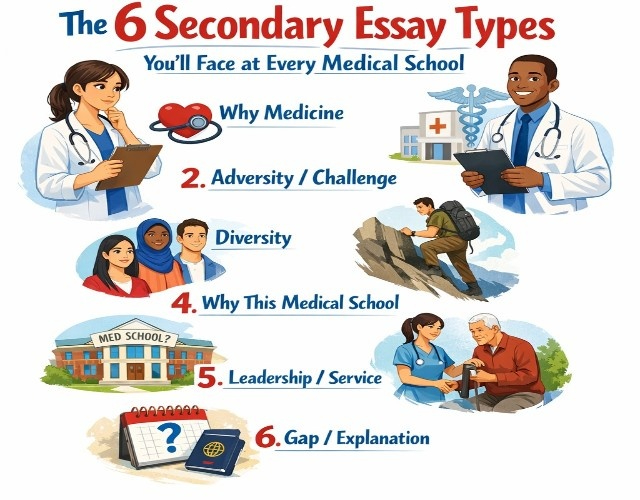
Secondary essay prompts vary by school, but the underlying questions almost never do. Once you know the 6 core types, you can draft "core essays" before your secondaries even arrive, then tailor each one to the specific school's prompt. This approach alone saves most applicants 20 to 30 hours during application season.
Here are the 6 types with what each is actually asking and what a strong response includes.
1. Why Medicine
This sounds like your personal statement, but it isn't. Secondaries use this prompt to see how you think about the physician's role specifically, not your backstory, but your current understanding of what the job actually demands. A strong answer is grounded in something you've observed or experienced, not an abstract belief about medicine's importance.
2. Adversity / Challenge
This isn't a competition for who had the hardest life. It's a question about self-awareness and growth. Admissions committees want to see that you can name what was hard, describe what you actually did, and articulate something specific that changed in you because of it. The generic version describes the difficulty at length and offers a vague "I grew stronger" conclusion.
3. Diversity
This prompt asks what perspective or identity you'd bring to the class that isn't already there. The strongest answers are specific, not "I'm the first in my family to attend college" as a standalone fact, but what that background taught you about patients, medicine, or healthcare access that a more traditional path wouldn't have. The generic version lists demographic facts and calls it diversity.
4. Why This Medical School
This is the most important prompt to take seriously, and the most commonly phoned in. Admissions committees can spot a generic "Why Us" essay in two sentences. Strong answers name specific faculty, programs, patient populations, or community missions and connect them directly to your own goals. The generic version praises the school's ranking and reputation.
5. Leadership / Service
This prompt is looking for evidence of sustained commitment and impact, not titles. You don't need to have been president of anything. What works is showing one specific thing you did over time, the decisions you made along the way, and what happened because you were there. The generic version lists positions held.
6. Gap / Explanation
If you have a gap year, a weak semester, a changed major, or anything that looks like a detour from the outside, this is where you address it.
The strongest answers are honest and brief:
The worst versions either over-explain defensively or pretend the gap isn't there. |
Most secondary essay prompts are one of six types in disguise; knowing which type you're facing makes it far easier to write a strong answer.
List of Secondary Medical School Essay Topics
- The moment I realized I wanted physician-level responsibility
- Why long-term patient care matters to me
- Choosing medicine over research or other healthcare roles
- How clinical exposure confirmed my commitment
- The qualities that draw me specifically to becoming a doctor
- Overcoming academic setbacks and improving performance
- Balancing caregiving responsibilities with pre-med studies
- Navigating financial hardship during college
- Learning resilience after a failed research project
- Managing time and stress during a demanding semester
- Growing up in a multilingual or multicultural household
- Being a first-generation college student
- Experiences in underserved or rural communities
- A unique career background before medicine
- Perspectives shaped by international travel or relocation
- Alignment with the school’s mission and values
- Interest in specific research centers or faculty work
- Community outreach programs that match my service goals
- Curriculum style (problem-based learning, early clinical exposure)
- Opportunities for leadership, global health, or innovation
- Leading a student organization or health initiative
- Coordinating volunteers at a free clinic
- Mentoring younger students in STEM
- Organizing community health awareness campaigns
- Taking initiative during a group research project
- Explaining a semester of lower grades and academic growth
- Clarifying a gap year focused on clinical work
- Addressing a leave of absence for family responsibilities
- Explaining a career transition into medicine
- Providing context for MCAT retake or delayed application
Running Out of Time on Your Medical School Essays?
Our writers have helped 50,000+ students get into their top programs.
Real writers. Real acceptances. Zero AI.
| After selecting the right topic, organize your ideas. Remember! Using a clear medical school essay format ensures your response is focused, structured, and impactful. |
Topics and Approaches Admissions Officers Are Tired of Seeing
An important clarification before this list: these aren't bad topics. They're commonly handled badly, which is different. The goal isn't to avoid a topic because it's popular; it's to avoid the version of that topic that reads exactly like the last 500 essays the reader has seen.
The Mission Trip Revelation
Going to another country and "realizing how privileged you are" without deeper self-examination is the most recognizable setup in admissions reading. What makes this topic work is genuine wrestling with what you saw, including the limits of what you were able to do, and what that revealed about the difference between wanting to help and being equipped to help.
The Sick Relative
Writing primarily about another person's suffering, with yourself as a witness, often results in an essay that centers on the wrong protagonist. It can work when the story is really about how you responded, what decisions you made, and what you understood about medicine because of it. It fails when the relative's diagnosis is the subject and your feelings are the object.
"I've Always Wanted to Be a Doctor"
This opening works if it's immediately followed by specific, adult evidence for that claim. By itself, as either an opening or a central theme, it doesn't distinguish you from 40,000 other applicants who also say it.
The Generic Volunteering Story
A paragraph describing how many hours you logged and how rewarding it felt reads like a job description, not a personal narrative. Pick one patient, one moment, one conversation that stayed with you, and build from there.
The Intellectual Brag Disguised as Inspiration
A research section that lists your lab's publications and findings without showing what any of it meant to you personally crosses from personal statement to CV. The reader already has your CV. The PS is where you explain what the work actually felt like and what it made you think about medicine's complexity.
The Everything Essay
Trying to cover six meaningful experiences in 700 words gives each of them about 100 words, not enough depth for any of them to land. One experience handled well, with real scene-setting, genuine reflection, and a forward thread, beats a tour of your entire résumé every time.
| Admissions officers don't penalize you for a common topic; they penalize you for a common version of it. |
Tips to Make Your Topic Stand Out Without Being Unusual
You don't need an unusual experience. You need an unusually specific version of a common one.
Most applicants who write weak essays aren't writing about the wrong things; they're writing about the right things at the wrong altitude. They describe experiences from 10,000 feet instead of getting close enough to show the reader what they actually saw, heard, and thought in a specific moment.
Three techniques that consistently work:
Name the person.
Not by name if that's inappropriate, but by a specific detail, the patient who cracked a joke during a difficult exam, the woman who had driven four hours to the clinic, the kid who kept asking questions the doctor didn't have time to answer. A person with detail is three-dimensional. A "patient" or a "family member" is a placeholder.
Name the moment.
Not "during my shadowing experience", but the Tuesday morning in the cardiac unit, the last patient of the shift, the hallway conversation you weren't supposed to hear. Specific time and place signals to the reader that this actually happened and that you were there.
Name what changed.
Not "I realized medicine was my calling", what specifically shifted? A belief you'd held that turned out to be too simple? A question you'd never thought to ask? A limit of medicine you hadn't expected to confront? The more specific the learning, the more credible the whole story becomes.
The most memorable essays aren't about extraordinary experiences; they're about ordinary experiences described with extraordinary clarity.
| If you want to see how strong topic choices translate into actual essays, our medical school essay examples article walks through 6 accepted personal statements and breaks down the specific technique each one uses |
Final Thought
Understanding the key medical school secondary essay topics, such as Why Medicine, Adversity, Diversity, Why This School, Leadership, and Gap Explanations, helps you approach each prompt with clarity and confidence. Knowing what each category truly assesses allows you to choose the right experiences and present them strategically.
By preparing strong examples for these common secondary essay topics in advance, you can respond quickly, stay within word limits, and maintain quality across applications. Mastering these core themes ensures your medical school secondary essays remain focused, authentic, and competitive.
Boost Your Medical School Secondary Essays Today
Strengthen your application with expertly crafted secondary essays designed to impress admissions committees and increase your interview chances.
- Customized responses tailored to each medical school prompt
- Strategic storytelling that highlights your strengths and growth
- Clear, concise writing within strict word and character limits
- 100% original, plagiarism-free content delivered on time
Take the next step toward medical school acceptance with professional secondary essay support.
Get Expert Help
-20610.jpg)