What Is a Thesis Defense? (And What It Actually Means)
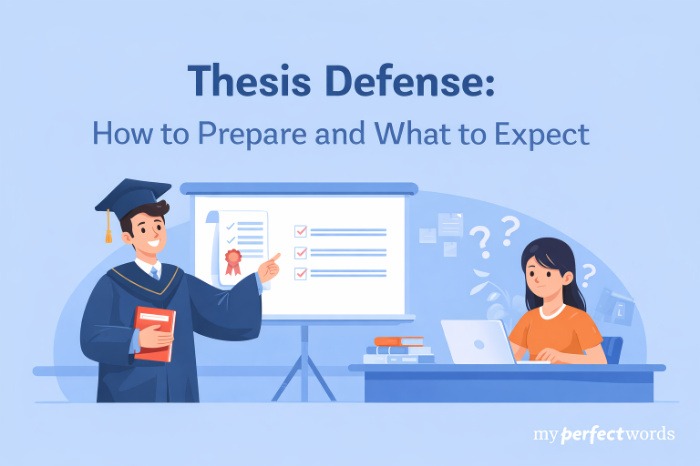
A thesis defense is a formal examination where you present your research and defend your conclusions to a faculty committee. The purpose isn't to find reasons to fail you. It's to verify that you understand your work deeply enough to have earned your degree.
Your committee typically includes your advisor and two to four other faculty members. Some institutions bring in an external examiner, particularly for doctoral defenses. The format varies: some defenses are open to the public, others are closed; some run under an hour, others well over two.
Master's vs. PhD: A master's defense typically runs 45 to 90 minutes and focuses on demonstrating your grasp of the topic and your contribution to the field. A PhD defense usually runs two hours or more and involves more rigorous scrutiny. The committee expects evidence of original research and the ability to situate your findings within the broader scholarly conversation.
Check with your department early about your program's specific format. Don't assume yours matches what a friend experienced at a different school. For a broader look at how the thesis process works from start to finish, see our thesis writing guide.
By the time you defend, your thesis has already been approved. The defense is your chance to show the committee you understand your work as well as they do.
If you're unsure whether your research involves a thesis or a dissertation, our ?thesis vs. dissertation breakdown clarifies the differences.
What Happens During a Thesis Defense? A Stage-by-Stage Breakdown
Most thesis defenses follow the same basic progression, even if the timing varies by institution.
Stage 1: Opening. The committee chair introduces everyone, outlines the format, and explains the timing. This part takes five minutes or less. Breathe. Stage 2: Your presentation. You present your research: your question, methodology, key findings, and conclusions. Master's presentations typically run 20 to 30 minutes; PhD presentations usually run 30 to 45 minutes. Aim for roughly one slide per minute of speaking time. Stage 3: Committee Q&A. This is the heart of the defense. Expect 30 to 60 minutes of questions, depending on your program. The committee will probe your methodology, challenge your assumptions, and ask what your work means for the field. Stage 4: Deliberation. You leave the room while the committee discusses your performance. This usually takes 10 to 20 minutes and feels like forever. It's normal to feel anxious. Get some water. Stage 5: Outcome announcement. You're invited back in, and the committee tells you the result. The section on post-defense outcomes below covers the possible scenarios. |
Learn about writing a thesis introduction first, and use your introduction chapter as the framework for your slides. It already contains your problem statement, methodology overview, and objectives. Avoid text-heavy slides. Visuals and graphs beat bullet points every time.
The Q&A isn't an interrogation. It's an academic conversation where the committee wants to understand your thinking, not catch you in a mistake.
The overall journey, from thesis proposal through to defense, is covered in our full thesis writing guide.
How to Prepare: A Week-by-Week Timeline
Preparation kills nerves. The more structured your run-up, the calmer you'll feel walking into that room.
4 Weeks Out
Start by confirming the exact format, timing, and requirements with your department coordinator. Don't assume. Schedule a meeting with your advisor to review their expectations and ask if there are any areas of the thesis they expect the committee to probe.
Begin re-reading your full thesis, chapter by chapter. Don't skim it. You need to own every sentence, including the parts you wrote six months ago and have mostly forgotten. If there's another student defending around this time, attend their defense. Watching one live reduces the unknown considerably and gives you a realistic sense of pacing.
2–3 Weeks Out
Build your presentation slides. Use your thesis introduction chapter as the framework: problem statement, literature review summary, research question, methodology, findings, and conclusions. Do a first run-through alone and time yourself. Most students underestimate how long their presentation runs.
Draft a list of 20 to 30 potential questions and write out answers to each. Start with the ones you'd least want to be asked.
Reviewing your thesis paper outline can help you think through which sections are most likely to raise questions.
1 Week Out
Practice presenting in front of anyone willing to watch: lab mates, friends, or a patient's family member. If you can arrange a full mock defense session with even one faculty member, do it. The feedback you'll get in 90 minutes of mock Q&A is worth two weeks of solo preparation.
Finalize your backups now: save the presentation to a USB, email it to yourself, upload it to cloud storage. Prepare printed copies of your thesis for committee members if that's customary in your department.
2–3 Days Out
Stop making changes to your presentation. It's ready. Review your anticipated question list and tighten your answers. Choose your outfit (professional, not casual) and do a practice run in it if you can. Confirm the venue, time, and AV equipment availability directly with whoever manages the room.
Day Before
Light review only. Re-read your abstract and conclusion. Rest and eat properly. Don't pull an all-nighter. Arriving exhausted is a much bigger risk than having one slide slightly imperfect. Know exactly where you're going and how long it takes to get there.
Don't have a topic yet? But how can you begin without a topic? You can't, which is why we have created a list of thesis topics for you to choose from.
Thesis Defense Questions: What to Expect and How to Answer
The Q&A is what most students fear most. Understanding what types of questions you'll face, and why the committee asks them, takes most of the edge off.
Types of questions you'll get:
- Clarification questions: "Can you walk me through your data analysis process?" These aren't traps. The committee just wants more detail.
- Challenge questions: "Why didn't you consider X methodology?" They're testing whether you can defend your choices, not whether you made the right ones.
- Implication questions: "What does this mean for the field?" They want to see if you can situate your work in the broader scholarly conversation.
Common questions students actually face:
- "Why did you choose this research methodology?"
- "What are the limitations of your study?"
- "How does your work contribute to the existing literature?"
- "If you could do this research again, what would you change?"
- "How would you apply your findings in a real-world setting?"
Handling a question you don't know the answer to: Acknowledge it directly. "That's a point I haven't fully explored in this research" is a fine answer. Offer what you do know, then suggest it as a direction for future work. The committee values intellectual honesty far more than a confident wrong answer.
Master's vs. PhD: Master's-level questions tend to focus on your grasp of the subject and whether your conclusions follow from your data. PhD-level questions push harder on original contribution. The committee wants to know what your research adds that didn't exist before. For further guidance on oral defense expectations at the graduate level, the University of Waterloo's graduate defense preparation resources offer useful context on committee expectations.
You don't have to know everything. You just have to know your research better than anyone else in that room.
Not Ready to Write It Yourself?
Get a professionally written thesis from expert writers: fast, original, and 100% AI-free.
Your thesis. Done right.
Thesis Defense Presentation Tips: Building Slides That Work
Your slides are a map. They guide the committee through your research story so they can follow along, ask better questions, and see the depth of your thinking.
A reliable rule of thumb: one slide per minute of speaking time. A 20-minute master's presentation needs roughly 20 slides. A 40-minute PhD presentation needs roughly 35–40 slides.
A slide structure that works:
- Title slide
- Agenda/outline
- Research background and context
- Research question/problem statement
- Literature review overview (2–3 slides)
- Methodology
- Key findings (2–4 slides with visuals)
- Discussion/interpretation
- Conclusions
- Future research directions
- Thank you / questions
Use the introduction chapter of your thesis as the backbone for your early slides. It already does the work of establishing context, framing the problem, and explaining your approach. Pull key figures and graphs directly from your thesis. Visuals communicate findings faster than text and give the committee something concrete to engage with.
Avoid text-heavy slides, small fonts, and data tables that are hard to read from the back of a room. |
Always have a backup: USB drive, email attachment, cloud storage. If the room's equipment fails, you need options. Printed handouts of your slides are a bonus, not a requirement, but they're a nice touch.
For guidance on how to structure your thesis introduction, which maps directly to your opening slides, that article covers how to frame your opening chapter clearly. Academic oral defense best practices also recommend keeping each slide focused on a single idea, a principle reinforced in graduate presentation guidelines from research institutions that emphasize clarity over density.
What Happens After the Thesis Defense?
Passing your thesis defense doesn't mean submitting and walking away. Most students have at least minor revisions to complete before the degree is officially conferred.
The possible outcomes:
- Pass with minor revisions: The most common result. You passed your defense but need to address small issues (clarifications, typos, formatting corrections) before your final submission. You typically have 30 to 90 days to complete these.
- Pass without revisions: Rare but it happens. You can submit your final thesis immediately.
- Pass with major revisions: You passed the defense, but significant content changes are required. The scope and timeline are agreed upon with your committee.
- Fail / redefense: Uncommon, particularly if your advisor cleared you to schedule. This involves a major rewrite and a second examination.
Immediately after your defense, while the conversation is fresh, ask your committee for a written list of required revisions and a clear submission deadline. Don't rely on memory for this.
Once your revisions are complete, you'll collect committee signatures, submit your final thesis to your institution's graduate repository, and complete any remaining degree requirements. After submission, you're officially on track to graduate.
For questions about thesis format requirements during the revision stage, our guide covers the institutional standards most programs expect.
Ready for a Thesis That's Defense-Ready?
Our human writers create thesis papers that meet committee standards, no AI, no shortcuts.
- Written from scratch by subject-specialist human writers
- 4.8/5 rating from verified student reviews
- Free revisions until you're completely satisfied
- Confidential, secure, and delivered on deadline
Focus on your defense. We'll handle the writing.
Place an Order