Why Editing Is More Than Just Fixing Typos
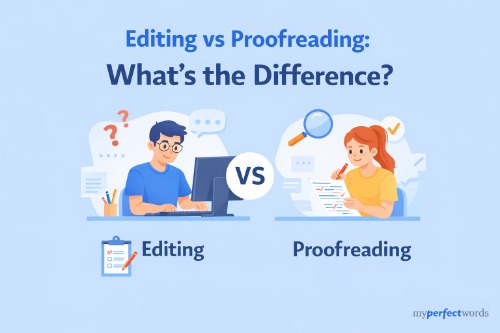
Most students treat editing like proofreading; they read through the essay once, fix the obvious spelling mistakes, and call it done. That's not editing. That's just the last five minutes of editing.
Strong editing works at three levels: structural (does your argument make sense?), sentence-level (is each sentence clear and well-phrased?), and surface (are there spelling and grammar errors?). Most students only proofread. The ones who do well also edit.
Skipping the first two levels is why essays that are technically correct still feel weak. The sentences are fine, but the argument doesn't land.
We cover the difference in more detail in our guide on editing vs proofreading, but for now, just know that proofreading is the last thing you do, not the only thing.
Step 1: Take a Break Before You Start
Before you touch your draft, walk away from it.
This sounds counterproductive when you're on a deadline, but there's a real reason behind it. When you've been staring at the same document for hours, your brain fills in what you meant to write instead of reading what you actually wrote. You stop seeing the gaps, the awkward sentences, the argument that doesn't quite hold.
Even an hour away helps. Overnight is better. If you're really pressed for time, try changing the font or printing it out; your brain registers it as something slightly new, and you'll catch more.
Come back to it fresh, and you'll immediately see things you missed the first time.
Step 2: Edit for Structure First
The biggest editing mistake is polishing language in a section you're about to cut. Always fix the big picture before you fix the details.
Structural editing asks one central question: does your essay actually answer the question you were given? Beyond that, it checks whether your argument flows logically from start to finish and whether each paragraph is doing the job it's supposed to do.
Here's what to check:
- Does your intro clearly state your thesis?
- Does each body paragraph have a single, clear point?
- Does your conclusion actually conclude, not just repeat what you already said?
- Is there a logical throughline from your intro to your conclusion?
A fast way to do this: read only the first sentence of each paragraph in order. If those sentences tell a coherent story, your structure is solid. If they don't connect, you've found the problem.
Fix anything structural before you move on. There's no point polishing a paragraph that might not survive the next pass. Think of this as the most important step when you revise an essay; everything else builds on getting the argument right first.
Step 3: Edit for Clarity and Flow
Once you're happy with the structure, shift your focus to the sentence level. This is where you make sure each sentence is clear, each paragraph moves smoothly into the next, and the whole thing is easy to read.
Things to look for:
- Sentences that are too long (if you have to read it twice to understand it, split it)
- Passive voice used too often (it makes essays feel flat and impersonal)
- The same word repeated in the same paragraph (your reader notices even if you don't)
- Transitions that feel abrupt or missing between paragraphs
The single best tool for this step is reading your essay aloud. You'll catch clunky sentences your eyes skip over every time. If you stumble while reading it, your reader will stumble too.
Pay close attention to how your paragraphs connect. The last sentence of one paragraph should create a natural bridge to the first sentence of the next; if it doesn't, that's a flow issue, not a structure issue. A quick fix is to add a transitional phrase or rework the opening of the next paragraph so the link is clear.
It's also worth checking your vocabulary across the whole essay. If you've used the same key term five times in two paragraphs, find a precise synonym or restructure the sentence to avoid the repetition. This is one of the things that's easy to miss when you're deep in the draft but jumps out immediately to a fresh reader.
For a deeper dive into practical shortcuts, check out our guide on essay editing tips, it covers techniques you can apply to any draft.
Step 4: Check Your Paragraphs
This step often gets skipped, but it's worth doing as a dedicated pass.
A solid body paragraph does a few things: it opens with a clear point (topic sentence), supports that point with evidence, explains what the evidence means, and connects back to the broader argument. If any of those pieces are missing, the paragraph feels incomplete even if the writing is fine.
Use this quick check for each body paragraph:
- Does the first sentence clearly state the paragraph's point?
- Is the evidence specific and relevant?
- Have you explained what the evidence means, or just dropped it in?
- Does the last sentence connect to what comes next?
Also look at length. Paragraphs over eight sentences are usually doing too much. Break them up. Conversely, paragraphs of just one or two sentences often haven't developed their point fully, unless it's deliberate for emphasis, a very short paragraph usually signals that more explanation is needed.
When you revise an essay at the paragraph level, you're essentially asking: is every paragraph earning its place? If a paragraph doesn't advance the argument or support your thesis, it either needs a clearer purpose or it needs to go.
Skip the Guesswork. Order Expert Editing Today.
Professional editors who fix every issue and preserve your voice.
Countless students helped since 2010. Your deadline is safe with us.
Step 5: Proofread Last
Proofreading is the final pass, not the whole editing process. It belongs here, at the end, not at the beginning.
Why last? Because there's no point perfecting the grammar in a sentence you're about to delete. Get the structure and language right first, then clean up the surface.
In this final pass, look for:
- Spelling errors (don't rely on autocorrect alone; it misses homophones)
- Grammar and punctuation mistakes
- Formatting consistency (heading styles, spacing, font)
- Citation formatting (check every reference against your required style guide)
For a full walkthrough of proofreading techniques, see our guide on how to proofread an essay.
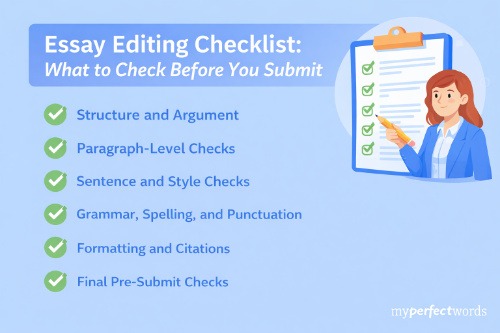
How to Use an Essay Editing Checklist
After you've worked through the steps above, a checklist is a useful final tool, not a replacement for editing, but a way to confirm you haven't missed anything.
The key is to use it after you've edited, not instead of editing. A checklist can't tell you if your argument makes sense. It can tell you if you've ticked off every category.
We've put together a printable essay editing checklist you can use for every assignment. It's designed to work with this process, not replace it.
When to Edit Yourself vs. When to Get Help
Self-editing works well when you have time, you understand the brief clearly, and the stakes are relatively low. If you can work through these steps without rushing, you can catch most of the problems yourself.
Professional editing makes sense when you're too close to the essay to see it clearly, when it's a high-stakes submission (final year project, scholarship application, grad school essay), when English isn't your first language, or when you've simply run out of time and need someone to catch what you missed.
Common Editing Mistakes to Avoid
Even students who know they should edit often fall into the same traps. Here's what to watch for:
- Editing as you write. It breaks your flow and slows you down. Write first, edit later; trying to do both at once means you do neither well.
- Proofreading before editing. You'll fix language in sections that don't survive the structural pass. Surface corrections are wasted effort if the paragraph gets cut.
- Making edits without reading the whole essay first. You need the full picture before you start changing things. Fixing paragraph three without reading paragraph seven can create new inconsistencies.
- Trying to do everything in one pass. That's how things get missed. Work through the levels in order, structure, then clarity, then surface.
- Over-editing until you lose your voice. There's a point where the essay stops sounding like you. If you've rewritten a sentence four times and it still feels wrong, the original was probably better.
- Ignoring the brief. When you revise an essay, always keep the assignment question visible. It's surprisingly easy to drift, especially in longer essays, and end up with a polished piece that doesn't quite answer what was asked.
Quick Editing Tips to Improve Any Essay
A few shortcuts that work on almost any draft:
- Read it aloud, your ears catch what your eyes skip
- Change the font before your final read to see it fresh
- Cut your first paragraph and see if the essay still makes sense (you'd be surprised how often the real intro is the second paragraph)
- Apply the 5-second test: if you can't tell what a sentence means in 5 seconds, it's too complex
- Read the last sentence of each section, that's where vague writing tends to hide
- Check your thesis against your conclusion, they should match
For a complete list of practical shortcuts, see our full guide on essay editing tips.
How Long Does Editing Take?
A rough rule: budget 20–30% of your writing time for editing. If the essay took you three hours to write, plan for at least an hour to edit it properly.
That varies depending on how much work the draft needs. A first draft that went well needs less restructuring than one written under pressure. If you want more information, contact our writers are out trusted essay writing service.
For a detailed breakdown by word count and essay type, we cover it in how long does essay editing take.
Your Essay Deserves a Professional Second Look
Send it to a professional editor and get it back submission-ready.
- Expert editors matched to your subject area
- Structural, language, and proofreading fixes, all in one pass
- Structural, language, and proofreading fixes, all in one pass
- Trusted by students at multiple universities worldwide
Fast turnaround. Real editors. Results you can submit with confidence.
Get Started Now