Why You Miss Errors in Your Own Essay
Here's something that'll actually help you: missing errors in your own writing isn't laziness. It's how your brain works.
When you read something you wrote, your brain already knows what you meant to say, which is exactly why it keeps skipping over the mistakes. You're not reading the words on the page; you're reading the words you intended to put there.
There's also the fatigue factor. By the time you're done writing a full essay, you've been staring at the same material for hours. Your brain shifts into skim mode. You stop processing every word and start pattern-matching against what you expect to see.
This is why "just read through it one more time" doesn't work. You need strategies that interrupt your brain's autocorrect and force it to actually see the text.
Before You Start: Two Things That Set You Up
Step Away First
If you have any time at all, close the document and do something else. Even an hour helps. A full day is better. Coming back to your essay with fresh eyes isn't a cliché; it genuinely changes what you catch.
Change How it Looks
Print it out or change the font and size on screen before you start. Your brain has seen your essay in one format this whole time. Changing the visual presentation forces it to process the text as something new instead of skipping ahead.
Round 1: Read Aloud for Grammar and Flow
This round is for grammar and sentence-level problems. Nothing else.
Read every word out loud, slowly, and mean it. Don't skim and mumble. Actually, say each word. Your ear catches what your eye skips. Specifically, you're listening for:
- Run-on sentences (you'll run out of breath)
- Missing words (you'll stumble and have to re-read)
- Wrong tense (sounds off when spoken)
- Awkward phrasing (anything that makes you pause)
If you stumble on a sentence when reading it aloud, your reader will stumble too.
Don't stop to fix as you go. Mark it with a circle or bracket and keep moving. If you pause to edit mid-pass, you'll lose your rhythm and start editing instead of proofreading. Fix everything after you've finished the full read-through.
One important note: Round 1 is not for catching spelling mistakes. That's what Round 2 is for. Keeping the passes separate means you're actually checking each thing properly instead of half-checking everything.
Round 2: Slow Scan for Spelling and Punctuation
This is the most detail-intensive round. Slow down.
Go through your essay sentence by sentence. Don't skim. For each sentence, you're checking:
- Spelling errors (including correctly-spelled-but-wrong words like "there" vs "their")
- Apostrophes (it's vs its, your vs you're)
- Comma use
- Full stops and capital letters
Try reading backwards. Start from your last sentence and work toward the first. Reading backwards sentence by sentence forces your brain to evaluate each one on its own, instead of skipping ahead to follow the argument. It sounds strange, but it works.
Don't rely on spell check alone. Spell check misses "form" when you meant "from." It misses "manager" when you meant "manager." It doesn't catch any homophone errors. It's a useful first pass, not a substitute for your own eyes.
As you go, circle every punctuation mark and consciously ask: is this right? It sounds slow. It is slow. That's the point, you're forcing yourself to check each mark rather than scan past it.
Short on Time? We've Got You. Professional proofreaders who catch every error and meet your deadline. Countless students helped. Your grade is worth it.
Round 3: Check Formatting, Citations, and Requirements
Most students skip this round. That's a mistake.
Your examiner isn't just reading your argument; they're also seeing your submission. A formatting error doesn't affect your argument, but it does affect how seriously your examiner takes your work. And a citation error can look a lot like academic dishonesty, even if it wasn't intentional.
Here's what to check:
Formatting: Font, size, line spacing, margins, page numbers, heading styles. Compare against the assignment brief, not against what you think the requirements were. Citations: Check every single in-text citation. Does it have a matching entry in your reference list? Check every reference list entry. Does it have a corresponding in-text citation? One missing, one extra, both are problems. Requirements: Re-read the assignment brief one more time. Word count within the required range? Specific headings required? Any formatting requirements you followed at the start and then forgot about? |
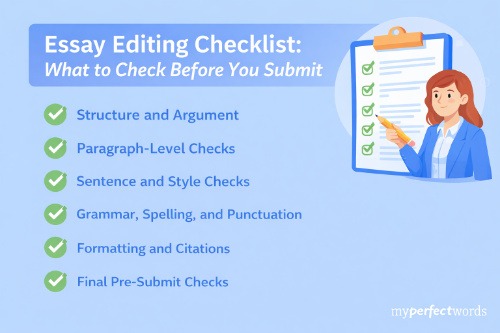
Confirming your essay editing checklist is the safest way to catch these. See our full essay editing checklist for a complete pre-submission review.
What to Do If You're Short on Time
Sometimes you don't have time to run all three rounds. That happens. Here's how to prioritise:
20 minutes: Run Round 2 (spelling and punctuation) and Round 3 (formatting and citations). These are the errors that are most visible to a marker and hardest to miss once they're on the page. An hour: Run all three rounds in order. One hour is genuinely enough time for a thorough proofreading of most undergraduate essays. Less than 20 minutes: If you're truly up against it, read through once very slowly, focusing on any section you know you wrote quickly or weren't sure about. Then check your citations and formatting. |
If you've hit a point where the deadline is tonight and you don't trust yourself to catch everything, that's when professional proofreading actually makes sense. A fresh set of eyes with no attachment to your writing will catch things you can't.
When to Ask for Help
Two situations make it worth getting someone else involved.
Peer review works well when a friend or classmate hasn't read your essay before. Their unfamiliarity with your argument means they'll actually notice missing words and unclear sentences instead of filling in the gaps the way you do. Professional proofreading makes sense when the stakes are high, a dissertation, a scholarship application, a final-year essay, or when you've genuinely run out of time to do it thoroughly yourself. What professional proofreaders do differently is simple: they're not attached to your writing. They read what's actually there. |
For practical tips you can apply to your next draft, see our guide on essay editing tips.
Almost Done. Let a Pro Finish It.
Send it to a professional and get it back polished, error-free, and submission-ready.
- Expert human proofreaders, never AI-generated corrections
- Rush delivery from just 3 hours, even for tight deadlines
- Every error caught: spelling, grammar, punctuation, formatting, citations
- Trusted by countless students. Rated 4.8/5 stars.
No stress. Just a cleaner essay.
Place Your Order