How Long Does It Take to Edit an Essay? (By Length)
The honest answer: editing takes longer than most students expect, and rushing it is how avoidable mistakes slip through.
Here's a realistic breakdown based on essay length:
Essay Length | Self-Editing Time | Professional Editing |
500 words | 30–45 minutes | 1–3 hours |
1,000 words | 45–90 minutes | 2–4 hours |
1,500 words | 1–2 hours | 3–6 hours |
2,000–2,500 words | 2–3 hours | 4–8 hours |
3,000+ words | 3–5+ hours | Same day to 24 hours |
These numbers assume you're actually editing, not just skimming through once and calling it done. A real edit means checking your argument structure, paragraph flow, sentence clarity, and then catching grammar issues on a second pass.
There's also a difference between a light proofread and a full structural revision. Proofreading (catching typos and surface errors) is faster. Restructuring weak arguments or reworking your intro takes significantly longer. If you know your essay needs both, budget time for both.
What Affects How Long Essay Editing Takes?
The rougher your first draft, the longer editing takes; that's just how it works.
Draft quality is the biggest factor. A clean, focused first draft might need 30% less editing time than one written in a rush. If you know your draft is rough, don't assume editing will be quick. The type of editing changes everything, too. Grammar proofreading is fast. Structural editing, improving your argument, fixing your thesis, and reorganizing paragraphs takes much longer and requires real concentration. Familiarity with the subject speeds things up. Editing a philosophy essay when you're a philosophy student goes faster than editing a topic you barely understand. You can spot weak reasoning more quickly when you know the material. Time since you wrote it matters more than people realize. Editing an essay you finished an hour ago is harder because your brain still sees what you meant to write rather than what's actually on the page. A 24-hour gap between writing and editing helps you catch more. Formatting requirements add time, too. If your essay needs APA or MLA citations checked, or specific heading formats verified, factor that in separately. |
DIY Editing vs. Professional Editing: What's the Real Difference?
Self-editing is free, but it comes with a blind spot; you see what you meant to write, not what's actually on the page.
DIY editing works fine when you have enough time, a strong draft, and enough distance from the writing. Purdue OWL's guidance on revision strategies is worth reading if you want a structured self-editing approach. The downside is that self-editing consistently catches fewer errors than a fresh set of eyes. You're also slower on your own essay than a professional would be, because familiarity with your own work creates blind spots.
Professional editing costs money but delivers a faster turnaround and catches the things you'd miss. A good editor also preserves your voice; they're not rewriting your essay, they're sharpening what's already there.
If you want to learn how to edit your own essay properly, it's a useful skill, but be realistic about the time it takes and your ability to spot your own mistakes.
No Time to Edit? We've Got You.
Hand your essay to a professional editor and get it back polished.
Countless students helped since 2010. Your essay is in good hands.
How to Edit Your Essay When You're Short on Time
When time is tight, triage your editing: fix structural problems first, then flow, then surface errors last.
Don't read your essay linearly from start to finish. Start by checking your structure. Does your argument make sense? Does your thesis actually match what you argued? Spend 5 minutes on this before you touch a single sentence.
Then read it aloud. It sounds slow, but it's actually the fastest way to catch awkward phrasing, missing words, and sentences that don't make sense. Your ear will catch what your eyes skip over. The UNC Chapel Hill Writing Center covers editing your writing in more depth if you want to build a repeatable process.
One warning: if you have under an hour for a 2,000+ word essay that needs real work, that's a red flag. A rushed edit on a long essay is often worse than no edit at all, because you'll skim past structural issues and only catch surface errors.
When Should You Hire a Professional Editor?
If your deadline is under 12 hours and your essay needs real work, that's not a DIY situation.
Use this as a quick decision guide:
- You're less than 12 hours from the deadline, and the draft needs serious work. Get help. There's not enough time for a thorough self-edit.
- It's a high-stakes submission (final paper, college application, scholarship essay), the cost of a professional editor is small compared to what's on the line.
- You've already edited it twice and still aren't confident; a second pair of eyes will catch what you're missing.
- You have a solid draft, plenty of time, and just need light grammar polish; DIY is fine.
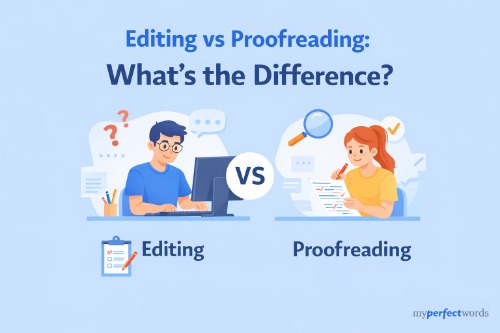
If you're not sure whether you need editing or proofreading, it's worth understanding the difference between editing vs proofreading before you decide what kind of help to look for.
MyPerfectWords offers rush delivery starting at 3 hours for students who need a fast turnaround without sacrificing quality.
Your Essay Deserves More Than a Rushed Edit
Let a professional editor catch what you'd miss and get it submission-ready.
- Same-day turnaround available, even for urgent deadlines
- Human editors with subject expertise in your field
- 100% original work, AI-free, and Turnitin clean
- Free revisions included
Order now and submit with confidence. We've done this countless times.
Place an Order