What Is Editing?
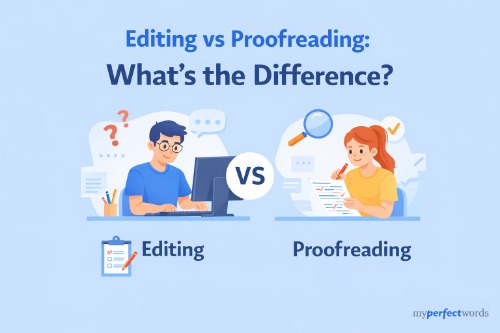
Editing is the big-picture work. It's the stage where you ask whether your essay actually says what you meant it to say.
An editor looks at argument, structure, flow, paragraph logic, and transitions. Does your intro set up the right claim? Do your body paragraphs support it? Does your conclusion land where it should? These are editing questions.
There are a few levels of editing you'll hear about. Substantive editing deals with the content itself, your argument, your ideas, and how you've organized them. Line editing focuses on individual sentences, clarity, word choice, and whether each sentence earns its place. Copy editing is the border zone between editing and proofreading, covering grammar and style consistency. For a deeper breakdown of academic writing standards, Purdue OWL's guidance on revision is worth bookmarking.
The key rule: editing comes before proofreading. There's no point fixing the commas in a paragraph you might cut entirely. Concrete example: Your intro argues that social media harms academic performance, but your body paragraphs mostly discuss screen time in general. That's an editing problem, a structural disconnect that no amount of grammar-checking will fix. "Editing asks the big question: does this essay actually say what you meant it to say?" |
If you want a step-by-step walkthrough of the editing process, see our full guide on how to edit an essay.
What Is Proofreading?
Proofreading is the final pass. Once your content is solid and your structure is sound, proofreading catches everything you missed on the surface: spelling mistakes, punctuation errors, typos, grammar slips, and formatting inconsistencies.
It's the last step, done after editing is complete, not instead of it.
Here's the catch: proofreading your own work is genuinely hard. Your brain already knows what you meant to write, so it tends to skip over errors and auto-correct as it reads. You see what you intended, not what's actually on the page. That's why a second set of eyes, human, not automated, catches so much more. The UNC Writing Center's guide on proofreading covers practical techniques for catching errors you'd otherwise read right past.
Concrete example: A missing comma after an introductory clause. "Affect" is spelled as "effect." A sentence that trails off mid-thought. These are proofreading catches, small but real, and they add up. "Proofreading is the final check that makes sure what you said is also what your reader sees." |
For a full breakdown of techniques, check out our guide on how to proofread an essay.
Editing vs Proofreading: Key Differences at a Glance
The simplest way to remember the distinction: editing changes what your essay says; proofreading changes how it looks.
Feature | Editing | Proofreading |
Focus | Structure, argument, flow | Spelling, grammar, punctuation |
When | After drafting, before proofreading | Last step before submission |
Changes | Can be major: rewrite or restructure | Minor: correct errors |
Goal | Make the essay say what it should | Make the essay look as it should |
Requires | Understanding of argument and logic | Attention to surface detail |
One stage builds on the other. You can't proofread your way out of a structural problem, and you shouldn't waste time editing once your content is already sound.
Your Essay Deserves a Professional Review Our editors handle both editing and proofreading, in the right order. Countless students helped since 2010. Your essay is in good hands.
How to Tell What Your Essay Needs
This is the question most articles skip over. Here's a practical way to diagnose your essay right now.
Your essay needs editing first if:
- Your argument shifts partway through, or your intro promises something your body doesn't deliver
- Paragraphs feel long but you're not sure what point they're making
- You added a section last minute and it doesn't connect to the rest
- Your conclusion lands somewhere different from where your intro started
Your essay is ready for proofreading if:
- The structure feels solid and the argument tracks, you just know there are typos
- You've already done a round of content revision and now need a clean surface pass
- You're close to submission and confident the argument is sound
The default rule: if you're unsure, edit first. Proofreading a structurally broken essay is wasted effort. "If your essay needs editing, proofreading it first is like painting a wall that needs to be torn down." |
What If Your Essay Needs Both?
Most student essays need both editing and proofreading. That's not a sign something went badly wrong; it's just how writing works.
The correct order is always: editing first, then proofreading. The reason is practical. Editing changes your content; sentences get rewritten, paragraphs move, sections get cut. If you proofread first, you'll be fixing errors in text that might not survive the editing stage. You'd be doing the work twice.
You also can't do both at the same time. Editing requires big-picture thinking, stepping back and reading for argument and structure. Proofreading requires the opposite, a tight, slow focus on every word. Trying to do both simultaneously means you do neither well.
When you're short on time and have to choose: prioritize editing. An essay with a clear argument and a handful of typos grades better than a polished essay with a broken structure.
That's also why professional editing services handle both in sequence. It's not just convenience, it's the correct process. For practical shortcuts, check out these essay editing tips that work even under deadline pressure.
"Most essays that need editing also need proofreading; the trick is doing them in the right order." |
Should You Do It Yourself or Hire Someone?
If you're doing it yourself, the approach is simple: first, read for argument only, don't touch a comma. Ask whether the essay does what you set out to do. Then, once you're satisfied with the structure, do a separate slow pass for surface errors. Treat them as two distinct tasks, ideally on two separate sittings.
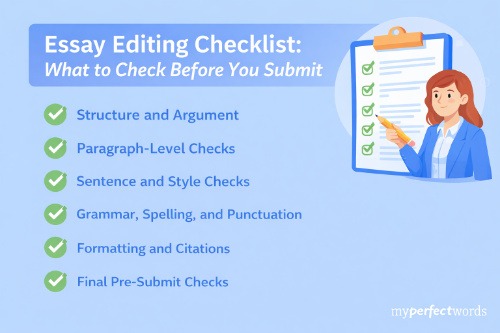
If you're working through it solo, an essay editing checklist helps make sure you don't miss anything at the editing stage.
When should you hire someone? A few situations where it makes sense: you're up against a tight deadline, the submission is high-stakes (a final essay, a grad school application), or you've read the draft so many times you genuinely can't see it clearly anymore. At a certain point, you stop reading what's there and start reading what you remember writing.
A professional editor handles both stages in the right order, preserves your voice and argument, and works to academic standards. Wondering about timelines? Here's a breakdown of how long does essay editing take depending on length and scope.
"When the stakes are high, a second pair of expert eyes catches what you'll always miss in your own work." |
Ready for a Submission-Ready Essay?
Send it to our editors and get it back polished, proofread, and ready to submit.
- Full editing and proofreading service in one
- No AI; every essay is handled by a human editor
- Rush orders accepted, even with tight deadlines
- Trusted by students since 2010
Professional editors. Zero AI. Your deadline is safe.
Get My Essay Edited