What Is Programming, Really?
Programming is writing a set of instructions that tells a computer what to do. That's it.
Think of it like a recipe. When you follow a recipe, you're executing steps in order: chop the onion, heat the pan, add the oil, and you get a predictable result. Programming works the same way. You write steps, the computer follows them, and something happens: a page loads, a number gets calculated, a file gets saved.
The instructions are written in a programming language. There are dozens of them, just like there are dozens of spoken languages. They share the same fundamental ideas but use different syntax. You don't need to understand all of them on day one; you don't even need to understand all of one language. You just need to learn enough to make things work, and the rest follows from there.
Why Learn Programming?
There's a lot of hype around programming, so here are four concrete reasons, not buzzwords.
Career demand is real. Tech roles are among the fastest-growing in almost every industry. But it goes beyond "getting a tech job." Marketing, healthcare, finance, education, and programming skills show up everywhere now, and having even basic coding knowledge makes you more effective in nearly any data-driven role. It changes how you solve problems. Programming teaches you to break big, messy problems into small, manageable steps. That mental model transfers to everything, project planning, debugging workflows, and making decisions under pressure. You can build actual things. Not just theoretical knowledge, real tools. Scripts that save you hours of manual work. A personal website. A simple app that solves a problem you have. There's something uniquely satisfying about writing code and watching it do something. It pays off even outside tech. Even if you never want to become a software engineer, coding literacy makes you more capable. Data analysis, basic automation, and understanding how digital products work these skills that pay dividends in almost any career path. |
None of this happens overnight. But it does happen, and faster than most people expect.
How to Choose Your First Programming Language
This is where a lot of beginners get stuck. They spend weeks researching languages instead of actually learning one.
Here's a straightforward framework: if you're a complete beginner with no specific goal, start with Python. It's the most widely recommended starting language for good reason; its syntax reads close to plain English, the community is enormous, the documentation is excellent, and it applies to web development, data science, automation, and more. It's also what most beginner courses use.
If you're interested in building websites, JavaScript makes sense alongside HTML and CSS; it's the language of the web, and you'll see results in a browser immediately, which is motivating.
If you're learning programming for a course or degree program, check what language your curriculum uses and start there. Don't fight it. The concepts you learn in one language transfer to others, so the specific language matters less than actually getting started.
For a full breakdown of what each language is used for and which fits your goals, check out our full programming languages list.
The Core Concepts You Need to Know
No matter which language you pick, you'll run into the same four building blocks everywhere. Here's what they are in plain English.
Variables are containers that store information. You give a container a name - like username or score, and put a value inside it. The computer can then use that name to retrieve or update the value. Think of it like a labeled box. Loops tell the computer to repeat something. Instead of writing the same instruction 100 times, you write it once and tell the computer how many times to repeat it. Like setting an alarm to go off every morning, one instruction, repeated behavior. Conditions let you make decisions. "If this is true, do that. If not, do something else." It's how programs respond to different situations, like a traffic light that shows green when cars can go and red when they should stop. Functions are reusable chunks of code that do one specific job. You write the instructions once, give them a name, and then call that name whenever you need that job done. Like a saved setting on a printer, press one button, and a whole sequence runs. |
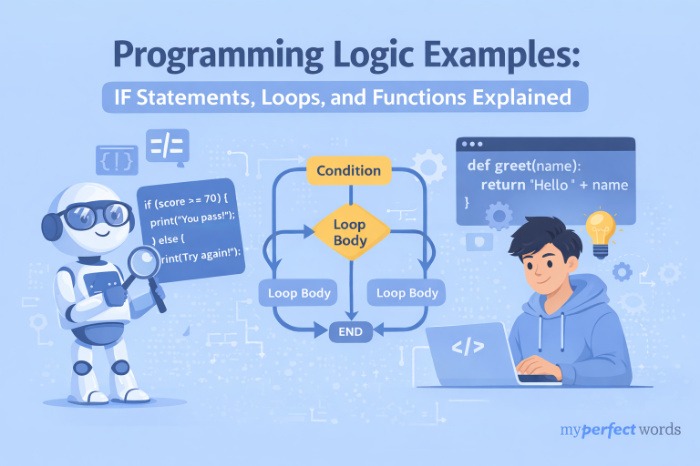
If these feel abstract right now, that's normal. They click fast once you see them in action. Our programming logic examples guide walks through each one with working code so you can see exactly how they behave.
Struggling With a Programming Assignment?
Our expert programmers can solve it for you: fast, accurate, and 100% original.
Join countless students who trust MyPerfectWords with their work.
Your Learning Path: What to Do First
Here's a realistic, step-by-step path, not a vague "just keep learning" pep talk.
- Pick one language and commit to it for at least three months. Jumping between languages is one of the most common mistakes beginners make. The grass always looks greener with a different language, but you'll make far more progress by going deep on one.
- Work through a structured beginner course. You don't need to pay for anything. freeCodeCamp, Khan Academy, and Codecademy all offer solid free content for complete beginners. Pick one and follow it through; don't hop between courses.
- Build something small. This is the most important step and the one most beginners skip. A calculator, a guessing game, a to-do list, it doesn't matter what it is. Building something forces you to apply what you've learned in a way that watching videos never will.
Need ideas? Our programming project ideas guide has starter projects for every skill level.
- Practice regularly, not in marathons. Thirty minutes every day beats six hours once a week. Consistency builds the mental patterns that make code readable and intuitive. Long gaps break that momentum.
- Get comfortable with being stuck. This is the one no course tells you upfront: professional programmers Google things constantly. They hit walls, debug for hours, and reread documentation. Feeling stuck isn't a sign you're failing; it's literally what programming feels like. The skill is learning to work through it, not around it.
Common Mistakes Beginners Make
A few patterns trip up almost every beginner. Knowing them in advance saves real time.
Tutorial hell. This is when you watch tutorials and read documentation endlessly but never actually write code yourself. It feels productive, but it's not. You have to get your hands dirty, write code, break it, and fix it. Switching languages too early. If Python feels hard in week three, it's not because Python is the wrong language. It's because programming is genuinely hard at week three, regardless of the language. Switching won't fix that. Skipping the fundamentals. It's tempting to jump to frameworks and libraries because they sound exciting. But if you don't understand variables, loops, and functions first, frameworks just become a source of confusion. Comparing your progress to others. Someone else learned Python in a month. Someone else built an app after two weeks. Their timeline is not your timeline, and your timeline is not wrong. Progress in programming is notoriously uneven; breakthroughs happen suddenly after long plateaus. |
If you've already picked Python as the language to work on, our Python programming basics guide walks you through the fundamentals step by step.
Free Resources to Get You Started
You don't need to spend anything to learn programming. These are the most reliable free starting points.
freeCodeCamp is structured, project-based, and completely free. It's one of the best options for beginners who want a clear curriculum to follow.
Khan Academy is particularly good for visual learners and absolute beginners who want to ease in gently.
Codecademy is interactive and browser-based; you write code directly in your browser, which is a low-friction way to get started with no setup required.
CS50 from Harvard (free on edX) is more rigorous than the others, but it's widely regarded as one of the best intro computer science courses available anywhere, for any price.
Python.org's official documentation is genuinely beginner-friendly, especially if you go the Python route, which has tutorials built specifically for people with no prior experience.
If nothing makes sense, then contact the writers at our professional writing service so they can help you along the way.
Need Programming Homework Help Right Now?
MyPerfectWords has expert programmers ready to help, starting at just $11/page.
- 100% human writers, no AI-generated code, ever.
- 4.8 star rating from 2,500+ verified student reviews.
- Your deadline is our deadline, even for 3-hour rush orders.
- Plagiarism-free, original solutions delivered directly to you.
Trusted by students since 2010, your assignment is in good hands.
Place an Order