How to Think About Programming Languages
Before you pick a language, it helps to understand a few basic distinctions. These aren't things you need to memorize. They're just mental frameworks that'll help the list below make a lot more sense.
High-level vs. low-level languages
High-level languages like Python read almost like English. They're designed for humans first, and the computer figures out the rest behind the scenes. Low-level languages like C are much closer to what the machine actually understands, which makes them faster and more powerful, but also harder to write and debug. Most beginners start high-level, and honestly, most developers spend their entire careers there.
Compiled vs. interpreted languages
A compiled language (like C or Go) gets translated into machine code all at once before it runs. An interpreted language (like Python or JavaScript) gets read and executed line by line as the program runs. In practice, this affects speed and how you test your code, but it's not something you need to worry about on day one.
General-purpose vs. domain-specific languages
General-purpose languages like Python or Java can be used for almost anything. Domain-specific languages are built for one job: SQL is for databases, MATLAB is for scientific computing, and Shell scripting is for automating system tasks. Knowing this distinction helps you understand why some languages dominate certain fields and barely show up in others.
The best programming language doesn't exist, only the best one for what you're trying to build.
One quick note: this section is about understanding how languages work at a conceptual level. If you want to dig into the logic that powers all of them, like IF/THEN statements, loops, and conditions, that's a different topic covered in our programming logic guide at [/programming-logic-examples].
The 20 Most Used Programming Languages
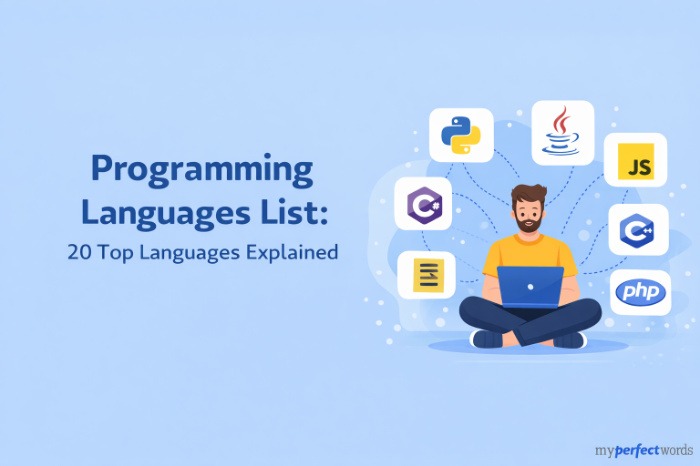
Here are 20 of the most popular programming languages today, grouped by where they're typically used. Each entry leads with what it's actually for, because that's the only thing that matters when you're choosing.
WEB AND GENERAL PURPOSE
Python is probably the first language you've heard recommended, and for good reason. It has a clean, readable syntax that's forgiving for beginners, and it's used everywhere from web development to data science to AI and machine learning. If you're stuck on where to start, Python is almost always the right answer.
Best for: Web apps, data science, AI/ML, scripting, automation. Difficulty: Beginner Job demand: Very High |
For a full breakdown of Python syntax and fundamentals, see our Python programming basics guide.
JavaScript is the language of the web. Every interactive thing you've clicked on a website, every pop-up, every form, every dropdown, JavaScript is almost certainly involved. It's the only language that runs natively in the browser, which makes it essential for front-end development. With Node.js it also handles back-end work.
Best for: Front-end web development, back-end (Node.js), full-stack apps Difficulty: Beginner Job demand: Very High |
TypeScript is JavaScript with guardrails. It adds a type system on top of regular JavaScript, which catches errors before your code runs and makes large codebases much easier to manage. Most major tech companies building web apps at scale have moved to TypeScript.
Best for: Large-scale web applications, teams with multiple developers Difficulty: Intermediate Job demand: High |
PHP powers a massive chunk of the internet, including WordPress, which runs roughly 43% of all websites. It's a back-end language that handles server-side logic, and while it doesn't get the same hype it once did, it's still widely used and actively maintained.
Best for: Web back end, CMS development, e-commerce Difficulty: Beginner Job demand: High |
Ruby is a language designed to make developers happy, and it shows. Ruby on Rails (its main web framework) made it famous for rapid prototyping and startup development. It's not the most in-demand language right now, but it's elegant, readable, and still actively used.
Best for: Web apps, rapid prototyping, startup MVPs Difficulty: Beginner Job demand: Medium |
ENTERPRISE AND SYSTEMS
Java has been the backbone of enterprise software for decades. It's verbose by modern standards, meaning you write more code to do the same thing as Python, but it's also incredibly stable, scalable, and runs on virtually every platform. It's still the dominant language for Android development and large corporate systems.
Best for: Enterprise applications, Android development, financial systems Difficulty: Intermediate Job demand: Very High |
C# is Microsoft's answer to Java. It's the primary language for building apps within the Microsoft ecosystem, and it's also the go-to language for Unity game development. If your career path involves Windows development, enterprise software, or game creation with Unity, C# is worth your time.
Best for: Microsoft stack, Windows applications, Unity game development Difficulty: Intermediate Job demand: High |
C is the grandfather of modern programming languages. Many of the languages on this list are directly descended from C, or at least heavily influenced by it. Writing C gives you direct control over hardware and memory, which makes it incredibly fast but also much harder to use. It's still essential for embedded systems, operating systems, and anywhere performance is non-negotiable.
Best for: Systems programming, embedded systems, operating systems Difficulty: Advanced Job demand: Medium |
C++ takes everything C does and adds object-oriented features, which makes it suitable for larger, more complex software. It's the language behind most AAA game engines (including Unreal Engine), real-time simulations, and performance-critical applications. Learning C++ takes time, but the understanding of how computers actually work is unmatched.
Best for: Game development, systems software, real-time applications, simulations Difficulty: Advanced Job demand: High |
Go (Golang) was built by Google to solve the scaling problems that come with building large distributed systems. It's fast, clean, and designed for concurrency, meaning it handles many tasks running at the same time with minimal friction. Go has become the backbone of a lot of cloud infrastructure and DevOps tooling.
Best for: Cloud services, microservices, back-end infrastructure, DevOps Difficulty: Intermediate Job demand: High |
DATA, AI, AND SCIENCE
R is a language built by statisticians, for statisticians. If your work involves heavy-duty statistical analysis, academic research, or specialized data visualization, R has libraries and functions that go deeper than anything Python offers in those specific areas. In most data science careers, though, Python comes first.
Best for: Statistical analysis, academic research, data visualization Difficulty: Intermediate Job demand: Medium |
SQL (Structured Query Language) isn't a programming language in the traditional sense, but no list of essential languages is complete without it. SQL is how you talk to databases. If you're working in data, business intelligence, or almost any back-end role, you'll use SQL constantly. It's also one of the fastest skills to pick up.
Best for: Database querying, data analysis, business intelligence, back-end development Difficulty: Beginner Job demand: Very High |
MATLAB is used primarily in engineering and scientific research. It's a commercial product (unlike most languages here, which are free) and it's built for numerical computing, simulation, and signal processing. You'll encounter it most often in electrical engineering, mechanical engineering, and academic research contexts.
Best for: Engineering simulations, signal processing, scientific computing Difficulty: Intermediate Job demand: Medium |
Need Help With Your Programming Assignment?
Our expert writers handle any programming language, from Python to Java to C++.
Countless students helped since 2010. Your assignment is in safe hands.
MOBILE
Swift is Apple's language for building iOS and macOS apps. It replaced the older Objective-C and is significantly more modern and beginner-friendly. If you want to build iPhone or iPad apps and sell them in the App Store, Swift is what you need to know.
Best for: iOS apps, macOS apps, Apple ecosystem development Difficulty: Intermediate Job demand: High |
Kotlin is the modern standard for Android development, officially preferred by Google over Java for new Android projects. It's also being used increasingly for back-end server-side development through frameworks like Ktor. Kotlin code is more concise and less error-prone than Java, which has made it popular quickly.
Best for: Android apps, server-side development Difficulty: Intermediate Job demand: High |
Dart is Google's language, and it powers Flutter, a framework that lets you build apps for Android, iOS, web, and desktop all from a single codebase. If cross-platform mobile development is your goal, Dart and Flutter are worth serious consideration, and adoption has grown significantly over the last few years.
Best for: Cross-platform mobile apps, Flutter development Difficulty: Intermediate Job demand: Medium |
MODERN AND EMERGING
Rust is the language getting the most buzz in systems programming right now. It gives you the speed and low-level control of C and C++, but with a type system that prevents the memory safety bugs that plague those languages. Major companies, including Google, Microsoft, and the Linux kernel team, are investing heavily in Rust.
Best for: Systems programming, performance-critical applications, WebAssembly Difficulty: Advanced Job demand: Growing |
Scala combines object-oriented programming with functional programming in a way that's powerful but genuinely difficult to learn. It runs on the Java Virtual Machine and is heavily used in big data processing, particularly with Apache Spark.
Best for: Big data processing, functional programming, distributed systems Difficulty: Advanced Job demand: Medium |
Perl was once the dominant language for text processing and system administration, and you'll still find it in legacy codebases, bioinformatics pipelines, and certain DevOps environments. It's not a language most beginners should prioritize today, but it's worth knowing it exists.
Best for: Text processing, legacy systems, bioinformatics Difficulty: Advanced Job demand: Low |
Shell/Bash scripting isn't a programming language in the traditional sense either, but every developer who works on Linux or macOS will write shell scripts regularly. It's how you automate repetitive tasks, manage files, and string together other command-line tools. It's beginner-accessible and immediately useful.
Best for: System automation, DevOps, Linux/macOS administration Difficulty: Beginner Job demand: High |
Programming Languages Comparison Table
If you want to compare all 20 languages at a glance, this table has the key details in one place.
Language | Primary Use Case | Difficulty | Job Demand |
Python | Web, AI, data science | Beginner | Very High |
JavaScript | Web (front + back end) | Beginner | Very High |
TypeScript | Large-scale web apps | Intermediate | High |
PHP | Web back end, CMS | Beginner | High |
Ruby | Web apps, prototyping | Beginner | Medium |
Java | Enterprise, Android | Intermediate | Very High |
C# | Microsoft stack, games | Intermediate | High |
C | Systems, embedded | Advanced | Medium |
C++ | Games, systems, low-level | Advanced | High |
Go | Cloud, microservices | Intermediate | High |
R | Statistics, data analysis | Intermediate | Medium |
SQL | Databases, BI | Beginner | Very High |
MATLAB | Engineering, science | Intermediate | Medium |
Swift | iOS/macOS apps | Intermediate | High |
Kotlin | Android, server-side | Intermediate | High |
Dart | Cross-platform mobile | Intermediate | Medium |
Rust | Systems, performance | Advanced | Growing |
Scala | Big data, functional | Advanced | Medium |
Perl | Text processing, legacy | Advanced | Low |
Shell/Bash | Automation, DevOps | Beginner | High |
Which Programming Language Should You Learn?
The comparison table is useful for research. This section is for decisions. Pick the path that fits where you want to go.
For Web Development
Start with JavaScript for front-end work, the visual stuff users actually see and interact with. Add Python or PHP once you want to handle the back-end logic that happens on the server. When you're comfortable with JavaScript and building real things with it, move to TypeScript. It'll make your code cleaner and your job applications stronger.
For Data Science and AI
Python, no debate. It has the most mature ecosystem of libraries (NumPy, pandas, scikit-learn, TensorFlow), the largest community, and the most job postings. Add R if your work skews heavily statistical or academic. SQL is a must-have addition for almost every data role because data always lives in a database somewhere.
For Mobile App Development
iOS apps: learn Swift. Android apps: learn Kotlin. Want to build for both platforms without maintaining two separate codebases? Learn Dart and build with Flutter. It's a genuinely good option for indie developers and startups watching their budget.
For Game Development
C++ for serious, professional-grade game development using engines like Unreal Engine. C# for Unity, which is where most indie developers and smaller studios work. If you're just starting out, Unity plus C# is the more accessible entry point.
For Systems and Infrastructure
The right answer depends on what you're building and how close to the metal you need to get. C for operating systems and embedded hardware. C++ for performance-critical applications. Rust if you want modern memory safety guarantees. Go if you're building cloud services, microservices, or DevOps tooling.
Once you pick a language, the fastest way to go from beginner to capable is to build something real. Our programming project ideas guide has a full list organized by difficulty level, so you're not starting from a blank page.
3 Questions to Help You Pick Your First Language
Still not sure? Run through these three questions. They'll narrow your options fast.
1. What do you want to build?
Web apps, mobile apps, data tools, games, systems software, none of those answers are wrong, but each one points to a different starting language. Your answer to this question alone eliminates most of the list above.
2. What's your current experience level?
Completely new to programming? Stick with Python, JavaScript, or SQL. They have the gentlest learning curves, the most beginner-friendly resources, and the most forgiving syntax. If you already have some coding background, the full list is open to you.
3. What does the job market actually reward?
If career outcomes matter (and they usually do), Python, JavaScript, Java, and SQL consistently top hiring demand data year over year. Choosing one of those four as your first language is never a wasted investment.
Pick one language, go deep, and build something real. The second language comes much faster than the first.
Need to know where to start? Our programming logic examples guide walks through the full learning path, teaching you how to create logic from scratch.
Let a Real Programmer Handle Your Assignment
From Python to Java to C++, our writers cover every language you'll encounter in class.
- Assignments written by experienced human programmers, never AI-generated.
- Fast turnaround: 3-hour rush delivery available when you're up against a deadline.
- Every solution is verified with Originality.ai and Turnitin for zero plagiarism.
- 4.8 stars from verified students, trusted since 2010.
Place your order and get your solution today.
Place Your Order