Why Math Homework Feels So Hard (And Why It's Not Just You)
Math is the one subject where last week's confusion becomes this week's roadblock.
Unlike history or English, where you can muddle through even with gaps in your knowledge, math builds on itself. If you didn't fully grasp how to factor polynomials, quadratic equations, or anyother type of equation solving in math is going to be a nightmare. If derivatives still feel shaky, integrals won't make sense. That compounding effect is why a single missed concept can spiral into ongoing frustration.
There's also something called math anxiety, and it's a real performance blocker not just nerves. Research shows that anxiety actively interferes with working memory, which is exactly what you need to solve problems. So if you feel like your mind blanks out the moment you open your math notebook, that's not you being bad at math. That's anxiety getting in the way.
| The other thing that makes math homework harder than it needs to be: most students dive straight into problems without reviewing what they learned in class first. That's like trying to assemble furniture without looking at the instructions, then wondering why nothing fits. |
Set Yourself Up Before You Start
Five minutes of preparation saves thirty minutes of frustration.
Before you touch a single problem, pull up your class notes from that day's lesson. Find a worked example that your teacher almost certainly did and keep it visible. If you get stuck later, that example is your first checkpoint.
Gather everything you'll need before you sit down: calculator, formula sheet, textbook, and scratch paper. Getting up to find things mid-session breaks your concentration and makes it way easier to get distracted.
Set a time block with an actual end time, not just "I'll do it until it's done." Open-ended homework sessions drag on because there's no pressure to focus. Tell yourself you're working on math for 45 minutes. That boundary helps.
| One more thing: put your phone in another room. Not just flipped over, not on silent other room. Notifications don't have to be loud to pull your attention. The habit of checking your phone every few minutes is enough to tank your focus, even when nothing is coming in. |
How to Work Through Problems Without Getting Stuck
Read every problem twice before you write anything. The first read is just to understand what it's asking. The second is to identify what information you have and what you need to find. Skipping this step is one of the most common reasons students set up problems wrong from the start.
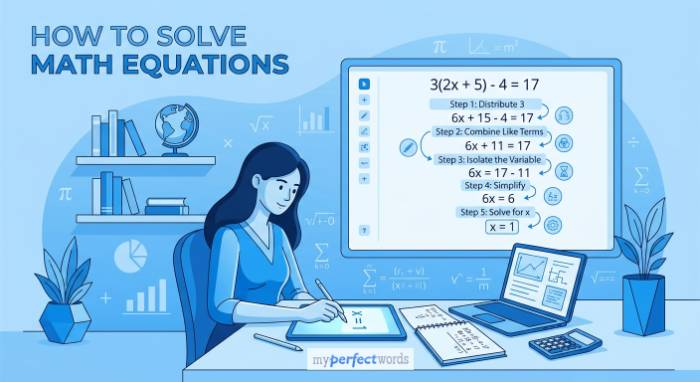
Write every step out, even the ones that feel obvious. This isn't busywork; it's how you debug your own thinking. When you skip steps in your head, you create opportunities to make small errors that compound. And when you do get an answer wrong and need to figure out why, a full set of written steps makes it much easier to spot where things went sideways.
When you hit a problem that stops you cold, go back to your notes and find the closest worked example. Don't just read it, try to match each step in the example to the problem in front of you. What's different? What's the same? Usually, you'll find the structure is similar, even if the numbers look different.
| Use the 10-minute rule: if you've spent 10 minutes on one problem and haven't made real progress, skip it and come back. Getting stuck on one problem and staying stuck kills momentum and eats time you could spend on problems you can actually solve. Come back to the tough one fresh. |
Understanding why each step works matters as much as knowing what to do. Procedures you memorized without understanding tend to fall apart on tests, where the context is slightly different. If you can explain why you're doing each step, not just what the step is, you'll actually retain it.
Improve Your Problem-Solving Skills Develop stronger mathematical thinking with guided examples Better strategies lead to better solutions.
Time Management Strategies That Work for Math
The students who struggle most with math tests are usually the ones doing all their homework on Sunday night.
Math rewards regularity. Short, focused sessions done consistently beat one long session done once. Your brain processes and consolidates what you practiced, so spreading homework across a few shorter sessions gives the material more time to actually stick.
Do your math homework when your brain is sharpest. For most people, that's not late at night after a full day of everything else. If you have any flexibility in your schedule, try doing math earlier in the day, right after class if possible, before your energy dips.
Try working in focused time blocks of around 25 minutes, then taking a 5-minute break. This approach is a technique backed by decades of research on focused work and is especially effective for cognitively demanding tasks like math. Set a timer, work with your full attention until it goes off, then step away briefly before the next block.
Prioritize harder problems first. It's tempting to do the easy stuff first to feel productive, but you're sharpest at the start of a session. Save the easier problems for when your energy dips.
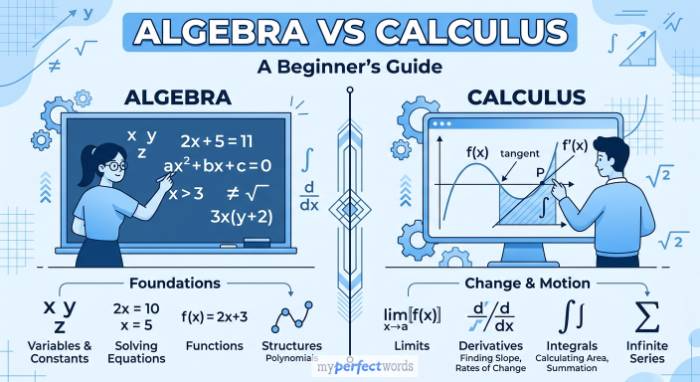
And if you're navigating one of the big jumps in math like the step up from algebra to calculus, it helps to understand what you're up against. Our article algebra vs calculus breaks down what actually changes and why it feels so much harder.
What to Do When You're Completely Stuck
There's no shame in getting stuck; the mistake is staying stuck and hoping it resolves itself.
Here's a step-by-step escalation for when you hit a wall:
Step 1: Go back to your class notes. Find a worked example of the same type of problem and walk through it side by side with what you're working on.
Step 2: Check the textbook. Look at the section that corresponds to the homework topic. Textbooks usually have additional examples and explanations that your notes might not cover.
Step 3: Search for a free video explanation. Free math explanations on khanacademy.org are excellent for this search, the specific concept and watch how someone works through it. Seeing the reasoning in real time often clicks in a way that reading doesn't.
Step 4: Ask a classmate or study group. This works best if you're both working to understand, not just copying answers. Explaining a problem to someone else, even poorly, often helps it make more sense.
Step 5: Flag it for your professor or teaching assistant. Not every problem is worth spending an hour on alone. If you've genuinely worked through the first four steps and still can't crack it, bring it to office hours. That's what office hours are for.
If word problems are a specific weak spot for you, there's a whole separate system for approaching those. Check out our dedicated guide to solving word problems in math.
After You Finish The Step Most Students Skip
What you do in the 10 minutes after homework matters more than most students realize.
| Most students finish their last problem, close the notebook, and move on. That's leaving value on the table. |
After you're done, go back through your answers and look at any problems you got wrong or struggled with. Don't just note that you got something wrong try to figure out why. Was it a setup error? A computation mistake? Did you use the wrong formula? Each type of error tells you something different about what needs attention.
Write down the concept behind any problem that gave you trouble. Even just a line like "struggled with implicit differentiation review chain rule" gives you a starting point the next time you sit down. It also builds a personal study guide for tests without any extra effort.
Notice patterns. If the same type of problem trips you up repeatedly, that's an exam warning sign, and it's much better to catch it during homework than during a test. A quick 5-minute review of your trouble spots after finishing beats a 30-minute panic session the night before an exam.
Remember,
If you're regularly hitting Step 5 of what to do when you are stuck and still not getting there, that's a signal worth paying attention to. It might be time to look at professional support rather than grinding alone.
Understand Math Concepts Clearly From basic arithmetic to advanced topics explained simply Clarity is the key to mastering math.