Why Word Problems Feel Harder Than They Actually Are
Here's what's actually happening when you stare at a word problem and go blank: you're being asked to do two things at once. You have to read and understand a little story, then translate that story into a math equation. Most students can do each of those things separately but doing both simultaneously, under pressure, is a different skill.
The other thing that trips people up is skipping straight to the numbers. You see "24" and "6" and you think okay, that's either 24 + 6, 24 - 6, 24 × 6, or 24 ÷ 6. You pick one and hope. That's not a strategy, that's a guess.
| "The math in most word problems isn't the hard part figuring out what equation to write is." |
Once you have a repeatable process for the translation step, word problems stop feeling random. You'll start recognizing patterns, and problems that used to seem impossible will feel predictable.
Step to Make Word Problems Easier
Step 1: Read the Problem Twice (And Know What You're Looking For)
The first read is big-picture. Don't look at numbers yet. Just ask yourself: what is this situation about? A purchase? A speed? A mixture? A comparison? Get a mental image of the scenario.
The second read is where you go, detail by detail. This time, underline every number. Circle the question at the end of the thing the problem is actually asking you to find. This is the step most students skip, and it's where most wrong answers start.
Before you write down a single equation, write out in plain English what you're trying to find. Not "x" something like "the number of hours it takes for the trains to meet" or "how much she spent on the jacket after the discount." Getting that clear before doing any math is worth more than you think.
| "Before you touch a number, write down in plain English what the problem is asking you to find." |
Step 2: Spot the Keywords That Tell You What Operation to Use
Operation keyword signals are the key to unlocking word problems. Every word problem contains language that hints at which math operation to use; you just have to know what you're looking for.
Here's a reference table you can come back to any time:
Operation | Signal Words |
Addition | total, sum, combined, altogether, more than, increased by, in all |
Subtraction | difference, fewer, less than, remain, decreased by, how many more, how much more |
Multiplication | times, product, every, per, of (with fractions/percentages) |
Division | each, shared equally, split, per, how many groups, ratio, average |
One important caveat: context always wins over keywords. "More than" usually signals addition, but in "Maria has 5 more than twice John's number," it's part of a comparison that needs a variable and an equation. Read the full sentence before committing to an operation.
As you do your second read-through, circle or highlight these signal words. It makes the next step much easier.
| "Once you know which words signal which operations, most word problems reveal themselves immediately." |
Step 3: Name Your Unknown and Write the Equation
This is the step that separates students who consistently get word problems right from those who don't. Most guides tell you to "set up an equation" without actually showing you how so let's fix that.
Start by naming your unknown. Choose a variable (x is the most common, but n works too) and write it down explicitly. Something like: "Let x = the number of hours worked." This forces you to stay clear on what you're actually solving for.
Then translate the problem phrase by phrase. Here are some of the most common translation patterns:
Word/Phrase | Math Notation |
a number | x |
twice a number | 2x |
5 more than a number | x + 5 |
5 less than a number | x > 5 |
the product of 3 and a number | 3x |
a number divided by 4 | x ÷ 4 |
the sum of a number and 7 | x + 7 |
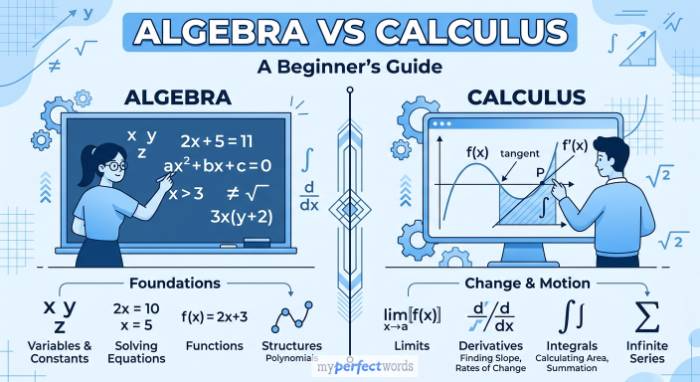
If you're not sure whether your problem calls for algebraic or calculus-level techniques, it helps to understand the [key differences between algebra and calculus] before setting up your equation.
Work through the problem sentence by sentence. Translate each phrase into math. Then connect those pieces into one full equation before you solve anything.
"The equation is just the problem in math language your job is to translate, not to calculate yet."
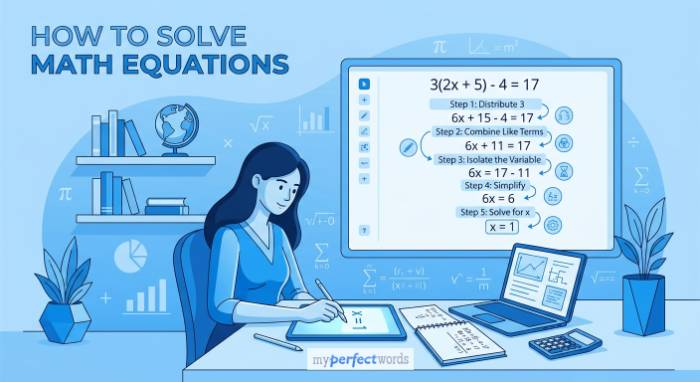
| One note: once you've got your equation written, the process of solving it depends on the type (linear equation, system of equations, etc.). If you need help with that side of things, our guide on how to solve math equations step by step covers equation-solving in depth.? |
Master the Art of Solving Math Word Problems Understand the logic behind translating real-life situations into equations Once you understand the process, solving becomes much easier.
Step 4: Solve the Equation and Check Your Answer in Context
Now you do the math. Use whatever algebra or arithmetic techniques the equation calls for. But here's the part most students skip: checking the answer in context.
Plug your answer back into the original word problem not just the equation. Does it actually make sense in the real-world scenario? If a problem about buying concert tickets gives you a negative number of tickets, something went wrong. If a problem about hours worked gives you 312 hours in a single day, go back and check your setup.
Also, check your units. If the problem asks "how many days," your answer should be in days, not hours or minutes. Unit errors are one of the easiest ways to get a problem wrong, even when the math itself is correct.
| "Getting a number isn't enough, your answer has to make sense in the real-world scenario the problem describes." |
Worked Example 1: Single Step Word Problem (Walk-Through)
Problem: A store sells notebooks for $3.50 each. Keisha buys 8 notebooks. How much does she spend in total?
Step 1: Read twice and identify what you're solving for: First read: This is a purchase problem. Second read: We know the price per item ($3.50) and the number of items (8). The question asks for the total cost. Written out: "I need to find how much Keisha spends altogether."
Step 2: Spot the keyword: "In total" signals addition... but wait, we're also dealing with a rate ("each"). "Each," combined with a repeated quantity, points to multiplication.
Step 3: Name the unknown and write the equation: Let x = total cost x = 3.50 × 8
Step 4: Solve and check in context: x = 28
Does $28 make sense for 8 notebooks at $3.50 each? Yes, $3.50 × 8 is $28. Units are in dollars.
If you are doing Calculus or Algebra, do check our algebra vs calculus blog to know the exact differeneces.
Worked Example 2: Multi Step Word Problem (Walk Through)
Problem: Marcus earns $12 per hour. He worked 6 hours on Saturday and 4 hours on Sunday. He wants to buy a pair of headphones that cost $95. How much money does he have left after buying them?
Before starting, identify that this is a two-step problem: first, find how much Marcus earned, then subtract the headphone cost. Multi-step just means running the same process more than once.
Step 1: Read twice and identify what you're solving for: First read: This is an earnings and spending problem. Second read: We know his rate ($12/hour), his hours (6 + 4), and the cost of headphones ($95). The question asks how much money he has left. Written out: "I need to find total earnings, then subtract $95."
Step 2: Spot the keywords: "Per hour" signals multiplication (rate × time). "Left after" signals subtraction.
Step 3: Name the unknowns and write the equations: Step 3a Total earned: Let e = total earnings e = 12 × (6 + 4) = 12 × 10 = $120
Step 3b Money left: Let r = money remaining r = 120 - 95
Step 4: Solve and check in context: r = 25
Does $25 left make sense? Marcus earned $120 total and spent $95 on headphones. $120 - $95 = $25. Units are in dollars.
| "Multi-step word problems aren't harder they just ask you to go through the same process twice." |
The Most Common Mistakes Students Make on Word Problems
Knowing what goes wrong is half the battle. Here are the five mistakes that cause the most wrong answers:
- Mistake 1: Jumping to math before fully understanding the question. If you don't know what you're solving for before you start, you'll end up solving for the wrong thing. Always write out the question in plain English before touching numbers.
- Mistake 2: Using all the numbers in the problem. Word problems often include numbers that are irrelevant they're there to test whether you can identify what matters. Just because a number appears doesn't mean it belongs in your equation.
- Mistake 3: Ignoring units. Solving for time when the question asks for distance, or getting miles when the answer should be in kilometers, is a setup error. Check your units at every stage.
- Mistake 4: Setting up the right equation but solving it wrong. This one's frustrating because you did the hard part correctly.
- Mistake 5: Forgetting to check if the answer makes sense. A 30-second context check catches errors that would otherwise cost you points on an exam. Build it into your habit.
| "Most wrong answers on word problems come from the setup, not the math." |
What To Do When You're Completely Stuck
Sometimes you follow all four steps and you still can't crack it. Here's what to try before giving up:
- Draw a diagram. Seriously sketching the scenario (a number line, a simple picture, a table) can unlock things that pure text can't. Visual representation works especially well for distance, rate, and geometry problems.
- Plug in simple numbers. If the problem has variables and you're not sure how they relate, try substituting small numbers (like 2 or 10) to see how the situation behaves. This often reveals the structure of the equation.
- Restate the problem in plain English. Cover up the original and write what you remember in your own words. If you can't do that, you haven't understood the problem yet and no amount of equation-writing will fix that.
If you've tried all of this and you're still stuck, check out additional examples, or look at how a similar problem is solved.
| "If restating the problem in plain English still doesn't help, a worked solution from an expert is often worth more than an hour of frustration." |
Make Word Problems Easier to Solve Discover simple strategies to decode and solve math word problems Break the problem down and the solution becomes clear.