What Kind of Equation Do You Have? (A Quick Diagnostic)
Before you solve an equation, you need to know what you're solving because the approach changes depending on the type.
Here's a quick look at the most common types you'll run into:
One-step equations Only one operation separates the variable from being alone. Example: x + 7 = 12. Two-step equations Two operations to undo. Example: 3x - 5 = 16. Multi-step equations Could have parentheses, like terms, or variables on both sides. Example: 2(x + 3) = 4x - 8. Quadratic equations Involve x² and need different methods like factoring or the quadratic formula. (These go beyond this guide.) |
To figure out what you have, look at the equation:
- Is there only one thing happening to the variable? You've got a one-step equation.
- Do you need to deal with a constant AND a coefficient? That's two-step.
- Are there parentheses, terms on both sides, or grouped expressions? Multi-step.
This guide focuses on linear and multi-step equations the most common types you'll see in homework. If your equation came from a word problem and you're stuck translating the scenario into an equation, check out our guide on how to solve word problems in math.
The Golden Rule of Equation Solving
An equation works like a balance scale. The moment you do something to one side without doing the same to the other, the whole thing tips.
This is the foundation of everything. Whatever operation you apply to the left side, you have to apply to the right. That's it. That's the rule.
There are four specific operations you're allowed to use, and they each have a name:
- Addition property of equality: You can add the same number to both sides. If x - 3 = 7, you can add 3 to both sides.
- Subtraction property of equality: You can subtract the same number from both sides. If x + 5 = 11, you can subtract 5 from both sides.
- Multiplication property of equality: You can multiply both sides by the same number. If x/4 = 3, you can multiply both sides by 4.
- Division property of equality: You can divide both sides by the same non-zero number. If 5x = 20, you can divide both sides by 5.
The goal of every equation you'll solve is to isolate the variable get x (or whatever letter it is) by itself on one side. These four properties are your tools for doing that.
How To Solve a One-Step Equation
A one-step equation only needs one operation to isolate the variable your job is to spot which one.
What does it look like? The variable has only one thing happening to it: either something is being added, subtracted, multiplied, or divided.
The process:
- Identify the operation being applied to the variable
- Apply the inverse (opposite) operation to both sides
- Simplify and write your answer
- Check it
Worked Example 1: x + 7 = 12 x is having 7 added to it. The inverse of addition is subtraction. Subtract 7 from both sides: x + 7 - 7 = 12 - 7 x = 5 Check: Substitute x = 5 back into the original equation. 5 + 7 = 12 |
Done. That's it for one-step equations: spot the operation, flip it, apply it to both sides.
How To Solve a Two-Step Equation
With two-step equations, the order you work through matters. Start by removing the constant, then deal with the coefficient.
What does it look like? There's a coefficient on the variable AND a constant being added or subtracted. Something like 3x - 5 = 16.
The process:
- Add or subtract to remove the constant from the variable's side
- Multiply or divide to remove the coefficient
- Check your answer
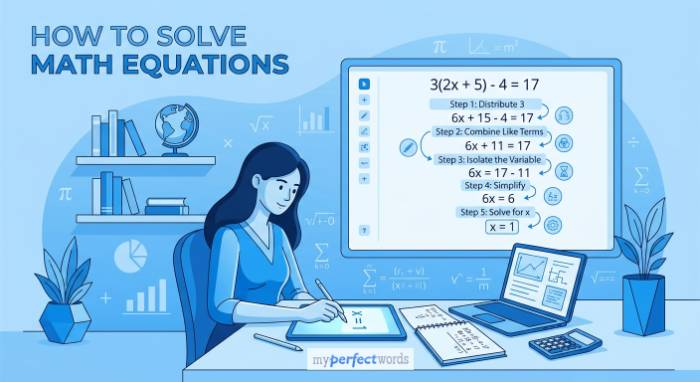
Worked Example 2: 3x - 5 = 16 Step 1: Remove the constant. Add 5 to both sides. 3x - 5 + 5 = 16 + 5 3x = 21 Step 2: Remove the coefficient. Divide both sides by 3. 3x / 3 = 21 / 3 x = 7 Check: Substitute x = 7 back into the original. 3(7) - 5 = 21 - 5 = 16 |
Common mistake: Some students try to divide by the coefficient first, before getting rid of the constant. Don't. Always handle the addition or subtraction first, then deal with multiplication or division.
Improve Your Equation-Solving Skills Practice proven techniques for solving different types of equations Practice and clear methods make equation solving faster and easier.
How To Solve Multi-Step Equations
Multi-step equations feel overwhelming until you break them into a sequence expand, combine, move, isolate.
What makes an equation "multi-step"? Parentheses, like terms on the same side, or variables appearing on both sides of the equation.
The process:
- Expand parentheses Use the distributive property to remove any brackets
- Combine like terms Simplify each side by grouping terms that are alike
- Move variables to one side Get all the x terms on the left, all constants on the right (or vice versa)
- Isolate the variable Use division or multiplication to solve
Worked Example 3: 2(x + 3) = 4x - 8 Step 1: Expand the parentheses. 2x + 6 = 4x - 8 Step 2: Move variables to one side. Subtract 2x from both sides. 6 = 2x - 8 Step 3: Move constants to the other side. Add 8 to both sides. 14 = 2x Step 4: Isolate x. Divide both sides by 2. x = 7 Check: Substitute x = 7 into the original. 2(7 + 3) = 4(7) - 8 2(10) = 28 - 8 20 = 20 |
If your multi-step equation came out of a scenario you had to translate first, our guide on how to solve word problems in math covers the translation stage in detail.
The Most Common Mistakes in Solving Math Equations (and How to Avoid Them)
Most equation-solving errors come from just two places: sign mistakes and forgetting to apply operations to both sides.
Here are the four mistakes that show up the most, and how to catch yourself before they cost you marks.
Mistake 1: Only changing one side
What goes wrong: 3x + 6 = 15 = subtracting 6 only from the left = 3x = 15 (incorrect, should be 3x = 9)
| Fix: Say it out loud, "I'm subtracting 6 from BOTH sides" before you write anything. |
Mistake 2: Sign errors with negative terms
What goes wrong: x - (-4) = 10 treated as x - 4 = 10 instead of x + 4 = 10
| Fix: Rewrite negative signs explicitly before solving. Two negatives make a positive. Slow down and write it out. |
Mistake 3: Distributing incorrectly
What goes wrong: 3(x + 5) expanded as 3x + 5 instead of 3x + 15
| Fix: Multiply the number outside the bracket by EVERY term inside. Draw arrows from the 3 to each term if it helps. |
Mistake 4: Skipping the check step
What goes wrong: Getting x = 4, moving on, then losing marks because x should have been x = 6.
| Fix: The check takes 30 seconds. Do it every time. There's no downside. |
Always Check Your Math Equation Answer
Substituting your answer back into the original equation is the one habit that separates confident math students from those who lose easy marks.
Here's all you need to do:
- Take your answer (e.g., x = 7)
- Plug it into the original equation
- Simplify both sides
- If the left side equals the right side, you're done. If it doesn't, there's an error somewhere go back and find it.
Using Worked Example 2 (3x - 5 = 16, where x = 7): LHS: 3(7) - 5 = 21 - 5 = 16 RHS: 16 16 = 16 |
That's a confirmed correct answer. It takes seconds, and it catches almost every mistake before it becomes a problem.
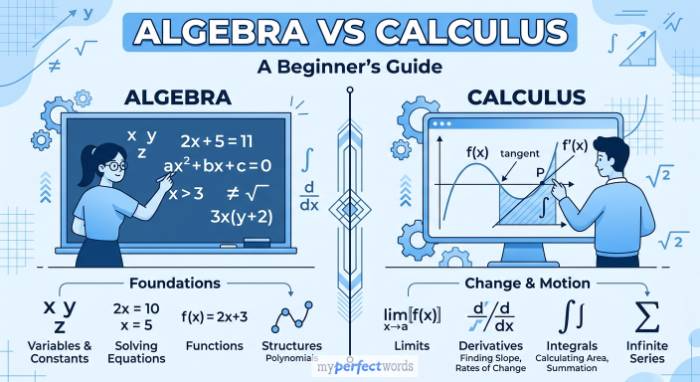
If you're wondering how equation types differ across subjects like algebra vs calculus, that's covered in a separate guide.
Solve Equations With Clear Methods Discover structured techniques to simplify and solve equations Every equation becomes easier when you follow the right method.