What Is Algebra? (The Foundation of All Math)
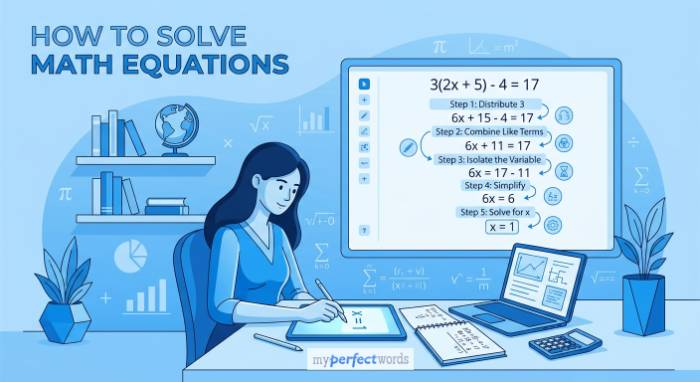
Algebra is about solving for unknowns. You're given a situation a relationship between values and your job is to figure out what the missing piece is. It's the math of "if I know these things, what can I figure out?"
Most students encounter algebra in middle school and work through it across several levels. Pre-algebra gets you comfortable with variables and basic operations. Algebra I introduces equations, inequalities, and the idea that letters can represent numbers. Algebra II goes deeper with functions, polynomials, and logarithms. Then there's linear algebra, a college-level course that's a different beast entirely (more on that in the FAQ).
| A real-world example: say you want to pay off a $3,000 credit card at $150 per month. Algebra lets you calculate exactly how long that'll take. You're solving for a variable, the unknown, using a relationship you already know. |
Algebra is the language of math. Once you speak it, everything else gets easier.
What Is Calculus? (Where Math Gets Dynamic)
Calculus is what happens when the numbers stop staying still. While algebra asks "what is the value?", calculus asks "how is the value changing?" It's the math of motion, growth, and rates that things algebra can track only as snapshots, not as moving pictures.
There are two main branches. Differential calculus deals with derivatives, the instantaneous rate of change. Think of it as figuring out exactly how fast your car is going at this exact moment, not your average speed over a whole trip. Integral calculus is the flip side: it lets you add up infinitely small pieces to find a total, like calculating the area under a curve.
| What you'll learn in calculus: limits (the foundation of everything), derivatives, integrals, and the fundamental theorem of calculus, which ties the two branches together. |
Here's what no one tells you when you're dreading it: calculus isn't magic. It's built directly on algebra. You'll be doing algebra constantly inside calculus problems, factoring, solving equations, and working with functions. Calculus is what happens when algebra starts asking, "But what if the numbers keep changing?"
Algebra vs Calculus: The Key Differences
Here's a side-by-side comparison before we get into the nuance:
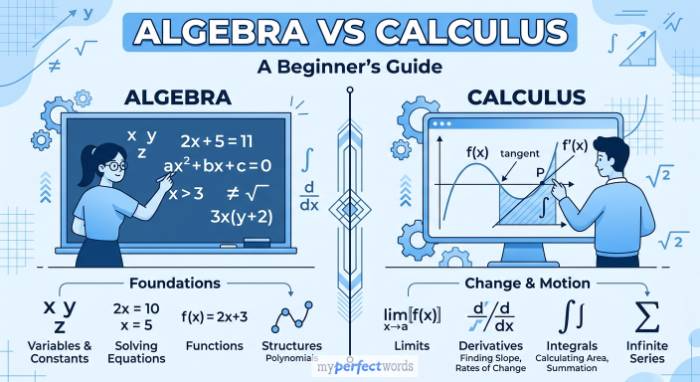
Algebra | Calculus | |
Core focus | Solving equations | Measuring change |
Main concepts | Variables, functions, polynomials | Limits, derivatives, integrals |
Approach | Static (find the value) | Dynamic (track how values change) |
When you learn it | Middle school through college | After algebra (usually) |
Difficulty | Foundational builds gradually | Harder requires solid algebra base |
Real-world use | Budgeting, coding, business | Physics, engineering, economics |
The practical difference is this: algebra finds a fixed answer. Calculus tracks how answers evolve. If you want to know the area of a rectangle, you use algebra. If you want to know the area under a curve that's constantly shifting, you need calculus.
| The other thing worth knowing: you don't leave algebra behind when you start calculus. Every calculus problem has algebra baked into it. You'll factor polynomials, simplify expressions, and solve equations constantly just in service of a bigger calculus concept. |
The biggest difference isn't difficulty; it's that algebra finds answers while calculus tracks how answers change.
Is Calculus Harder Than Algebra?
Yes, generally. But here's why that answer matters less than you think.
Calculus introduces genuinely new ideas, limits, derivatives, and integrals that don't have direct algebra equivalents. That's a real mental shift. Algebra, by comparison, builds more gradually on itself. Each concept extends the one before it without requiring a completely new framework.
But here's the part people miss: most students who struggle in calculus don't struggle because of calculus. They struggle because their algebra has gaps they didn't realize were there. They thought they understood functions, but when calculus pushes on them in new ways, those gaps open up. Most people who fail calculus don't fail because of calculus; they fail because of algebra they thought they understood.
If you're asking, "I'm bad at math, will calculus destroy me?", the honest answer is: it depends on how solid your algebra foundation is, not on whether you're "a math person." That's mostly a myth anyway.
Calculus concepts are learnable. The prep work is what determines how hard the experience is.
Should You Take Algebra or Calculus First?
For most students, this isn't really a choice; algebra always comes first. You can't skip it. The standard high school and college math progression looks like this:
Pre-Algebra = Algebra I = Algebra II = Pre-Calculus = Calculus
Each step assumes the previous one. There's no shortcut.
The choice becomes more interesting for college STEM students deciding between calculus and linear algebra as electives. These are different subjects: calculus is about continuous change; linear algebra is about vectors, matrices, and transformations. Depending on your major, you might need one, both, or neither.
| One tip that's worth following: if your school offers pre-calculus, take it. A lot of students think they can skip it because they did fine in Algebra II. Sometimes that's true. Often, pre-calculus is where functions, trigonometry, and graphing concepts get the depth they need before calculus demands them. It's not wasted time. |
You can't outrun algebra even in calculus; you'll be doing algebra problems inside every single problem.
Are You Ready for Calculus? (A Quick Checklist)
Readiness for calculus isn't about being "a math person." It's about five specific skills. Go through this honestly:
- Can you factor polynomials and quadratic equations without a calculator? This comes up constantly in calculus.
- Do you understand functions domain, range, and composition? Calculus is almost entirely built on functions.
- Can you graph basic equations and explain what slope means? You'll need this every time you work with derivatives.
- Are you comfortable with logarithms and exponents? They show up repeatedly in integration.
- Do you have basic trig down sine, cosine, tangent? Especially important for integrals and applications.
If you can do all five without hesitation, you're ready for calculus. If you're shaky on two or more, take pre-calculus, or spend some time reviewing those algebra topics first. It's not a setback; it's the difference between struggling all semester and actually understanding what's happening.
Some students skip gaps and power through. Some take extra prep time and end up genuinely enjoying calculus. Both outcomes are possible. Calculus readiness isn't a talent test; it's a skills test. If your algebra foundation is solid, you'll be fine.
Algebra or Calculus: Which Should You Learn First? Discover how algebra builds the foundation for understanding calculus Strong algebra skills make calculus much easier.
Common Mistakes to Avoid in Algebra and Calculus
Common Calculus Mistakes to Avoid
1. Weak Algebra Foundations
Many students struggle with calculus because they overlook the importance of algebra. Simplifying expressions, factoring, and solving equations are essential skills when working with derivatives and integrals.
2. Memorizing Formulas Without Understanding Concepts
Relying only on memorization often leads to mistakes. Understanding ideas like limits, rates of change, and accumulation helps students apply formulas correctly.
3. Ignoring the Role of Limits
Limits are the foundation of calculus. Skipping or misunderstanding them can make it difficult to grasp derivatives and integrals later.
4. Skipping Steps in Problem Solving
Trying to solve calculus problems too quickly can lead to errors. Writing each step clearly helps avoid mistakes and improves accuracy.
Common Algebra Mistakes to Avoid
1. Misapplying Algebraic Rules
Students often confuse rules for exponents, factoring, or distributing terms. Applying these rules incorrectly can completely change the result of an equation.
2. Sign Errors
Forgetting negative signs or incorrectly adding and subtracting terms is one of the most common algebra mistakes.
3. Not Checking Solutions
After solving an equation, students sometimes forget to verify their answer. Substituting the solution back into the original equation ensures it is correct.
4. Misunderstanding Variables and Expressions
Some students treat variables as fixed numbers rather than placeholders for values. This misunderstanding can make solving equations and simplifying expressions difficult.
Common Mistakes to Avoid When Comparing Calculus vs Algebra
1. Treating Them as Completely Unrelated Subjects
Many students assume calculus and algebra are totally different. In reality, calculus builds on algebraic concepts. Without strong algebra skills, solving calculus problems becomes much harder.
2. Ignoring the Role of Algebra in Calculus
A common mistake is focusing only on formulas in calculus while neglecting algebraic manipulation. Simplifying expressions, factoring, and solving equations are essential for solving derivatives and integrals.
3. Confusing Their Core Purpose
Algebra focuses on solving equations and understanding relationships between variables, while calculus studies change and motion. Mixing these purposes can lead to misunderstanding both subjects.
4. Thinking Calculus Replaces Algebra
Some students believe once they start calculus, algebra is no longer needed. In reality, algebra remains a fundamental tool throughout advanced math and even higher-level calculus.
5. Overlooking the Learning Progression
Jumping into calculus without mastering algebra basics is a frequent mistake. Understanding functions, equations, and graphs in algebra makes calculus concepts much easier to grasp.
When Do You Actually Use Algebra vs Calculus?
For most people, algebra is the math of everyday life. Budgeting, calculating cooking ratios, writing code, and analyzing data are all algebra at heart. If you work in business, accounting, or most areas of tech, algebra is the tool you'll reach for constantly.
Calculus gets more specialized. Physics, engineering, economics, modeling, machine learning, and medicine all use calculus heavily. If you're going into one of those fields, calculus isn't optional, it's fundamental. If you're not, you might use it rarely or never after college.
Here's a quick breakdown by field:
- Software engineering: Mainly algebra and discrete math. Some calculus if you're doing machine learning or graphics.
- Business/accounting: Algebra is your main tool. Calculus appears in some financial modeling, but sparingly.
- Physics/engineering: Calculus is everywhere. You'll use it constantly.
- Medicine: Mostly algebra and statistics in practice, though pharmacokinetics involves calculus concepts.
You'll use algebra for the rest of your life; whether you use calculus depends entirely on your career path.
If you want to learn about word problems, check out our blog on how to solve word problems in math.
From Algebra to Calculus: The Math Journey
Learn how algebra prepares you for advanced calculus concepts
- Algebra foundations
- Calculus introductions
- Concept connections
- Learning strategies
Every advanced concept begins with a strong foundation.
Get Started Now