You can read twenty guides about process essays, but one good example teaches you more than all of them combined.
Examples show you the structure in action instead of just describing it. You see exactly where the thesis goes, how transitions connect steps, and what tone actually sounds like in context. Abstract concepts like "clear step sequence" or "appropriate transitions" become concrete when you see them working in a real essay.
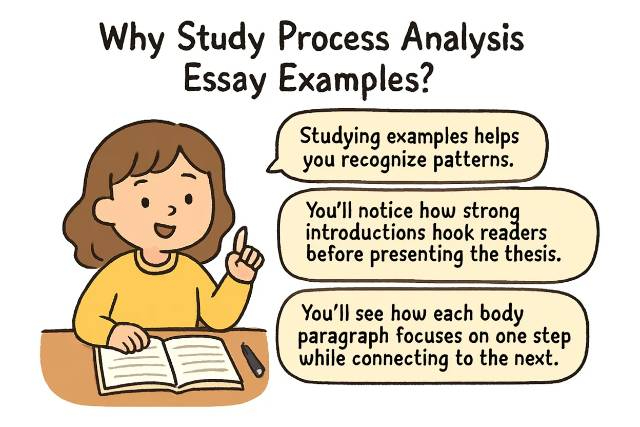
The best way to learn process essay writing isn't memorizing rules. It's seeing those rules applied in complete, effective essays. That's what you're getting here.
Complete Directive Process Essay Example
Here's a complete directive process essay that instructs readers step by step. Pay attention to the command tone, materials list, and logical sequencing.
How to Change a Flat Tire
[ANNOTATION: Strong hook with relatable scenario] You're driving home after a long day when you hear that dreaded sound: flap, flap, flap. Your tire's gone flat, and you're stuck on the side of the road. Don't panic. Changing a flat tire looks intimidating, but it's actually a straightforward process that anyone can learn. [ANNOTATION: Thesis statement] This guide will walk you through each step of safely changing your flat tire, from preparing your vehicle to securing the spare, so you can get back on the road in about 30 minutes.
[ANNOTATION: Materials section clearly marked] Before you start, gather these materials from your trunk: Spare tire (properly inflated), Car jack, Lug wrench, Wheel wedges or heavy rocks, Flashlight (if working in low light), Gloves (optional but recommended), Owner's manual
[ANNOTATION: Step 1 with safety emphasis] First, pull over to a safe, flat location away from traffic. Turn on your hazard lights immediately. You need a solid, level surface because jacks can slip on soft ground or slopes, which creates serious safety risks. If you're on a highway, get as far off the road as possible. Set your parking brake and put your car in "Park" (automatic) or first gear (manual). This prevents the vehicle from rolling while you work.
[ANNOTATION: Transition word "Next"] Next, place wheel wedges behind the tires opposite to the flat. If your front right tire is flat, wedge the rear left tire. If you don't have wheel wedges, large rocks work fine. This extra precaution keeps your car from rolling when you lift it with the jack.
[ANNOTATION: Complex step broken into sub-steps] Now remove the hubcap or wheel cover if your flat tire has one. Some hubcaps pop off with the flat end of your lug wrench. Others require removing the lug nuts first. Check your owner's manual if you're not sure. Once the hubcap is off, use the lug wrench to loosen the lug nuts by turning them counterclockwise. Don't remove them completely yet just break their resistance. Loosen each nut about a quarter turn. This is much easier to do while the tire is still on the ground bearing the car's weight.
[ANNOTATION: Chronological marker "After"] After loosening all the lug nuts, position the jack under your car's frame near the flat tire. Your owner's manual shows the exact jack placement points for your vehicle model. Never put the jack under the bumper, fender, or any plastic components these will crack under pressure. The jack goes under reinforced metal points specifically designed to handle your car's weight.
Turn the jack handle clockwise to raise your vehicle. Keep turning until the flat tire is about six inches off the ground. You need enough clearance because the fully inflated spare tire will be larger than your flat.
[ANNOTATION: Action verbs in command form] Remove the lug nuts completely now and set them aside where they won't roll away. A hubcap turned upside down makes a perfect container. Pull the flat tire toward you firmly it should slide right off the exposed bolts. Set it flat on the ground under your car's frame as an extra safety measure. If the jack fails, the flat tire will catch the vehicle before it crashes to the ground.
[ANNOTATION: Detailed step with specific guidance] Lift the spare tire onto the exposed bolts. Line up the rim holes with the bolts and push the spare all the way onto the hub. This might take some wiggling, especially if you're not used to lifting tires. Take your time you want the spare sitting flush against the hub before you proceed.
Screw the lug nuts back on by hand. Turn each one clockwise until it's snug but not tight. Don't use the wrench yet. Hand-tightening in a star pattern (tightening opposite nuts in sequence rather than going around in a circle) helps center the wheel properly.
[ANNOTATION: Safety warning highlighted] Lower your vehicle completely before fully tightening the lug nuts. This is critical. If you tighten them while the car is still jacked up, you'll torque the wheel incorrectly. Turn the jack handle counterclockwise until the spare tire touches the ground and the vehicle's weight rests on it. Remove the jack entirely.
[ANNOTATION: Final step with specific technique] Now tighten the lug nuts with the wrench as much as possible, using your body weight if needed. Work in a star pattern again tighten one nut, then tighten the one opposite it, and continue this pattern. This ensures even pressure across the wheel. The nuts should be very tight, but don't stand on the wrench or you might strip the threads.
Replace the hubcap if your spare tire has one, though many spare tires don't use them. Gather your equipment and flat tire. Store everything in your trunk carefully a loose jack becomes a dangerous projectile during sudden stops.
[ANNOTATION: Conclusion with next steps and safety reminder] You've successfully changed your flat tire and you're ready to drive again. Remember that spare tires, especially compact "donut" spares, aren't designed for long distances or high speeds. Drive directly to a tire shop to repair or replace your flat tire. Check your spare's air pressure while you're there keeping it properly inflated means it'll be ready next time you need it. With practice, this 30-minute task becomes even faster. Many drivers change their first flat in 45 minutes but complete subsequent changes in 20 minutes or less.
What Makes This Example Effective?
|
Complete Informational Process Essay Example
This informational essay explains how a process works rather than instructing you to perform it. Notice the third person perspective and analytical tone.
How Coffee Makers Work
[ANNOTATION: Hook with interesting observation] Millions of people start their mornings with coffee brewed by automatic coffee makers, yet few understand the elegant physics and engineering that transform water and grounds into a hot cup of coffee. The process seems simple from the outside: add water, add grounds, press a butto,n but inside that ordinary kitchen appliance, a carefully orchestrated sequence of heating, pressure, and gravity produces your morning caffeine. [ANNOTATION: Thesis with analytical angle] Understanding how coffee makers work reveals the clever application of thermodynamics and fluid mechanics that turns basic components into reliable brewing systems.
[ANNOTATION: Process overview in explanation format] A standard drip coffee maker contains several key components that work together. The water reservoir holds cold water at the start. The heating element sits at the machine's base. A tube runs from the reservoir bottom up to the drip area above the filter. The filter basket holds the coffee grounds, and the carafe sits below to collect the finished brew. These simple parts create a system that requires no pumps, no moving parts beyond water itself, and barely any electricity beyond basic heating.
[ANNOTATION: First stage explained with technical details] The brewing process begins when you flip the power switch. Electricity flows to the resistive heating element, which sits in direct contact with an aluminum tube. This element operates much like a stovetop coil, converting electrical energy into heat energy. The aluminum tube heats rapidly because aluminum conducts heat efficiently. Most coffee makers heat the element to approximately 200°F (93°C), which is slightly below water's boiling point of 212°F (100°C) at sea level.
[ANNOTATION: Technical terminology explained accessibly] As the heating element warms the aluminum tube, it heats the small amount of water inside. This water reaches boiling temperature within a few minutes. When water boils, it undergoes a phase change from liquid to gas, creating steam bubbles. These bubbles form at the bottom of the tube where the heat source is strongest. The bubbles rise because steam is less dense than liquid water this is buoyancy in action. As bubbles rise through the tube, they push the water above them upward.
This creates what engineers call a "thermosyphon effect." Hot water and steam rise through the tube not because of any pump, but because of density differences and the continuous generation of steam bubbles below. It's the same principle that makes hot air rise in a room, just applied to water and steam in a confined tube.
[ANNOTATION: Process stage with cause-and-effect explanation] The rising water and steam travel up the tube and emerge at the top near the filter basket. Here's where the design gets clever. The tube doesn't just dump water onto the grounds. Instead, it terminates in a drip area or spray head that distributes the hot water across the grounds evenly. Uneven distribution would over-extract some grounds while under-extracting others, creating bitter and weak spots in your coffee. The spray head prevents this by ensuring consistent water contact.
[ANNOTATION: Why this matters - analytical insight] Temperature control at this stage determines coffee quality significantly. Water that's too hot (over 205°F) extracts bitter compounds from the grounds. Water that's too cool (under 195°F) fails to extract the flavorful oils and compounds that make coffee taste good. Quality coffee makers maintain that narrow 195-205°F window through precise element design. Budget machines often brew too hot or too cool because their heating elements lack this precision.
[ANNOTATION: Explanation of extraction process] Hot water seeps through the coffee grounds in the filter basket, dissolving flavor compounds, oils, and caffeine. This process, called extraction, depends on contact time, water temperature, and ground size. Drip coffee makers optimize these variables through design. The grounds sit in a cone or basket shape that ensures adequate contact time, usually 4-6 minutes for the complete brewing cycle. Gravity pulls the water downward through the grounds at a rate that allows proper extraction without rushing.
The filter paper or permanent filter serves two purposes. Obviously, it keeps grounds out of your coffee. Less obviously, it regulates flow rate. Water can't rush through; it must seep through the filter material, which extends contact time between water and grounds. This filtering also removes coffee oils to varying degrees depending on filter type. Paper filters trap more oils, producing clearer, lighter-bodied coffee. Metal filters allow more oils through, creating fuller-bodied but potentially cloudier coffee.
[ANNOTATION: Final stage with complete system view] Brewed coffee drips from the filter into the carafe below. Meanwhile, the heating element continues its work at the reservoir, sending more water up the tube in a continuous cycle until the reservoir empties. The entire process takes 5-7 minutes for a full pot. Many coffee makers include a warming plate under the carafe. This is simply a second heating element that keeps finished coffee warm without reboiling it.
[ANNOTATION: Conclusion with broader significance] The coffee maker's brilliance lies in its simplicity. No pumps move the water; thermodynamics does that work through heat-induced pressure differences. No computer monitors temperature; the element's resistance properties create consistent heat. No timers control flow rate, gravity and filter design handle that naturally. This elegant system transforms electrical energy into thermal energy, leverages basic physics principles, and reliably produces coffee using components that rarely fail. Understanding these processes reveals how good engineering doesn't require complexity. It requires smart application of fundamental principles.
What Makes This Example Effective?
|
Short Process Essay Example
This directive essay example shows a directive essay style applied to a professional topic with appropriate tone adjustment.
How to Write a Resume
[ANNOTATION: Hook addressing professional challenge] You've found the perfect job posting. The role matches your skills, the company excites you, and the salary works for your goals. Now you need to convince a hiring manager to interview you, and that means creating a resume that showcases your qualifications clearly and professionally. [ANNOTATION: Thesis with outcome promise] This guide will walk you through the complete resume writing process, from choosing the right format to crafting compelling bullet points, so you can create a document that gets your phone ringing with interview requests.
[ANNOTATION: Materials/preparation step] Before you start writing, gather your employment history details. List every job you've held for the past 10-15 years, including job titles, company names, locations, employment dates, and major responsibilities. Collect any performance reviews, awards, or metrics that demonstrate your accomplishments. Find the job description for the position you're applying for and highlight keywords and required qualifications. This preparation makes the writing process much faster because you won't need to hunt for information mid-draft.
[ANNOTATION: First major step with decision guidance] Choose your resume format first. You have three main options: chronological, functional, or a combination. Chronological format lists your jobs from most recent to oldest and works best if you have a steady employment history in the same field. Functional format emphasizes skills over job history and helps if you're changing careers or have employment gaps. The combination format merges both approaches and suits experienced professionals with diverse skills.
For most people, chronological format is the strongest choice. Hiring managers prefer it because they can quickly see your career progression. Use functional format only if you have significant gaps or you're making a dramatic career change. Choose a combination format if you have 10+ years of experience and multiple relevant skill areas.
[ANNOTATION: Step with specific structure guidance] Start your resume with a clear header that includes your full name, phone number, email address, and location (city and state). Skip the full street address, it's outdated and takes up valuable space. Make your name the largest text on the page. Use a professional email address, ideally firstname.lastname@email.com. If your current email is partygirl1995@whatever.com, create a new professional one right now.
Below your header, add a professional summary or objective statement. This 2-3 sentence section tells hiring managers who you are and what you offer. Keep it specific to the job you want. "Marketing professional with 5 years of digital campaign experience and proven track record of increasing social media engagement by 200%" works much better than "Hard-working team player seeking opportunities to grow." The first statement includes concrete experience and results. The second could describe anyone.
[ANNOTATION: Complex step with sub-components and examples] Create your work experience section next. This is your resume's foundation. List each job with the following structure:
Company Name, Location (City, State) Job Title | Month/Year – Month/Year
Under each job, add 3-5 bullet points describing your responsibilities and accomplishments. Here's where most people struggle, so pay close attention to this technique:
Start each bullet with a strong action verb. "Led," "Developed," "Increased," and "Managed" sound much more impressive than "Responsible for" or "Was in charge of." Strong verbs demonstrate active contribution rather than passive presence.
Include metrics whenever possible. "Increased sales by 30% in Q3" beats "Improved sales." "Managed team of 12 employees" beats "Supervised staff." Numbers provide concrete evidence of your impact.
Focus on accomplishments over duties. Anyone can list what they were supposed to do. Smart candidates show what they achieved. Instead of "Handled customer complaints," write "Resolved 95% of customer issues on first contact, improving satisfaction ratings by 25%." See the difference? One states a duty. The other proves results.
[ANNOTATION: Additional section with rationale] Add an education section after your work experience. List your degrees from most recent to oldest. Include the degree name, major, school name, and graduation year. If you graduated within the past 3-4 years, you can include your GPA if it's 3.5 or higher. If you graduated 5+ years ago, drop the GPA; your work experience matters more now.
If you have relevant certifications or licenses, create a separate section for them. These demonstrate ongoing professional development and can set you apart from other candidates. Include the certification name, issuing organization, and date received or renewal date.
[ANNOTATION: Skills section with strategic advice] Include a skills section that matches the job description keywords. Read the job posting carefully and note which skills appear multiple times. If the posting mentions "project management" three times and you have project management experience, put it in your skills section. This helps your resume pass applicant tracking systems (ATS) that scan for keyword matches before human eyes see your application.
Organize skills into categories if you have many to list. "Technical Skills," "Language Skills," and "Certifications" work better than one long mixed list. Keep this section relevant, your expertise in vintage arcade games probably doesn't belong on a marketing manager's resume.
[ANNOTATION: Formatting step with professional standards] Format your resume for readability and professionalism. Use a clean, standard font like Arial, Calibri, or Times New Roman in 10-12 point size. Stick to one font throughout; mixing fonts looks amateur. Use bold for section headers and company names, but don't overdo it. Too much bold text makes nothing stand out.
Keep your entire resume to one page if you have less than 10 years of experience. Two pages are acceptable if you have extensive relevant experience, but never go beyond two pages. Hiring managers spend 6-7 seconds on initial resume review. If they flip to page three, you've lost them.
Use consistent formatting throughout. If you bold one job title, bold them all. If you use bullet points for one job description, use them for all jobs. Inconsistency suggests carelessness, and hiring managers notice.
[ANNOTATION: Review step with specific checks] Proofread your resume multiple times. Read it forwards. Read it backwards. Use spell-check, but don't rely on it exclusively. Spell-check won't catch "manger" when you meant "manager" because both are real words. Better yet, ask someone else to read your resume. Fresh eyes catch errors you've become blind to after multiple revisions.
Check that your dates make sense and don't show unexplained gaps. Verify that your phone number and email are correct. An application with wrong contact information is worthless. Confirm that your resume is saved as a PDF unless the application specifically requests another format. PDFs preserve your formatting across all devices and operating systems.
[ANNOTATION: Conclusion with action steps and encouragement] You've created a professional resume that presents your qualifications clearly and compellingly. Save your resume with a professional file name like "FirstName_LastName_Resume.pdf" rather than "Resume_Final_Version_2.pdf." Update your resume every 6-12 months even if you're not job searching. Keeping it current makes applying for unexpected opportunities much easier.
A strong resume opens doors to interview opportunities, but remember that it's a living document. Customize it for each application by emphasizing the experience and skills most relevant to that specific job. This extra 10-15 minutes of tailoring dramatically increases your chances of getting interview calls.
What Makes This Example Effective for Professional Topics
|
Ready to outline your essay? Use our process essay outline template to get started.
Process Essay Introduction Examples
Strong introductions set up your entire essay. These five examples show different hooks, topics, and thesis approaches.
Example 1: How to Bake a Cake (Directive)
[ANNOTATION: Hook with relatable scenario] The smell of freshly baked cake fills your kitchen, and friends gather around as you slice into a perfect, moist creation. Baking a cake from scratch intimidates many people, but the process is simpler than you think. [ANNOTATION: Overview of process] Success depends on measuring ingredients accurately, mixing them in the correct order, and monitoring baking time carefully. [ANNOTATION: Thesis statement with outcome] This guide will show you how to bake a delicious layer cake from scratch, taking you from gathering ingredients to frosting a beautiful finished dessert.
| What makes this effective: The hook engages the senses and creates a desirable outcome image. The overview previews major steps without giving everything away. The thesis promises both the process ("how to bake") and the result ("delicious layer cake from scratch"). The introduction is concise but complete no wasted words. |
Example 2: How Solar Panels Work (Informational)
[ANNOTATION: Hook with interesting fact] A single hour of sunlight striking Earth contains enough energy to power human civilization for an entire year, yet we capture only a tiny fraction through solar panels. [ANNOTATION: Context setting] These increasingly common rooftop installations convert sunlight into electricity through a process that combines physics, chemistry, and engineering. [ANNOTATION: Thesis with analytical angle] Understanding how solar panels work reveals both the elegant simplicity of the photovoltaic effect and the complex system design required to make it practical for home use.
| What makes this effective: The opening fact surprises readers and establishes the topic's significance. The context acknowledges solar panel prevalence while signaling depth ahead. The thesis promises explanation ("how solar panels work") and analysis ("elegant simplicity" vs "complex system design"). The informational tone is immediately clear this essay explains, not instructs. |
Example 3: How to Start a Small Business (Directive)
[ANNOTATION: Hook with challenge/opportunity framing] You've got a great business idea and the determination to make it succeed. Now you need to transform that idea into a functioning company that generates revenue and grows over time. [ANNOTATION: Preview of major steps] Starting a small business requires careful planning, proper registration, securing financing, and building systems for daily operations. [ANNOTATION: Thesis with outcome promise] This guide walks you through the complete business startup process, from validating your concept to opening your doors, so you can launch with confidence and avoid costly beginner mistakes.
| What makes this effective: The hook validates the reader's entrepreneurial ambition while acknowledging the work ahead. The preview establishes that multiple major steps exist without overwhelming. The thesis specifies scope ("complete business startup process") and benefits ("launch with confidence and avoid costly beginner mistakes"). The professional topic gets professional tone without sounding stuffy. |
Example 4: How to Train for a Marathon (Directive)
[ANNOTATION: Hook with personal connection] Standing at a marathon starting line with thousands of other runners is exhilarating, but getting there requires months of dedicated training. [ANNOTATION: Scope definition] Training for your first 26.2-mile race involves building endurance gradually, preventing injuries through smart planning, and preparing both physically and mentally for race day. [ANNOTATION: Thesis with timeline] This 16-week training guide will prepare you to complete your first marathon, taking you from short easy runs to race-ready endurance in four months.
| What makes this effective: The hook creates an emotional connection to the goal while acknowledging the commitment required. The scope preview mentions physical and mental aspects, setting expectations for comprehensive coverage. The thesis provides a specific timeline ("16 week") and explicit outcome ("complete your first marathon"), which helps readers assess if this matches their needs. |
Example 5: How Vaccines Work (Informational)
[ANNOTATION: Hook with medical relevance] Vaccines have prevented more deaths in the past century than any other medical intervention, yet many people don't understand how these life-saving tools actually protect us from disease. [ANNOTATION: Complex process preview] The immune system's response to vaccines involves multiple biological processes, from initial recognition of foreign substances to the creation of long-lasting immunological memory. [ANNOTATION: Thesis with importance statement] Understanding how vaccines work illuminates both the remarkable sophistication of human immune response and the careful scientific design required to safely trigger that response without causing illness.
| What makes this effective: The opening establishes medical and historical significance while creating curiosity. The preview signals biological complexity without using jargon that would scare readers away. The thesis promises explanation of both natural processes ("human immune response") and human innovation ("careful scientific design"), making the essay relevant to both biology and medicine. The informational approach is perfect for this educational topic. |
NEED PROCESS ESSAY URGENTLY?
Getting stuck on your process analysis essay?
Our process is simple: share your requirements, and we will create custom essays to get you the grades you deserve.
Process Essay Body Paragraph Examples
Strong body paragraphs maintain focus, connect to surrounding content, and advance the process clearly. These six examples show different techniques.
Example 1: Step with Materials List
[ANNOTATION: Topic sentence establishing the step] Before you begin painting, gather all your materials and prepare your workspace properly. [ANNOTATION: Materials needed listed clearly] You'll need latex paint, paint roller with extension pole, paint tray, painter's tape, drop cloths, sandpaper, and cleaning supplies. [ANNOTATION: Step execution with rationale] Remove all furniture from the room or move it to the center and cover it with drop cloths paint splatter travels farther than you expect. Cover floors completely with additional drop cloths, taping edges to baseboards. [ANNOTATION: Transition to next step] Once your workspace is protected, you're ready to prepare the walls themselves.
| What makes this work: The materials integrate naturally into the preparation step rather than appearing in an isolated list. The rationale ("paint splatter travels farther than you expect") helps readers understand why thoroughness matters. The transition explicitly signals movement to the next phase. |
Example 2: Complex Step Broken into Sub Steps
[ANNOTATION: Topic sentence introducing complex step] Installing the new faucet requires careful attention to three distinct connection points. [ANNOTATION: Sub-step A] First, attach the water supply lines to the faucet's threaded connections. Hand-tighten the nuts, then use a wrench for another quarter turn. Overtightening can crack the plastic threads. [ANNOTATION: Sub-step B] Second, feed the water supply lines and mounting hardware up through the sink holes from below. You might need to work from underneath the sink while someone above guides the faucet into place. [ANNOTATION: Sub-step C] Third, secure the mounting nuts from below, tightening them evenly in an alternating pattern to prevent the faucet from sitting crooked. [ANNOTATION: Result/transition] With all three connections solid, you can restore water pressure and check for leaks.
| What makes this work: The topic sentence prepares readers for a multi part step. Each sub step gets its own sentence or two with clear ordering ("First," "Second," "Third"). Specific details like "quarter turn" and "alternating pattern" prevent common mistakes. The concluding sentence shows the result and transitions to the verification phase. |
Example 3: Step with Warning/Caution
[ANNOTATION: Topic sentence] Thread the new blade onto the circular saw's arbor, aligning the blade's hole with the shaft. [ANNOTATION: Step instruction] Tighten the arbor nut by turning it clockwise the opposite direction the blade will spin during operation. [ANNOTATION: Important warning highlighted] Never over-tighten the arbor nut thinking it will hold better. Over-tightening can actually crack the blade mounting hole or strip the threads, and the blade will loosen properly during normal use anyway. [ANNOTATION: Why this matters] Manufacturers design the threading direction specifically so cutting forces naturally tighten the blade as you work. [ANNOTATION: Transition] With the blade properly secured, you can adjust the cutting depth for your material.
| What makes this work: The warning integrates naturally where readers need it most right when they're tempted to over tighten. The explanation of "why" (thread direction design) helps readers understand rather than just follow blindly. The warning uses "Never" to signal its importance without breaking the paragraph's flow. |
Example 4: Smooth Transition Between Steps
[ANNOTATION: Previous step wrap-up] You've successfully mixed your concrete to the proper consistency. [ANNOTATION: Transition sentence connecting steps] Now you need to move quickly because concrete begins setting within 30 minutes in warm weather. [ANNOTATION: New step introduction] Pour the concrete into your prepared forms in one continuous process rather than in stages. Start in one corner and work systematically across the form. Concrete poured in stages can create weak spots at the seams where different batches meet.
| What makes this work: The transition does three jobs: confirms the previous step's completion, provides timing context (urgency), and introduces the next step. The time constraint creates natural flow from mixing to pouring. The paragraph maintains forward momentum while connecting logically to what came before. |
Example 5: Informational Explanation Paragraph
[ANNOTATION: Topic sentence] The fermentation stage transforms grape juice into wine through the action of yeast cells. [ANNOTATION: Process explanation, not instruction] As yeast consumes the natural sugars in grape juice, it produces two primary byproducts: ethyl alcohol and carbon dioxide gas. [ANNOTATION: Technical detail] This conversion follows a precise biochemical pathway where enzymes break complex sugar molecules into simpler compounds, releasing energy that yeast cells use for growth and reproduction. [ANNOTATION: Significance explained] The fermentation duration and temperature directly affect the wine's final flavor profile. Slower, cooler fermentation preserves delicate fruit flavors, while warmer, faster fermentation creates bolder, fuller-bodied wines.
| What makes this work: The paragraph explains rather than instructs readers learn about the process, not how to perform it. Technical terms get immediate context. The cause and effect relationship between temperature/duration and flavor shows analytical thinking. Third person perspective maintains informational tone throughout. |
Example 6: Final Step Leading to Conclusion
[ANNOTATION: Topic sentence marking final step] The last step involves testing your newly installed dimmer switch to ensure proper function. [ANNOTATION: Verification actions] Restore power at the circuit breaker and turn the switch to its lowest setting. The light should glow dimly without flickering. Slowly rotate the dimmer through its full range. The light should brighten smoothly without buzzing sounds or sudden jumps in brightness. [ANNOTATION: Common problems addressed] If the light flickers at low settings, the bulb type might not be compatible with your dimmer LED bulbs require dimmers specifically rated for LED use. [ANNOTATION: Transition toward conclusion] With the dimmer working smoothly, you've completed the installation and added customizable lighting control to your room.
| What makes this work: The verification step provides closure without abruptly ending. Mentioning common problems shows thoroughness and helps readers troubleshoot. The final sentence acknowledges completion and benefits achieved, creating natural momentum toward the conclusion. |
Process Essay Conclusion Examples
Strong conclusions provide closure without just repeating the introduction. These four examples show different approaches.
Example 1: Summary with Encouragement (Directive)
[ANNOTATION: Brief summary] You've learned how to write a process analysis essay from brainstorming topics through final proofreading. [ANNOTATION: Main points recap] Choosing between directive and informational approaches depends on whether readers will perform the process or simply understand it. Breaking complex processes into clear, sequential steps makes even complicated topics accessible. [ANNOTATION: Encouragement and future application] Your first process essay might take several drafts, but each one you write gets easier. The skills you develop writing process essays logical organization, clear transitions, and attention to detail improve your writing across all essay types.
What makes this work: The summary stays brief two sentences covering the main journey without belaboring points already made. The encouragement feels genuine rather than patronizing. The conclusion looks forward to future application rather than just closing the current essay. |
Example 2: Importance Statement (Informational)
[ANNOTATION: Process significance] Understanding how honeybees communicate through dance patterns reveals the sophistication of insect intelligence and social organization. [ANNOTATION: Broader implications] These tiny creatures process visual information, calculate distances and directions, and convey complex spatial data to their hive mates through precise movements. [ANNOTATION: Why this matters] Research into bee communication has influenced robotics design, swarm intelligence algorithms, and our understanding of how decentralized systems can accomplish complex tasks without central control. [ANNOTATION: Closing thought] The waggle dance proves that effective communication doesn't require language or large brains, it just requires a system both parties understand and can act upon.
| What makes this work: The conclusion moves from specific (honeybee dances) to general (broader implications). It shows why understanding this process matters beyond simple curiosity. The final sentence offers insight that readers can ponder after finishing. The informational tone stays consistent, explaining significance rather than issuing commands. |
Example 3: Practical Application (Directive)
[ANNOTATION: Completion acknowledgment] You now know how to change your car's oil safely and effectively. [ANNOTATION: Practical next steps] Mark your calendar for your next oil change based on your owner's manual recommendations, typically every 5,000-7,500 miles. Keep your oil change receipt with mileage noted for future reference. [ANNOTATION: Cost/time savings] This 30-minute task saves you $30-50 per oil change, which adds up to $120-200 per year for most drivers. [ANNOTATION: Skill development note] More importantly, you've gained mechanical confidence and the ability to spot potential problems early. Many engine issues show up in your oil before they cause breakdowns, and now you'll notice them.
| What makes this work: The conclusion provides actionable next steps instead of just celebrating completion. Concrete numbers (cost savings, time investment) help readers assess value. The paragraph acknowledges non obvious benefits (mechanical confidence, early problem detection) that extend beyond the immediate task. |
Example 4: Call to Action (Directive)
[ANNOTATION: Achievement recognition] You've created a complete content calendar that will guide your social media efforts for the next quarter. [ANNOTATION: Next steps clearly stated] Start implementing your plan tomorrow morning with your first scheduled post. Track engagement metrics weekly so you can adjust your strategy based on what resonates with your audience. [ANNOTATION: Additional resources] Many free social media management tools can automate posting and compile your analytics. Try Hootsuite, Buffer, or Meta Business Suite to see which interface you prefer. [ANNOTATION: Motivating close] Consistent posting following a strategic plan outperforms sporadic posting every time. You've done the planning work, now stick to your calendar and watch your engagement grow.
| What makes this work: The call to action specifies immediate next steps ("tomorrow morning") instead of vague suggestions. Mentioning specific tools helps readers start immediately. The motivating close reinforces the value of following through without sounding preachy. |
Looking for topic ideas? Browse our process essay topics for inspiration.
Side by Side: Directive vs Informational
Here's the same topic approached both ways. Notice the tone, perspective, and purpose differences.
Topic: Making Sourdough Bread
Directive Approach (Instructional)
Mix 100 grams of active sourdough starter with 350 grams of water in a large bowl. Stir until the starter dissolves completely. Add 500 grams of bread flour and 10 grams of salt. Use your hands to combine the ingredients into a shaggy dough. Don't worry about smoothness at this stage; the dough will be sticky and uneven.
Cover the bowl with a damp towel and let it rest for 30 minutes. This autolyse period allows the flour to hydrate fully before you begin kneading. After resting, knead the dough by folding it over itself repeatedly for 5-10 minutes. You'll feel the dough become smoother and more elastic as gluten develops.
Informational Approach (Explanatory)
Sourdough bread develops its characteristic tangy flavor and chewy texture through a fermentation process driven by wild yeast and lactic acid bacteria. The process begins when flour and water combine with an active starter culture, itself a thriving community of microorganisms.
These microorganisms consume the flour's starches and sugars, producing carbon dioxide gas that makes the dough rise and organic acids that create sourdough's distinctive taste. The fermentation proceeds slowly compared to commercial yeast bread, typically requiring 4-12 hours depending on temperature and starter vigor. This extended fermentation partially breaks down gluten and phytic acid, making the bread more digestible while developing complex flavors impossible to achieve with quick rise methods.
Key Differences
| Element | Directive | Informational |
|---|---|---|
| Perspective | Second person (“you”) | Third person (“the bread,” “the process”) |
| Verb forms | Commands (“Mix,” “Add,” “Cover”) | Descriptive (“develops,” “begins,” “proceeds”) |
| Purpose | Enable reader to make bread | Enable reader to understand fermentation |
| Details | Specific measurements and actions | General principles and scientific explanations |
| Outcome | Reader can perform task | Reader understands how task works |
Both approaches serve valid purposes. Choose a directive when readers need to do something. Choose informational when readers need to understand something.
Weak vs Strong Process Essay Comparisons
Seeing weak examples alongside strong ones clarifies what makes process essays effective.
Weak Introduction
The topic I will be discussing in this essay is how to study for exams. Studying for exams is important because you need good grades to graduate. There are many different ways to study. Some people like studying alone, and some people like studying with friends. In this paper, I will talk about the steps of studying.
Problems:
- Announces the essay awkwardly ("The topic I will be discussing")
- States obvious information ("studying is important")
- Lacks specific thesis
- Generic observations don't guide reader
- Passive, academic tone sounds stilted
Strong Introduction
You've got three exams next week, and the panic is setting in. Smart studying can help you retain information better in less time, leaving you feeling confident rather than frazzled on test day. Effective exam preparation involves active recall techniques, strategic time management, and understanding which study methods work best for different subjects. This guide shows you how to create a personalized study schedule and use proven techniques that improve retention by up to 50% compared to passive reading.
Strengths:
- Opens with relatable scenario
- Promises specific benefits
- Clear thesis with defined approach
- Concrete claim (50% improvement) adds credibility
- Conversational tone engages reader
Weak Body Paragraph
The next step is to take notes. You should take notes during class. Taking notes helps you remember things better. There are different types of notes, like Cornell notes and outlines. Good notes are important. After you take notes, you should review them.
Problems:
- Vague ("take notes") without actionable detail
- Obvious statements add no value
- Mentions note types without explanation
- No connection to previous or next steps
- Tells rather than shows
Strong Body Paragraph
Take notes actively during lectures by focusing on concepts rather than transcribing verbatim. Listen for signal phrases like "The main point is..." or "There are three reasons why..." that highlight key information. When the professor draws diagrams, copy them exactly, as visual information often appears on exams. Leave wide margins on your note pages so you can add questions, connections, and clarifications during later review sessions. This margin space transforms your notes from static records into active study tools.
Strengths:
- Specific, actionable advice
- Explains what to listen for
- Addresses why techniques work
- Connects to future use
- Shows technique in action
Weak Conclusion
In conclusion, studying for exams is very important for students. This essay talked about different ways to study, including making notes, reviewing, and using flashcards. If you follow these steps, you will do better on your exams. Good luck with your tests.
Problems:
- "In conclusion" signals tired ending
- Merely lists what was covered
- Generic encouragement lacks impact
- "Good luck" undermines the guidance given
- Doesn't provide closure or forward momentum
Strong Conclusion
You've built a complete study system that works with your brain's natural learning patterns rather than against them. These techniques, active recall, spaced repetition, and strategic review, are supported by decades of cognitive science research. Your first exam using these methods might feel different from your usual cramming sessions, but trust the process. Students who consistently apply these strategies report not just better grades, but actually understanding and retaining course material long after exams end. Start implementing these techniques with your next test, and you'll wonder how you ever studied any other way.
Strengths:
- Reinforces value of content
- Acknowledges potential discomfort with new methods
- Provides evidence (research, student reports)
- Looks beyond immediate goal (long term retention)
- Ends with confidence building statement
Process Essay Examples by Academic Level
Process essays look different at the high school vs college level. Here's what distinguishes them.
High School Level Example: How to Make a Smoothie
Smoothies make a healthy breakfast or snack in just five minutes. Start by gathering your ingredients: frozen fruit, yogurt, milk or juice, and any add-ins like protein powder or spinach. Add one cup of liquid to your blender first, this helps the blades move smoothly. Next, add one cup of yogurt for creaminess. Then add two cups of frozen fruit. If you're using fresh fruit instead of frozen, add ice cubes to make the smoothie cold and thick.
Level indicators:
- Simple, familiar topic
- Basic structure without complex analysis
- Straightforward language
- Clear sequential steps
- Minimal technical terminology
College Level Example: How Vaccines Stimulate Immune Response
Vaccines work by introducing antigen substances the immune system recognizes as foreign in a form that triggers a protective response without causing disease. Most vaccines use weakened pathogens, killed pathogens, or isolated protein fragments from pathogens. When these antigens enter the bloodstream, antigen-presenting cells recognize and process them, displaying fragments on their surface using major histocompatibility complex (MHC) molecules.
Helper T cells with receptors matching these antigen-MHC combinations become activated and proliferate. These activated T cells then stimulate B cells to produce antibodies specific to the vaccine antigen. Some of these B cells become memory cells that persist for years or decades, providing a rapid response if the actual pathogen invades later.
Level indicators:
- Complex scientific topic
- Technical terminology with context
- Analytical depth beyond mere description
- Multiple interacting processes explained
- Assumes baseline biology knowledge
The difference isn't just topic complexity it's depth of analysis, vocabulary sophistication, and conceptual complexity.
Use These Process Essay Examples Effectively
These examples help you most when you actively analyze them rather than passively read them.
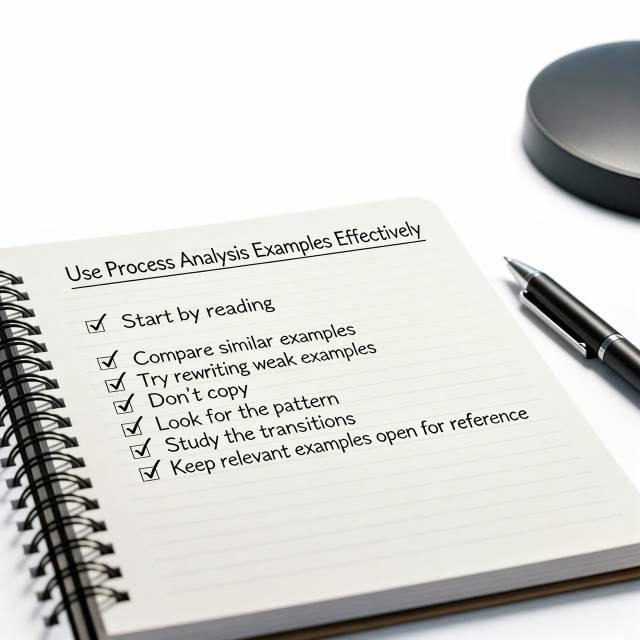
- Start by reading one example completely without stopping. Get the overall flow and structure clear in your mind. Then read it again, this time paying attention to the annotations. Notice where thesis statements appear, how transitions work, and when warnings integrate naturally.
- Compare similar examples to each other. Read both directive examples and note how they maintain command tone despite different topics. Read both informational examples and observe how third person perspective creates analytical distance.
- Try rewriting weak examples to make them stronger before looking at the strong versions. This active practice builds your editing skills faster than just reading.
- Don't copy these examples for your own essays. Use them to understand principles, then apply those principles to your unique topic. Notice the pattern, not just the specific words.
- Look for the pattern in introduction structures. Hook + overview + thesis appears in different forms across examples, but the basic structure stays consistent. Recognize this pattern so you can apply it with any topic.
- Study the transitions between paragraphs. Strong process essays flow smoothly because each paragraph connects logically to the next. You can adopt these transition techniques even when writing about completely different processes.
- When you're drafting your own process essay, keep one or two relevant examples open for reference. If you're stuck on a conclusion, look at the conclusion examples. If you're struggling with a complex step, check how Example 2 breaks complexity into sub steps.
The goal isn't memorizing these examples it's internalizing the patterns that make them work so you can apply those patterns flexibly to any process you need to explain.
Downloadable Process Analysis Essay Examples
Below are some good process analysis essay samples. These examples will help you learn how to write a process analysis essay in a better way.
Final Thoughts
Process analysis essays teach through demonstration when done well. You've seen complete examples; they work because they follow clear principles: strong thesis placement, logical organization, appropriate tone, and a helpful level of detail.
Your own process essays will improve when you apply these patterns. Start with a clear purpose, instruction, or explanation. Choose an appropriate perspective: second person for directive, third person for informational. Structure your content logically with transitions that guide readers smoothly from step to step.
Study the examples here, but write your own content. Use these models to understand what works, then adapt those successful techniques to your unique topic. Process essay writing becomes easier with practice as these patterns become natural.
Master Essay Writing Without the Confusion
Get expert writing support trusted by students worldwide.
- Clear theme and symbol analysis
- Strong thesis and evidence
- 100% original content
- On time delivery guaranteed
Make every essay insightful and stress free.
Get Started Now