Understanding Science Fair Essays
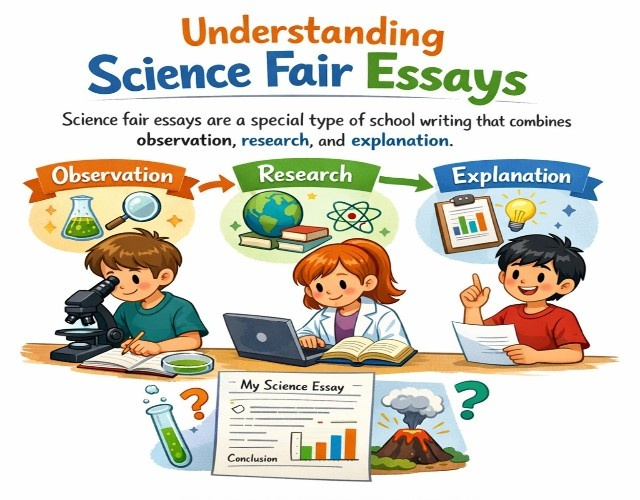
Unlike regular essays, these essays are usually based on a student’s participation in, or visit to, a science fair. They are meant to show not only knowledge of scientific concepts but also curiosity, critical thinking, and practical application.
Types of Science Fair Essays
Not all science fair essays are the same. Before you start writing, you need to know which type your teacher wants, because each one has a different focus and structure.
Type 1: Descriptive/Visit Essay
This is the most common type. You visited a science fair, and you're describing what you saw: the exhibits, the experiments, and the atmosphere. Your job is to paint a picture of the event and share what stood out to you.
For more guidance on general descriptions, check our descriptive essay writing guide.
Type 2: Narrative/Experience Essay
You participated in a science fair as a student, and you're telling the story of that experience. What did you do? What challenges did you face? What did you learn from the process? This type is more personal and reflective.
Want to know more about narrative essays? Then visit our narrative essay writing guide.
Type 3: Informative/Importance Essay
Here, you're not describing a specific event. You're explaining why science fairs matter, for students, schools, or society. Teachers often assign this type when students haven't attended or participated in a fair but need to write about one.
| The type of science fair essay you write depends on whether you're describing a visit, telling your experience, or arguing for science fairs' importance. When in doubt, ask your teacher which angle they want. |
Essay About Science Fair: 5 Real Examples
Reading a real science fair essay before writing your own is the fastest way to understand what your teacher is looking for.
Here are five examples covering different types, angles, and word counts:
Example 1: Essay About Science Exhibition (Descriptive/Visit, 200 words)
Last week, I visited my school’s annual science exhibition, and it was one of the most exciting learning experiences I’ve had. The auditorium was transformed into a lively display of creativity, with colorful charts, working models, and students eagerly explaining their projects. Each stall represented a different branch of science, from physics and chemistry to biology and environmental studies. One experiment that immediately caught my attention was a working volcano model. When baking soda and vinegar were mixed inside the structure, bright red foam erupted from the top, demonstrating a chemical reaction in a dramatic way. At another stall, students displayed a simple water filtration system made from sand, charcoal, and gravel. Watching muddy water turn clear as it passed through the layers helped me understand how filtration works in real life. I was also impressed by a renewable energy project that used a small solar panel to power a fan. It showed how sunlight can be converted into electricity, making science feel practical and relevant to everyday life. By the end of the exhibition, I realized that science is not just a subject in textbooks. It is present in the air we breathe, the water we drink, and the technology we use daily. The visit inspired me to observe the world more carefully and appreciate the science behind ordinary things. |
Example 2: Essay About Science Project (Narrative/Participation, 300 words)
Example 3: Essay About Science Fair in School (Descriptive/Visit, 200 words)
Our school organized its annual science fair last month, and the entire campus was filled with excitement. The classrooms were converted into exhibition halls, each decorated with charts, models, and colorful banners. Students from different grades participated enthusiastically, presenting projects that reflected both creativity and scientific understanding. The event aimed to encourage curiosity and practical learning beyond textbooks. As I walked through the fair, I observed a variety of impressive projects. One group demonstrated a model of the human heart with working valves that showed how blood circulates through the body. Another project displayed a small wind turbine that generated electricity to light a bulb, highlighting the importance of renewable energy. I was also fascinated by an experiment that showed how plants respond to sunlight, using two pots placed in different positions to compare growth patterns. Each stall was carefully explained, and students confidently answered questions about their work. By the end of the science fair, I realized how science connects to everyday life. The event was not just about competition but about learning through observation and experimentation. It inspired me to think more creatively and appreciate the practical side of science beyond the classroom |
Example 4: Essay Writing About Science Fair (Informative/Importance, 300 words)
Science fairs play an important role in schools because they transform theoretical knowledge into practical experience. Rather than memorizing facts from textbooks, students actively explore scientific concepts through experiments, models, and research. These events encourage curiosity and allow learners to understand how science functions in real-world situations. As a result, science fairs are not just academic activities but powerful learning opportunities. One major benefit of science fairs is the development of critical thinking skills. When students design a project, they must ask questions, form hypotheses, test ideas, and analyze results. This process teaches them how to solve problems logically and evaluate evidence carefully. Instead of simply accepting information, students learn to investigate and draw their own conclusions based on observation and experimentation. Another important advantage is the opportunity to apply classroom knowledge. Concepts learned in subjects like physics, chemistry, and biology become more meaningful when students use them in practical projects. For example, building a working model of a volcano demonstrates chemical reactions, while creating a solar-powered device explains renewable energy principles. Applying knowledge in this way strengthens understanding and improves long-term retention. Finally, science fairs can inspire future scientists, engineers, and innovators. By exploring topics that interest them, students may discover a passion for scientific research or technological development. Presenting their projects also builds confidence and communication skills, which are essential for future academic and professional success. In conclusion, science fairs are valuable educational experiences that promote critical thinking, practical learning, and inspiration. They prepare students not only for exams but also for real-world challenges, making them an essential part of a well-rounded education. |
Example 5: Science Fair Essay Sample (General, 150 words)
The science fair at our school was an exciting and educational event that brought students’ creativity to life. Participants from different grades presented projects based on topics such as renewable energy, human biology, and simple chemical reactions. Each display included charts, working models, and clear explanations, showing the effort students had put into their work. Walking around the exhibition, I learned how scientific concepts from our textbooks can be applied in practical ways. One project demonstrated how solar panels generate electricity, while another showed how plants grow differently under various light conditions. These experiments made complex ideas easier to understand. Overall, the science fair was more than just a competition. It encouraged curiosity, teamwork, and confidence among students. The experience reminded me that science is not limited to classrooms, it is present in everyday life and can be explored through observation and experimentation. |
Free Downloadable Resources for Science Essay
To conclude,
Writing a good essay is an important part of your academic success. By reading the samples and following the tips outlined above, you can write a well-written and engaging essay.
But if you are still struggling to write your science essay, don't worry! Check our step by step guide on a science essay.
Need Help With Your Science Fair Essay?
Get expert-written, plagiarism-free essays tailored to your requirements.
- Custom-written science fair essays based on your topic and word count
- Well-structured content with clear introduction, body, and conclusion
- 100% plagiarism-free work with proper formatting
- On-time delivery with free revisions for complete satisfaction
Order your science fair essay today and submit a high-quality paper with confidence!
Get Expert Help
-20551.jpg)