What Is a College Application Essay?
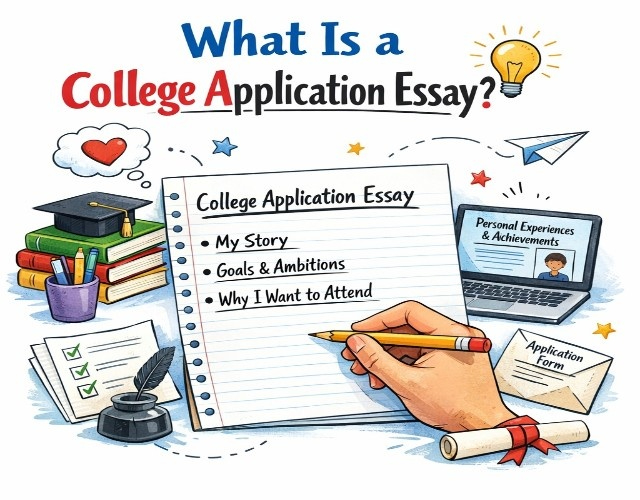
A college application essay is a personal written statement that admissions officers use to understand who you are as a person, not just as a student. Your GPA shows what grades you got. Your activities list shows what you did. The essay shows how you think, what matters to you, and why you'd be a good fit for their campus.
It's not a résumé in paragraph form. It's not a brag sheet. And it's definitely not a summary of your best achievement. The students who write the strongest essays write about something real, a shift in perspective, a moment that revealed something about who they are, or a problem they care about.
Most schools ask for one main personal statement, but you'll likely write additional pieces too. If you're applying through the Common App, you'll write a Common App essay as your primary statement.
Many schools also require shorter supplemental essays specific to their institution. Understanding which type you're writing matters before you start.
"The college application essay is the one part of your application where you control the entire narrative, and that's both the opportunity and the challenge."
Purpose of College Application Essay
The college application essay serves several important purposes:
- Show Who You Are
It gives admissions committees a deeper understanding of your personality, values, and experiences. - Stand Out From Other Applicants
It highlights your unique qualities and sets you apart from others with similar grades and test scores. - Demonstrate Your Fit
It shows why you’re a great match for the college and how you align with its values and programs. - Make a Memorable Impression
It’s your opportunity to leave a lasting impact and increase your chances of admission.
How to Choose What to Write About
This is the step most guides skip, and it's the one that causes the most paralysis. Here's the truth: the topic itself matters less than what you do with it. Admissions officers have read essays about mission trips, sports injuries, and immigrant grandmothers thousands of times. What they haven't read is your specific take on any of those things, if you actually have one.
Start by asking yourself what you already think about a lot. Not what sounds impressive, but what actually takes up space in your head. The topic that produces the most to say is almost always the right one.
| Try this: List five experiences or ideas that changed how you see something. They don't have to be dramatic. Then ask "so what?" after each one. The essay that survives the "so what?" test, where you can clearly say what you understood differently afterward, is the one worth writing. |
What to avoid:
- Tragedy tourism (leading with loss to seem deep, without a genuine insight)
- Humble bragging disguised as self-reflection
- Topics that center on someone else's story.
- If your essay is mostly about a coach, a parent, or a teammate, it probably needs to be reframed.
Different schools use different prompts to guide your topic choice. If you need help with that part, check out our guide to college application essay prompts.
Types of College Application Essays
Common App Essay (Personal Statement)
- A main essay submitted through the Common Application.
- Typically 250 to 650 words, showcasing your personality, experiences, and motivations.
Supplemental Essay
- School-specific prompts that highlight fit, values, or unique programs.
- Example: “Why Our University?” or “Describe a community you belong to.”
College Diversity Essay
- Focuses on how your background, perspective, or experiences contribute to campus diversity.
Extracurricular / Activity Essay
- Highlights leadership, involvement, and personal growth through activities, sports, or volunteer work.
Short Answer / Quick Prompt Essay
- Concise responses to specific questions, often under 150–250 words.
Creative / Unconventional Essay
- Allows for storytelling, humor, or unique formats to showcase personality.
Career or Major-Specific Essay
- Explains your interest in a particular field of study or career path.
Challenge / Overcoming Adversity Essay
- Discusses personal obstacles, setbacks, or challenges and the lessons learned.
Academic Achievement Essay
- Focuses on research, projects, or intellectual experiences that shaped your learning.
How to Write a College Application Essay Step by Step
Most students try to write a perfect essay on the first try. That's not how good essays get written. Here's the process that actually works.
Step 1: Understand the College Application Essay Prompt
Read it more than once. Then read it again. A lot of essays get off track not because the writing is bad, but because the student answered a slightly different question than the one being asked. Don't fit a pre-written idea into a prompt that it doesn't actually match.
Step 2: Brainstorm Before You Draft
Set a timer for ten minutes and write without stopping. Don't edit. Don't delete. Just get every relevant thought onto the page. If you're stuck, talk it through with someone who knows you well, a friend, a sibling, or a parent. Ask them what they'd say is your most interesting quality. The answer might surprise you.
Step 3: Plan Your Essay Structure
Before you write a full draft, map out where you're going:
|
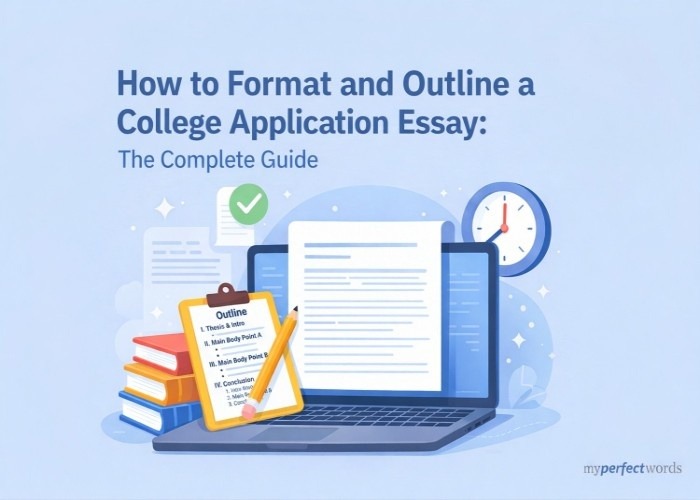
Keep it simple. An essay that does three things well beats one that tries to cover six things and does none of them fully. If you want guidance on structure and spacing, our college application essay format guide covers that in detail.
Step 4: Write a Messy First Draft
Give yourself permission to write badly. The first draft's only job is to exist. Write in your own voice, the test is whether you'd actually say that sentence out loud. If you wouldn't, rewrite it. Avoid formal language that sounds nothing like you.
Step 5: Revise, Cut, and Polish
Read the draft aloud. Every awkward sentence will be obvious. Cut anything that doesn't earn its place; a weak sentence is worse than no sentence. Then get at least one other person to read it, ideally someone who doesn't already know your story. Ask them what they took away. If it's not what you intended, revise.
"Your first draft doesn't have to be good; it just has to exist. The rewrite is where the essay actually gets written."
If you want to see what strong finished essays look like, browse through real college application essay examples to get a clearer picture of what works.
Stuck on Your College Essay? We Can Help. High school essays shape your future. Get expert help to make yours outstanding. Your dream school deserves your best essay. We'll help you get there.
How to Start a College Application Essay
The opening sentence does more work than any other in your essay. Admissions officers read thousands of applications. If the first line doesn't pull them in, the rest of the essay is already working uphill.
Three openings that consistently work:
Drop into a moment.
Start mid-scene, as if the reader is already there. "The first time I burned dinner, I called it experimental." This is more immediate than any amount of background-setting.
Lead with an unexpected detail.
Something specific and slightly surprising signals right away that this essay will be different. A concrete, unusual detail does more to establish voice than a paragraph of abstract reflection.
Open with an honest observation.
A direct, genuine statement about how you see something, not a quote from someone famous, not a dictionary definition, can be disarming in the best way.
What not to open with: a dictionary definition of anything, "My name is...", a quote you found online, or a restatement of the prompt. These are signals that the essay is going to be generic before the reader has even gotten started.
"Admissions officers read thousands of essays. If your first sentence doesn't pull them in, the rest of the essay is already working uphill."
How to End a College Application Essay
Don't summarize. They just read the whole thing; they don't need you to recap it.
The most effective endings do one of two things: they loop back to the opening image or idea (called a callback), or they make a forward-looking statement about where you're headed and what you're looking forward to at college. Either approach creates a sense of resolution without the flatness of a traditional conclusion.
Before you submit, run through this checklist:
- Word count is within the required range (check the specific school's limit)
- You've read it aloud at least once
- Someone else has read it and told you what they took away
- It directly addresses the prompt, not a version of it
- There are no obvious AI-sounding phrases or generic filler
- The voice throughout sounds like you
"A great conclusion doesn't wrap everything up neatly; it leaves the reader with something to think about."
College Application Essay Tips That Actually Help
Skip the advice you've already heard a hundred times. Here's what actually makes a difference.
Write like you talk.
| Read every sentence aloud. If it sounds stiff, it probably reads stiff. The goal is your voice on the page, not a formal essay voice that sounds like nobody. |
Show the moment, don't describe it.
| "I was nervous" is a summary. "My hands wouldn't stop shaking" is a scene. When you can make the reader feel something instead of just telling them about it, the essay lands differently. |
One idea. One essay.
| Don't try to tell your whole story. Pick the single most interesting thread and follow it all the way through. Breadth is the enemy of depth in a 650-word essay. |
The word count is a ceiling, not a target.
| If your essay is genuinely done at 550 words, stop at 550. Padding to hit 650 makes it worse. |
Your essay should be about you, not about someone else.
| If the most important person in your essay is a coach, a parent, or a mentor, flip the perspective. What did you do, think, or feel? Keep the camera on yourself. |
Get honest feedback.
| The most useful readers are people who'll tell you when something isn't working, not people who'll tell you it's great because they love you. |
Common Mistakes to Avoid in Your College Application Essay
Most essays don't fail because of bad writing. They fail because of avoidable decisions made before a word was typed.
1. Opening with a dictionary definition: Nothing signals a generic essay faster. If your first sentence is "Webster's Dictionary defines leadership as...", start over.
2. Listing achievements the application already covers: Your activities section already shows what you've done. The essay should show something that isn't in any other part of your application.
3. Writing what you think they want to hear: Admissions officers read tens of thousands of essays. They know when a student is performing. An honest, specific, slightly imperfect essay almost always beats a polished essay that sounds like everyone else.
4. Ignoring the word limit. Going 200 words over the limit doesn't show enthusiasm. It signals that you didn't edit carefully, which is not a quality most colleges are looking for.
Submitting without reading it aloud. This is the fastest way to catch every awkward sentence, every place where the flow breaks, and every phrase that doesn't sound like you.
To sum it up,
A strong college application essay is your opportunity to showcase your personality, experiences, and goals beyond grades and test scores. Understanding the different types of essays, from the Common App personal statement to supplemental, diversity, and challenge essays, helps you choose the right approach for each prompt.
By planning your structure, reflecting on meaningful experiences, and writing authentically, you can create essays that stand out to admissions committees. Following a clear guide ensures your essays are focused, compelling, and polished, increasing your chances of acceptance at your dream colleges.
Ready to Submit an Essay You're Proud Of?
Our writers turn your story into a compelling essay, every time.
- Step by step guidance for Common App and supplemental essays
- Tailored feedback to highlight your unique experiences and voice
- Editing for clarity, structure, and impact to impress admissions committees
- 100% original, plagiarism-free content delivered on time
Get started today and take the stress out of your application.
Get College Application Help
-20643.jpg)