What Is a Report?
A report is a structured, formal document designed to present findings, analyse data, or inform a decision. It's divided into clearly labelled sections, often including an abstract, introduction, methodology, findings, and recommendations. Reports are written for a specific audience (a lecturer, a business, a client) and stick to objective, impersonal language. Charts, tables, and visual data are common.
The structure isn't optional. It's part of what makes a report a report. If you are interested in writing one, then check out our how to write a report guide.
For a full breakdown of the different kinds, see our types of reports guide.
What Is an Essay?
An essay is an argument. It takes a position on a topic and defends it through a series of connected paragraphs, no section headings, no methodology, no recommendations table. You build your case from an introduction through the body to a conclusion, using analysis, interpretation, and referenced sources.
Essays give you more structural flexibility than reports, but that doesn't mean they're easier. The argument has to hold together from start to finish.
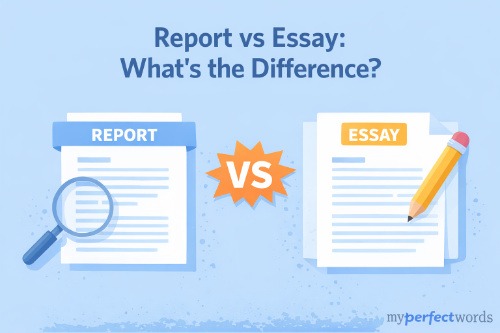
Report vs Essay: Key Differences
Here's the clearest way to see it side by side:
Feature | Report | Essay |
Purpose | Present findings / inform decisions | Argue a point / explore ideas |
Structure | Divided into sections with headings | Continuous paragraphs (intro, body, conclusion) |
Tone | Formal, objective, impersonal | Formal to semi-formal, may include analysis |
Use of data | Tables, charts, graphs common | Rarely used |
Abstract/Summary | Usually included | Not included |
Recommendations | Often included | Not included |
Table of contents | Yes | No |
Personal opinion | Avoided | May be included (depends on type) |
The biggest practical difference? Open a report and you see labelled sections. Open an essay and you see paragraphs that flow into each other. That difference in structure reflects a difference in purpose, one presents, the other argues.
Need Help With Your Report or Essay? Our writers handle both formats; you just tell us what you need. Stop guessing, get the right format, written right.
Is It a Report or an Essay? (How to Tell)
If you're not sure what your assignment is asking for, work through these questions:
- Were you given a data set, experiment, or scenario to analyse? That's a report.
- Are you being asked to argue or evaluate a position? That's an essay.
- Does the brief come with a prescribed structure or template? Almost certainly a report.
- Are you asked to apply theory and critical analysis to a topic? Lean toward essay.
- Does the brief say "discuss," "critically evaluate," or "to what extent"? Essay.
- Does it say "investigate," "identify," or "recommend"? Report.
When in doubt, check the module handbook or ask your lecturer directly. Guessing is how students end up rewriting the whole thing.
You can also check our report writing templates to see what a fully structured report looks like before you commit to a format.
Similarities Between Reports and Essays
They're not completely different animals. Both formats require solid research, proper citations, and formal academic language. Both have an introduction that sets up what's coming and a conclusion that wraps up what was found or argued. Both need to be well-organised and clearly written.
Knowing this is actually useful, if you've written one, you're not starting from scratch with the other. The fundamentals of good academic writing carry over. The format changes; the standard doesn't.
Common Mistakes Students Make
The most common mix-up: writing an essay when a report was required. That usually means no section headings, no methodology, no recommendations, just paragraphs of analysis. It reads fine as writing, but it's the wrong document entirely.
The reverse happens too. Students write bullet points, data tables, and structured sections when their professor wanted a flowing argument. The content might be solid, but it doesn't meet the brief.
A third mistake is misreading the tone. Reports should be impersonal, "the data suggests," not "I think." Essays can be more analytical and sometimes invite your own position. Flip those, and it signals to your marker that you didn't understand the task.
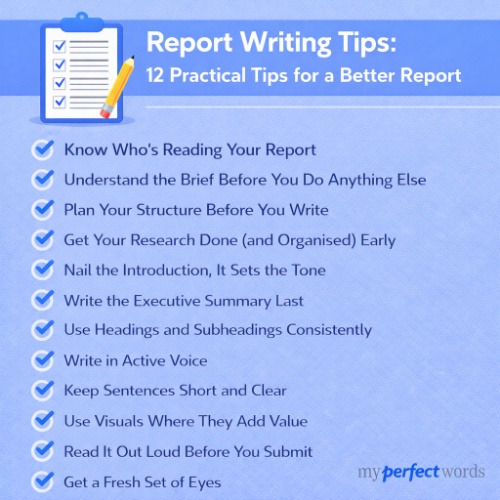
For more on getting reports right, check our report writing tips before you start.
When You Might Need Both
It's more common than you'd think, especially in science, business, and healthcare courses. You might write a lab report on an experiment in one week, then submit a reflective essay on your learning process in the same module. Some coursework bundles them: a report on your research findings, followed by an essay discussing their implications.
If your course uses both formats, it's worth getting comfortable with switching between them. The expectations shift significantly, and what works in one won't work in the other.
For more information on reports, check out our report writing examples.
So, Which One Do You Need?
Here's the short version: if your assignment asks you to present findings, analyse data, or make recommendations, it's a report. If it asks you to argue a position or critically evaluate an idea, it's an essay. The format follows the purpose, not the other way around.
Once you know which one you're dealing with, the structure largely takes care of itself. Reports have a clear template to follow. Essays give you more freedom, but your argument has to do the heavy lifting. Either way, getting the format right from the start saves a lot of pain later.
Leave the Writing to a Professional
Whether it's a report or an essay, our expert writers know exactly what your professor expects.
- Writers with degrees in your subject area
- Correctly formatted to your assignment type, every time
- Starting from just $8/page with fast turnaround options
- Rated 4.9/5 by students across the UK, US, and Australia
Your deadline is waiting; get started in minutes.
Place an Order