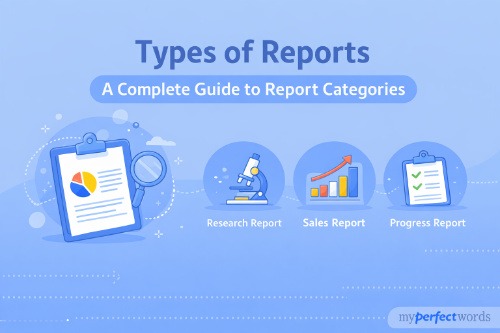
What Are the Main Categories of Reports?
Reports fall into two main categories based on their purpose: informational and analytical.
Informational reports present facts without analysis. You're simply showing what happened, what you found, or what the current status is. Think of these as "just the facts" reports; you're not interpreting anything or making recommendations. A progress report updating your professor on your research project status is informational. You're reporting what you've completed, not analyzing whether your approach is working. Analytical reports interpret data and make recommendations. These reports don't just present information, they analyze what it means and often suggest what to do next. A feasibility report evaluating whether your company should launch a new product is analytical. You're examining options, weighing pros and cons, and recommending a course of action.
The key difference? Purpose. Informational reports answer "what?" Analytical reports answer "so what?" and "now what?"
Here's how they compare:
| Feature | Informational Reports | Analytical Reports |
| Purpose | Present facts | Analyze and recommend |
| Structure | Straightforward | Problem-solution |
| Tone | Objective | Evaluative |
| Your Role | Reporter | Analyzer |
| Examples | Progress reports, status updates | Feasibility reports, research reports |
You'll write informational reports when your assignment asks you to "describe," "report on," or "summarize." You'll tackle analytical reports when you see words like "analyze," "evaluate," or "recommend."
Types of Informational Reports
Informational reports stick to facts and avoid interpretation. Here are the five main types you'll encounter.
Progress Reports
A progress report updates readers on where a project stands. You're showing what's been completed, what's in progress, and what's coming next.
You'll write progress reports when you're working on long-term projects, research papers, internships, group assignments, or multi-phase tasks. They keep supervisors or professors informed without requiring them to ask for updates.
Key features include a timeline showing the project schedule, accomplishments listing completed work, challenges noting any obstacles, and next steps outlining upcoming tasks. A progress report for a research project might include chapters you've completed, sources you've reviewed, and upcoming deadlines for drafts. |
These are common in academic research projects, internships, and consulting work.
Status Reports
A status report describes the current state of operations or activities. Unlike progress reports that focus on project advancement, status reports capture a snapshot of right now.
You'll write status reports for regular updates on ongoing operations. A weekly team status report might cover current tasks, resource allocation, or issues that need attention.
Key features include current status showing what's happening now, issues highlighting problems, key metrics presenting relevant numbers, and upcoming priorities. These are common in business settings, project management, and operations monitoring. |
Informational Reports (General)
An informational research report presents findings on a specific topic without analysis or recommendations. You're sharing what you found, not what it means.
You'll write these when your assignment asks you to research a topic and present the information. A report on renewable energy sources might describe solar, wind, and hydro power, explaining how each works, without arguing which is best.
Key features include organized facts, multiple sources, clear structure using headings, and objective tone. These reports are common in introductory college courses and background research. |
Descriptive Reports
A descriptive report provides detailed description of a subject, event, process, or condition. You're painting a complete picture with words.
You'll write descriptive reports when someone needs to understand something in detail. A descriptive report on a manufacturing process might walk through each production stage, describing equipment and procedures without evaluating efficiency.
Key features include comprehensive details, systematic organization, specific observations, and neutral tone. A lab report describing experimental procedures is descriptive; you're documenting what you did and what you observed. |
Compliance Reports
A compliance report documents adherence to standards, regulations, or requirements. You're proving you've met specific criteria.
You'll write compliance reports when organizations need to demonstrate they're following rules. A school compliance report might show how programs meet accreditation standards.
Key features include standards checklist, supporting evidence, verification statements, and clear organization. These are common in regulated industries and accreditation processes. |
Want to know how each report is written? Have a look at our report writing templates.
Types of Analytical Reports
Analytical reports interpret information and guide decisions. Here are the six main types you'll write.
Research Reports
A research report investigates a topic in depth, analyzing findings and drawing conclusions. This is the most common analytical report type in college.
You'll write research reports for course papers, thesis projects, and lab experiments. Unlike informational reports that just present facts, research reports explain what those facts mean.
Key features include a hypothesis or research question, methodology explaining your approach, findings presenting discoveries, analysis interpreting results, and conclusions drawing insights. A research report on consumer behavior might analyze survey data to identify purchasing patterns and explain why they occur. |
These are common in academic courses across disciplines and market research.
Feasibility Reports
A feasibility report evaluates whether a proposed project or plan is viable. You're assessing if something can and should be done.
You'll write feasibility reports before major decisions or investments. A feasibility report on opening a campus tutoring center would examine demand, costs, space requirements, and potential revenue, then recommend whether to proceed.
Key features include project description, analysis of options, assessment of resources, identification of risks, and clear recommendation. These are common in business planning and strategic decisions. |
Recommendation Reports
A recommendation report analyzes options and recommends a specific course of action. You're helping decision-makers choose between alternatives.
You'll write recommendation reports when multiple options exist. A recommendation report on learning management systems would compare platforms like Canvas and Blackboard, evaluate them against criteria, and recommend the best fit.
Key features include problem statement, criteria for decision, analysis of options, comparison, and explicit recommendation. Unlike feasibility reports that assess if one thing is viable, recommendation reports compare multiple options. |
Analytical Reports (General)
A general analytical report examines causes, effects, or solutions to problems. You're investigating why something happens or how to address it.
You'll write these when assignments ask you to analyze rather than just describe. An analytical report on declining student engagement might examine factors like class size and teaching methods, then discuss which have the biggest impact.
Key features include clear analysis framework, interpretation of data, identification of patterns, and evidence-based conclusions. These are common in social sciences and business analysis. |
Evaluation Reports
An evaluation report assesses the effectiveness of programs, policies, or initiatives. You're judging how well something worked.
You'll write evaluation reports after implementation or trial periods. An evaluation report on a peer tutoring program would assess participation rates, student satisfaction, and grade improvements, then judge whether the program achieved its goals.
Key features include evaluation criteria, evidence gathering, assessment of effectiveness, comparison to benchmarks, and recommendations. These are common in education and nonprofit evaluation. |
Justification Reports
A justification report makes the case for a specific action or decision. You're persuading decision-makers to approve something.
You'll write justification reports when you're proposing something that needs approval. A justification report for new lab equipment would explain why it's needed, detail costs and benefits, and argue why the purchase should be approved.
Key features include clear proposal, benefits explanation, cost analysis, risk assessment, and persuasive argument. Unlike recommendation reports that compare options, justification reports advocate for one specific choice. |
Struggling With Your Report Assignment?
Our expert writers handle any report type, from research reports to feasibility studies.
Join countless students who trust us for professional, plagiarism-free reports.
Academic Reports vs Business Reports: Key Differences
Academic and business reports serve different purposes, which affects how you write them.
Academic reports demonstrate your learning and understanding. Your professor wants to see that you can research, analyze, and communicate effectively. You're required to follow strict formatting guidelines, APA, MLA, or Chicago style, and include comprehensive citations. The tone is formal, often using third person.
Business reports drive decisions and actions. Your manager wants clear recommendations they can act on quickly. Citations are flexible or sometimes unnecessary. The tone is professional but prioritizes clarity over formality. Length matters because busy professionals don't have time for unnecessary detail.
Here's a comparison:
| Aspect | Academic Reports | Business Reports |
| Primary purpose | Demonstrate learning | Drive decisions |
| Citation style | Strict (APA, MLA, Chicago) | Flexible or none |
| Tone | Formal, often third-person | Professional, clear, concise |
| Length | Often longer | As short as possible |
| Audience | Professor evaluating your work | Decision-makers needing info |
| Common Types | Research, lab, case study | Progress, feasibility, recommendation |
In college, you'll mostly write research reports for course papers, lab reports for science classes, and case study reports for business courses. If you're writing for an internship or job, expect progress reports to update supervisors and feasibility or recommendation reports for business decisions.
The type of report doesn't change between contexts, a research report is still a research report, but expectations for formatting and tone will differ.
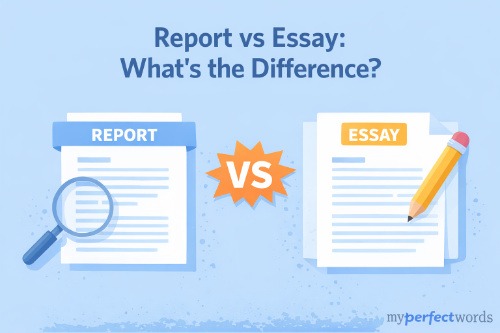
If you're not sure whether you need a report or essay format, check out our report vs essay comparison.
Other Common Report Types
Beyond the main categories, you'll encounter a few specialized report types in specific contexts.
Lab Reports
Lab reports document scientific experiments. You're showing what you did, what happened, and what it means. These are standard in STEM courses with a specific structure: introduction, methods, results, and discussion. Lab reports combine informational (methods and results) and analytical (discussion) elements.
Case Study Reports
Case study reports analyze real-world scenarios by applying theoretical concepts. You're examining a specific situation in depth. These are common in business, psychology, and education courses. A marketing case study might analyze how a company's advertising campaign succeeded or failed.
White Papers
White papers are authoritative guides on complex topics. You're educating readers and establishing expertise. These are common in policy, technology, and consulting. A white paper on blockchain technology might explain how it works and propose implementation strategies.
Trip Reports
Trip reports document business travel or field work. You're recording what you did, learned, or accomplished. These are common in consulting and field-based work. A trip report from a conference might summarize sessions attended and recommended follow-up actions.
How to Determine What Type of Report to Write
Not sure which report type your assignment requires? Here's how to figure it out.
Ask yourself these questions:
- Am I being asked to recommend or decide something? If yes, you need an analytical report. If you're just presenting information, go with informational.
- Does my assignment use words like "analyze," "evaluate," or "assess"? These signal analytical reports.
- Does it say "describe," "report on," or "summarize"? These indicate informational reports.
- Am I working with data that needs interpretation? If you need to explain what data means, choose analytical.
- Is there a problem I need to solve or a decision to inform? Problem-solving requires analytical reports.
Key phrases in assignments tell you what to write:
- "Analyze the effectiveness of...": Evaluation Report (analytical)
- "Evaluate options for...": Recommendation Report (analytical)
- "Research the causes of...": Research Report (analytical)
- "Describe the current...": Descriptive Report (informational)
- "Report on your progress...": Progress Report (informational)
- "Determine if it's feasible...": Feasibility Report (analytical)
- "Summarize findings on...": Informational Report
When in doubt, ask your professor or supervisor. It's better to clarify expectations upfront than to write the wrong type of report.
Once you've identified your report type, check out our report writing examples for instructions on structure, formatting, and writing process.
Key Tips for Each Report Category
Different report categories need different approaches. Here's what to focus on for each type.
For Informational Reports: Stick to facts and resist adding your opinion. You're a reporter, not an analyst. Organize your information logically, chronologically for progress reports, by topic for descriptive reports. Use clear headings so readers can find information quickly. Keep your tone objective throughout. |
For Analytical Reports: Start with a clear problem statement or research question. Show your analysis process, not just conclusions. Explain how you reached your recommendations so readers understand your reasoning. Support every recommendation with evidence. Be explicit about what you're recommending. |
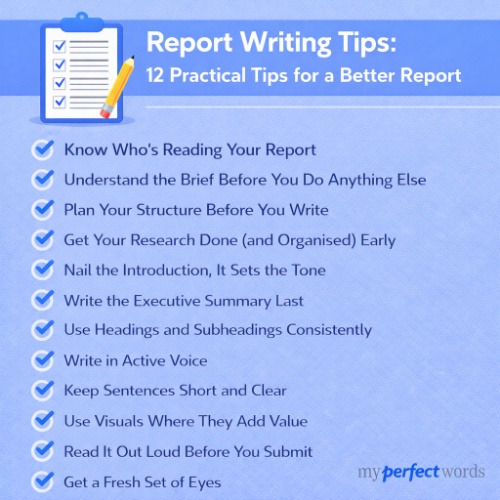
Want more tips? Don't worry. We have created a report writing tips guide just for you.
Conclusion
Understanding report types makes writing them much easier. The two main categories, informational and analytical, differ in purpose: informational reports present facts, while analytical reports interpret those facts and make recommendations.
We've covered 12+ types of reports you'll encounter in academic and professional settings. Informational types include progress reports, status reports, general informational reports, descriptive reports, and compliance reports. Analytical types include research reports, feasibility reports, recommendation reports, general analytical reports, evaluation reports, and justification reports.
The key to choosing the right type? Look at what your assignment asks you to do. Words like "analyze" and "evaluate" signal analytical reports. Words like "describe" and "summarize" indicate informational reports. When you're unsure, ask for clarification.
Now that you know which type you need, you're ready to start writing.
Need Your Report Written by Experts? We've written countless reports for students since 2010, any type, any subject, any deadline. Rated 4.8/5 stars by verified students. Start your order in 3 minutes.