What Makes a Good Report Writing Template?
A good template does three things well.
It covers all the required sections for your report type so nothing gets left out. It's flexible enough to adapt to different subjects and assignment requirements. And it's clear about what actually belongs in each section, not just the label.
The templates below follow all three of those principles. Each one includes the standard sections for that report type, a short description of what goes in each section, and notes on when you'd use it and how to adjust it.
If you want to know what kinds of reports exist, have a look at our types of reports guide.
How to Choose the Right Report Writing Template
The best template for you depends on your assignment. Here's a quick guide:
Report Type | Use This Template |
Business analysis, feasibility study, company report | Business Report |
Science experiment (biology, chemistry, physics) | Lab Report |
Literature review, research project, capstone | Research Report |
Site visit, field observation, practical work | Field Report |
Business case, law scenario, healthcare case | Case Study Report |
Book review, article critique, source analysis | Book/Article Report |
If your assignment guidelines specify the report type, use that template. If they don't, read the section breakdown below to find the closest match. When in doubt, ask your professor before you start.
Report Writing Template #1: Business Report Format
Best for: Business analysis, feasibility studies, market research, company performance reports
Business reports are the standard format for business courses, MBA programs, and entrepreneurship classes. They're structured to walk the reader from background context through to a clear recommendation.
Section Breakdown:
- Title Page: Report title, your name, course, date, and institution
- Executive Summary: A one-page overview of the whole report (written last, placed first). Includes your key finding and recommendation in 150-250 words.
- Table of Contents: For reports over 10 pages
- Introduction: Background on the topic, scope of the report, and what question you're answering
- Methodology: How you gathered information (surveys, secondary research, interviews)
- Findings: What you found. Facts, data, and evidence, presented neutrally
- Analysis: Your interpretation of the findings. What do they mean?
- Recommendations: What should happen next, based on your analysis
- Conclusion: Brief summary of the whole report
- References: All sources cited, in your required format (APA, MLA, Chicago)
- Appendices: Supporting data, charts, or tables that are too detailed for the main body
Customization tip: Shorter assignments may not need a Table of Contents or Methodology section. Match what's required by your rubric.
Report Writing Template #2: Lab Report Format
Best for: Biology, chemistry, physics, and other science courses that involve experiments
Lab reports follow a strict structure because they're designed to communicate scientific work clearly and completely. Every section has a specific job.
Section Breakdown:
- Title: Specific and descriptive (e.g., "The Effect of Temperature on Enzyme Activity," not just "Enzyme Experiment")
- Abstract: 150-250 word summary covering aim, method, key result, and conclusion. Written last.
- Introduction: Background theory, the scientific question being investigated, and your hypothesis
- Materials and Methods: Everything someone would need to replicate your experiment exactly. Write in past tense.
- Results: What you observed and measured. Include data tables, graphs, and figures. Don't interpret here.
- Discussion: Your interpretation of the results. Did they support your hypothesis? What do they mean? What could have caused errors?
- Conclusion: One paragraph answering the original question based on your results
- References: Textbooks, journal articles, and any sources cited in your intro or discussion
Customization tip: Some courses require additional sections like Calculations, Error Analysis, or Pre-Lab Questions. Check your lab manual.
Report Writing Template #3: Research Report Format
Best for: Literature reviews, upper-level research projects, capstone projects, and any assignment requiring a formal academic investigation
This is the most comprehensive format. It's designed for longer, in-depth work where you're reviewing existing literature and presenting original analysis.
Section Breakdown:
- Title Page: Full details: title, author, institution, course, supervisor (if applicable), date
- Abstract: 200-300 words covering research question, methodology, key findings, and conclusion
- Table of Contents: Required for longer reports
- Introduction: Background, research question, significance of the topic, and overview of the report structure
- Literature Review: What existing research says about your topic. Identifies gaps your research addresses.
- Methodology: How you conducted your research (qualitative, quantitative, mixed methods; sources used; why)
- Results/Findings: What you found, presented objectively
- Discussion: Analysis of findings in context. How do they relate to the literature?
- Conclusion: Summary of findings, limitations, and recommendations for future research
- References: Full bibliography of all sources cited
- Appendices: Raw data, survey instruments, interview transcripts, or other supplemental material
Customization tip: This template is modular. For shorter assignments, you can omit the Literature Review or combine Results and Discussion into one section. Always check your guidelines first.
Report Writing Template #4: Field Report Format
Best for: Social sciences, education, environmental studies, and any course requiring observation at a site or in a community setting
Field reports document what you observed, not just what you read. They're common in social work, anthropology, urban planning, and education programs.
Section Breakdown:
- Introduction/Purpose: What was the goal of your field visit? What question were you trying to answer?
- Site Description: Where did you go? Physical setting, context, and any relevant background about the site
- Observations: Detailed, descriptive notes of what you saw, heard, and experienced. Be specific. Use present tense.
- Analysis: Your interpretation of the observations. What patterns did you notice? How do they connect to course concepts or theory?
- Recommendations: If applicable: what changes, interventions, or actions would you suggest based on your observations?
- Conclusion: What did you learn? What are the limitations of your observations?
Customization tip: Some programs require a Reflection section where you discuss your role as an observer and any personal biases. Check your assignment prompt.
Need a Professionally Written Report?
Get Expert Help With Any Report Type
Join over 144,000 students who trust us with their academic success.
Report Writing Template #5: Case Study Report Format
Best for: Business, law, healthcare, social work, and any course that presents a real or hypothetical scenario for analysis
Case study reports ask you to analyze a specific situation and propose solutions. The goal is to show you can apply theory to a real-world scenario.
Section Breakdown:
- Case Background: Overview of the situation. Who's involved? What happened? What's the context?
- Problem Statement: One or two sentences clearly defining the central problem or challenge
- Analysis: In-depth examination of the problem using relevant frameworks, theories, or models from your course
- Alternative Solutions: At least two or three possible approaches to solving the problem, with pros and cons for each
- Recommended Solution: The option you're recommending and why, based on your analysis
- Implementation Plan: How would your solution be put into practice? Steps, timeline, and resources needed.
- Conclusion: Summary of the case and key takeaway
Customization tip: Some case studies are more analytical than prescriptive, meaning your professor wants analysis but not necessarily recommendations. Read your assignment carefully.
Report Writing Template #6: Book/Article Report Format
Best for: English, literature, humanities, and any course requiring you to critically engage with a specific text
This isn't just a summary. A book or article report evaluates the text, which means you're making a judgment about its quality, argument, or contribution.
Section Breakdown:
- Introduction: Title, author, publication date, and a brief overview of the text's subject and purpose. End with your thesis: your overall evaluation.
- Summary: A concise overview of the text's main argument or narrative. Keep this to about 25-30% of your report. Your professor already knows what the book says.
- Critical Analysis: This is the core of your report. What's the author's argument? Is it well-supported? What evidence do they use? Are there weaknesses or biases?
- Evaluation: Your judgment: How successful is the text at achieving its purpose? How does it compare to other works on the topic?
- Conclusion: Restate your overall assessment and the key reasons for it
- References: The text you reviewed, plus any other sources you cited
Customization tip: For article reports, the same structure applies. For book reports in creative writing or literature courses, you may focus more on narrative elements (character, theme, style) than argument.
How to Customize Your Report Writing Template
Every template in this guide is a starting point. You'll almost always need to adjust it to fit your specific assignment.
- Start by reading your rubric or assignment guidelines carefully before you touch the template. These tell you which sections are required, how long each section should be, and what your professor is actually grading.
- If something on the rubric doesn't match a section in the template, add it.
- If a template section isn't mentioned anywhere in your guidelines, check with your professor before including it.
You may also need to adjust for your citation style. Sciences typically use APA, humanities lean toward MLA, and history often uses Chicago. Your institution's library website will have the most current formatting guidelines for each. |
Finally, don't copy section headings word for word from these templates if your professor has specified different labels. Use the template structure, but name your sections the way your assignment asks.
Report Formatting Guidelines
Most academic reports follow these general formatting standards unless your professor specifies otherwise.
Font and size: Times New Roman 12pt or Arial 11pt. Use the same font throughout.
Margins: One inch on all sides.
Line spacing: Double-spaced body text. Single-spaced within reference entries.
Page numbers: Top right corner or bottom center. Number from the first page of body text, not the title page.
Headings: Use a clear hierarchy. H1 for your main title, H2 for major sections, H3 for subsections. Keep them consistent.
Title page: Your institution may have a required format. Check before you create your own.
Common Report Writing Mistakes to Avoid
The biggest one is using the wrong template for your assignment type. A business report template and a lab report template have almost nothing in common. Using the wrong one signals immediately that you didn't read the assignment.
Other frequent mistakes:
- Skipping sections that seem optional but aren't
- Inconsistent formatting between sections
- Missing or incomplete references
- Writing too much summary when the assignment calls for analysis.
If your assignment is called a "critical analysis," more than half your report should be analysis, not background. |
Also, don't treat the template as a fill-in-the-blank form. The sections give you structure, but the quality of your thinking is what gets graded.
These mistakes are different from the ones made in essays. For more information on essays, check out our report vs essay guide.
Tips for Using Report Templates Effectively
Read through the full template before you start writing. Understanding how the sections connect helps you plan your content more effectively.
Gather your research and evidence before you begin filling sections in. Trying to write the Findings section when you haven't finished your research yet leads to a weak report with gaps you'll have to go back and fill.
Save multiple versions as you work. Label them clearly (Draft 1, Draft 2) so you can go back if needed.
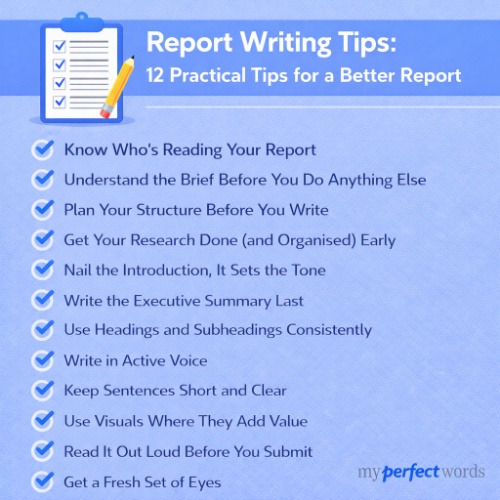
For more tips, check out our report writing tips guide.
Final Thoughts
These six templates cover the vast majority of academic reports you'll encounter. Each one gives you a structure to work within so you can focus your energy on the thinking and research, not the formatting.
One thing to remember: templates provide the skeleton, but your content is the substance. A well-structured report with weak analysis won't score well. A report with strong thinking that's organized clearly will.
And if you want to see how these structures look in practice, check out our report writing examples with real annotated samples.
Get Expert Report Writing Help
Professional Writers, Every Report Type. Our writers are ready to deliver your report on time, in the right format.
- Writers matched to your exact subject and report type
- All report formats mastered, from lab reports to business cases
- Formatted to your required style guide (APA, MLA, Chicago)
- Free revisions until you're completely satisfied
Join thousands of students who trust us with their academic success.
Place an Order