Who Gives Speeches at a Wedding?
The traditional speech order at a wedding goes: father of the bride, groom, then best man. That's the classic lineup, and plenty of couples still follow it. But modern weddings have expanded that list significantly.
Today it's common to hear from both sets of parents, the bride herself, the maid of honor, and sometimes close friends or siblings. There's no rule saying only certain people can speak. The couple decides who goes up and when.
Traditional Order | Modern Order |
Father of the bride | Father of the bride |
Groom | Mother of the bride |
Best man | Groom |
Bride | |
Father/Mother of the groom | |
Maid of honor | |
Close friends |
This guide covers all the non-best-man roles in detail. The best man speech follows a different set of conventions and has its own playbook check the separate guide for that one.
"The traditional order exists as a guide, not a rule the couple decides who speaks and when."
How Long Should a Wedding Speech Be?
The answer for almost every role is the same: 3 to 5 minutes. That's roughly 400 to 600 words. Five minutes is the absolute ceiling. Go longer than that and you'll start to feel the room shift.
Here's a quick breakdown by role:
Role | Target Length | Word Count |
Father of the bride | 5–7 minutes | 600–800 words |
Mother of the bride | 3–5 minutes | 400–600 words |
Groom | 3–5 minutes | 400–600 words |
Bride | 3–5 minutes | 400–600 words |
Maid of honor | 3–4 minutes | 400–500 words |
The father of the bride traditionally gets a bit more time because he's welcoming guests and setting the tone for the whole reception. Everyone else should aim for the shorter end of the range shorter is almost always better.
The only reliable way to time your speech is to read it aloud. Reading silently is slower than speaking to a room. You'll consistently underestimate your length if you're counting words in your head. Read it out loud, at a natural pace, at least three times before the day.
| "A 3–5 minute speech around 400–600 words is long enough to say something meaningful and short enough to hold the room." |
How to Structure a Wedding Speech
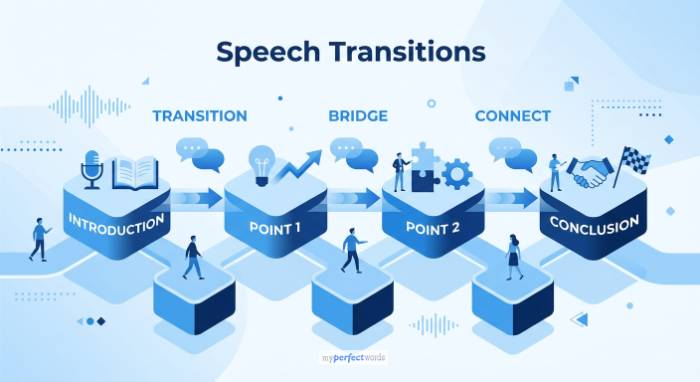
Every great wedding speech follows the same basic skeleton, regardless of who's giving it.
Opening:
Introduce yourself and establish your relationship to the couple. Guests want to know who you are and why you're the one standing up. Keep it brief one or two sentences at most.
Middle:
Share two or three stories, qualities, or moments that paint a picture of the person (or people) you're speaking about. If you only know one half of the couple well, make sure you still bring the other partner into your speech with genuine warmth. The speech should celebrate both of them.
Close:
End with a forward-looking wish for the couple and raise your glass. The toast is the punctuation mark of the whole thing don't forget it.
A useful rule of thumb: pick three traits, three memories, or three reasons you love this couple. Three is the right number. More than that, and the speech starts to feel like a list. Fewer, and it feels thin.
The speech is about the couple, not the speaker. That sounds obvious, but it's the thing most people lose sight of when they sit down to write.
"Every great wedding speech follows the same skeleton: introduce yourself, tell a story (or two), celebrate the couple together, and raise your glass."
Father of the Bride Speech
Your role: Official welcomer. You set the emotional tone for the entire day. Timing: Traditionally goes first. This is also the one speech where a bit more time is expected 5 to 7 minutes is appropriate. |
What to cover:
- Welcome guests, especially anyone who traveled a long way
- Thank the people who helped make the day happen
- Share one or two memories of your daughter growing up ones that show her character
- Welcome your new son- or daughter-in-law to the family with real warmth
- Offer a brief piece of advice or a blessing for the marriage
- End with a toast to the couple
What to leave out: Embarrassing childhood stories that only get laughs at your daughter's expense. Long tangents that lose the room. The speech is warm and forward-looking, not a highlight reel of awkward moments.
Starter line: "I've been preparing this speech for [daughter's name]'s entire life, and now that the moment is here, I realize I had it wrong no words are quite enough."
"The father of the bride's job is to welcome, celebrate, and hand off warmth is more powerful than perfection."
Mother of the Bride Speech
Your role: Emotional anchor. You bring the maternal perspective that no one else in the room can offer. The mother of the bride speech isn't part of the traditional lineup, but it's increasingly welcomed and expected at modern weddings. If you've been asked to speak, or you want to, go for it. |
What to cover:
- Welcome guests alongside or right after the father
- Share a memory or quality of the bride that means something to you
- Welcome your new son- or daughter-in-law with genuine openness
- Offer a personal message to the couple this is where the heart of your speech lives
- End with a toast
Tone: Warmer and more personal than the father's speech. Less formal. The mother of the bride's speech doesn't need to be polished it needs to be honest.
Starter line: "Watching your child find their person is one of the greatest joys a parent can experience and today, that joy is overflowing."
"The mother of the bride brings emotional depth her speech doesn't need to be polished, it needs to be honest."
Groom Speech
Your role: The gratitude speech. You speak on behalf of the couple, thank everyone who made the day possible, and say something real about the person you just married. Timing: Traditionally follows the father of the bride. |
What to cover:
- Thank both sets of parents
- Acknowledge the wedding party bridesmaids, groomsmen, anyone who played a role
- Call out guests who traveled from far away
- Share one heartfelt moment or observation about your partner
- Toast the bridesmaids (this is traditional, though not required)
What to leave out: Long, rambling stories. That's the best man's territory. The groom's speech is warm, grateful, and relatively concise.
Starter line: "There are a few things I've been looking forward to about today. Marrying [name] was number one. This speech was not."
"The groom's speech is the gratitude speech thank everyone, love your partner publicly, and keep it moving."
Struggling to Find the Right Words?
Our writers craft personalized speeches that sound exactly like you.
Join thousands of customers who said it perfectly.
Bride Speech
| Your role: Modern tradition. There's no historical template for the bride's speech, which actually gives you more freedom than anyone else at the podium. |
What to cover:
- Thank guests for coming and for being part of your lives
- Thank both sets of parents and anyone who helped pull the day together
- Share a loving message or a specific moment with your partner
- Add something personal a memory, a quality you admire, a small joke if it fits your personality
- Toast the room or the marriage
The bride's speech is entirely your own. No one's expecting a particular format. That can feel like pressure, but it's actually a gift. You get to decide what matters most.
Starter line: "I spent so much time thinking about what to wear today that I almost forgot I also needed to figure out what to say."
"The bride's speech has no set formula that's the freedom and the fun of it."
Maid of Honor Speech
Your role: The bride's voice in the room. You celebrate her, bring some warmth and laughter, and make the couple feel genuinely seen. Timing: Usually toward the end of the speeches, often after the best man. Ideal length: 3 to 4 minutes keep it tight. |
What to cover:
- Introduce yourself and explain your relationship to the bride
- Share one or two stories that reveal her actual character not just that she's "the best person you know"
- Talk about how you felt when you met her partner. First impressions matter here.
- Celebrate both of them as a couple, not just the bride as an individual
- End with a toast
What to avoid: Inside jokes that only two people understand. Anything that could embarrass the bride in front of her new in-laws. The maid of honor's speech should make the bride feel celebrated, not roasted.
If you're struggling with how to open, our how to start a speech guide has specific techniques for wedding speech openers.
"The maid of honor's job is to be the bride's voice in the room, personal, loving, and just a little emotional."
Wedding Speech Dos and Don'ts
Do | Don't |
Introduce yourself early | Assume everyone knows who you are |
Thank the hosts and families | Skip the acknowledgments entirely |
Include both partners in your speech | Make it entirely about one person |
Practice out loud at least three times | Wing it with notes you've never read aloud |
Keep it under 5 minutes | Go longer because you think the moment calls for it |
End with a clear, confident toast | Forget the toast entirely |
Talk about something specific and real | Fill time with generic praise |
Specific details are what separate a good speech from a great one. "She's the kindest person I know" tells the room very little. "She's the kind of person who remembers my dog's birthday with a card," tells the room everything.
"The fastest way to ruin a good wedding speech is to make it more about you than the couple."
Common Wedding Speech Mistakes to Avoid
Going too long:
This is the most common one. An 8-minute speech feels endless to everyone who isn't giving it. Time yourself. Cut mercilessly.
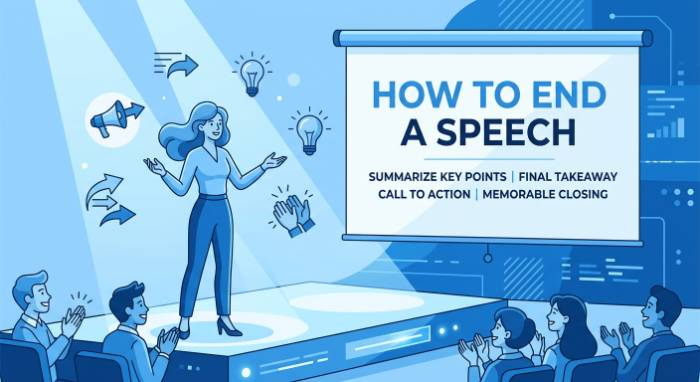
When you're working on your closing, check out our how to end a speech guide for finishing strong.
Mentioning ex-partners:
Even as a "funny" story. It's not. Skip it entirely.
If you're looking for actual speech examples to study before writing yours, that's a good place to start.
Not acknowledging both partners equally:
If you only know one half of the couple, make an effort. Ask people who know the other partner. Getting this wrong feels cold.
Heavy drinking before you speak:
A glass to settle nerves is fine. More than that and your timing, your pacing, and your filter all start to slip.
Reading word-for-word without ever looking up:
You lose the room the second your eyes go down and don't come back up. Use cue cards not a phone, not printed sheets. Small cards let you glance down and back up without losing your place.
Opening with a dictionary definition:
"The dictionary defines love as..." No. Start with something real.
Forgetting the actual toast:
After everything, some people get to the end of a 6-minute speech and forget to say "please raise your glasses." Don't be that person. Write the toast last, and deliver it with intention.
For more on structuring any speech well, our speech format guide walks through the principles that apply across every type.
How to Deliver Your Wedding Speech
Writing a good speech is half the battle. Delivering it is the other half.
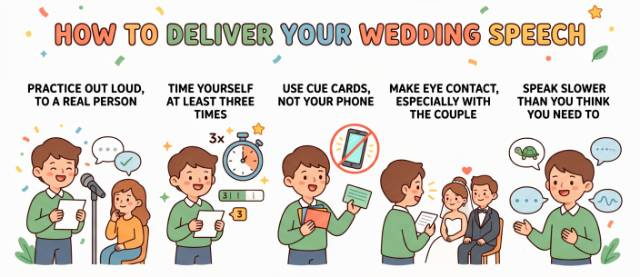
Practice out loud, to a real person
Not in your head. Not in front of a mirror. Read it to someone who will react naturally. You'll immediately hear what lands and what doesn't.
Time yourself at least three times
Your first read-through always feels different from the second and third. By the third, you'll have a realistic sense of your actual pace.
Use cue cards, not your phone
Scrolling through a speech on your phone looks awkward on camera and makes it harder to maintain eye contact. Small cue cards are better.
Make eye contact, especially with the couple
You're talking to the room, but the couple should feel like the speech is for them. Find them regularly throughout.
Speak slower than you think you need to
Nerves make everyone speed up. Build pauses into your delivery. Pause after a laugh. Pause after an emotional moment. Let the room breathe.
If public speaking anxiety is a real concern for you, Toastmasters has practical resources that go beyond wedding speeches. And if writing the speech itself is the bigger obstacle, check out the resources at The Knot or consider having it written professionally.
| "The difference between a good wedding speech and a great one usually comes down to one thing: practice." |
For guidance on special occasion speech writing more broadly, that guide covers the conventions that apply across celebrations, milestones, and formal events.
Conclusion
Wedding speeches don’t succeed. After all, they follow strict traditions, they succeed because they feel genuine. Whether you’re a parent, partner, or close friend, the goal is the same: speak with warmth, keep it concise, and center the couple at every turn.
When you respect the time limits, follow a clear structure, and share specific, heartfelt moments, your speech will land exactly as it should. Practice it out loud, trust your voice, and remember that perfection matters far less than sincerity.
Say something real, raise your glass with confidence, and you’ll give the couple a moment they’ll remember long after the reception ends.
Ready to Stop Stressing About Your Speech?
Get a professionally written wedding speech that feels completely personal.
- Written to match your voice, and role
- Structured for delivery sounds natural out loud
- On-time guarantee
- AI-detection tested so it reads like you, not a robot
Your speech will be the one they remember let's make it count.
Get Started Now