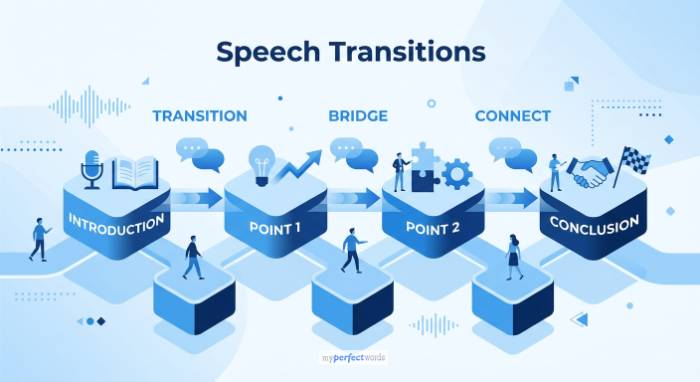
What Makes Speech Transitions So Important?
Without transitions, your audience is left doing the cognitive work themselves, figuring out how your ideas connect, why you moved from one point to another, and where you're headed next. Most won't bother. They'll zone out.
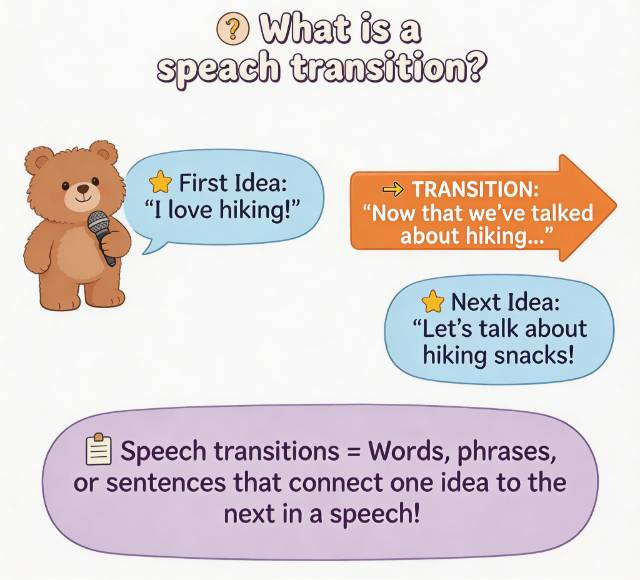
Transitions do two things at once: they signal a shift and show the relationship between ideas. That second part is what most speakers miss. It's not enough to say "moving on," you need to show whether you're adding a point, contrasting it, or building on it.
The brain is wired to look for patterns and connections. When you give it clear signals, it stays engaged. When you don't, it drifts.
| "A speech without transitions is like a highway without road signs. Your audience is moving fast, but they don't know where they're going." |
The 6 Main Types of Speech Transitions
Transitions fall into categories based on the relationship they signal. Choosing the right one isn't just about words it's about the logic between your ideas.
| "Choosing the right transition type is like choosing the right road sign the relationship between your ideas determines which one fits." |
Type 1: Addition Transitions
Use these when you're building on your last point, adding evidence, or introducing a new but related idea.
Examples: "What's more," / "On top of that," / "Building on that," / "And consider this:" / "That's not all "
Type 2: Contrast Transitions
Use these when your next point pushes back on or complicates what you just said.
Examples: "On the other hand," / "That said," / "But here's the thing:" / "Not everyone sees it that way." / "The flip side is,"
Type 3: Cause and Effect Transitions
Use these to show that one idea leads to or results from another.
Examples: "As a result," / "That's why," / "This leads to," / "Because of this," / "The outcome is clear:"
Type 4: Example and Illustration Transitions
Use these when you're about to make your point concrete with a story, statistic, or scenario.
Examples: "Here's what that looks like:" / "Take, for example," / "To put that in context," / "Consider this:" / "A good example is,"
Type 5: Time and Sequence Transitions
Use these when you're guiding the audience through steps, stages, or a chronological narrative.
Examples: "Before we get there," / "After that," / "At the same time," / "Once you understand that," / "Going back to,"
Type 6: Summary and Conclusion Transitions
Use these when you're wrapping up a point or the whole speech.
Examples: "So to recap," / "The key takeaway here is," / "When you step back," / "To put it simply," / "What this all comes down to is,"
100+ Speech Transition Phrases (Organised by Purpose)
This is the section you'll want to bookmark. Below is a comprehensive table of speech transition words and phrases, grouped by their purpose. Pick the one that matches the relationship between your ideas, not just the one that sounds good.
"Keep this list bookmarked, the right transition is often just one phrase away."
Purpose | Transition Phrases |
Adding information | What's more / Building on that / On top of that / And consider this / That's not all / Beyond that / To add to this / It gets better / Worth noting is / Another factor is |
Showing contrast | On the other hand / That said / But here's the thing / The flip side is / Not everyone agrees / By contrast / Despite that / Even so / Yet / At the same time |
Showing cause and effect | As a result / That's why / This leads to / Because of this / The outcome is / Which means / This explains / What follows from that / Naturally / The consequence is |
Giving examples | Here's what that looks like / Take, for example / To put that in context / Consider this / A clear example is / To illustrate / Picture this / Think about / Imagine / In practice |
Moving to the next point | Let's turn to / That brings us to / Which leads me to / Now, here's where it gets interesting / Shifting to / With that in mind / Now consider / On to / Let me turn now to / The next piece is |
Referring back | As I mentioned earlier / Coming back to / Building on what I said / If you remember / Earlier, I noted / Returning to / To revisit / Following from that point / As we saw / That connects back to |
Signalling importance | Here's the key point / Pay attention to this / What matters most here / Don't miss this / This is where it gets critical / The big takeaway is / Crucially / The real issue is / This is significant / At its core |
Transitioning to summary | So to recap / The bottom line is / What this means for you is / When you step back / To sum up / In short / The key takeaway is / To put it simply / At the end of the day / What this all comes down to is |
Introducing a question | So why does this matter? / Here's the question you should be asking / What does that mean in practice? / So where does that leave us? / But what happens when / You might be wondering / Here's what I'd ask / Think about it this way / So what do we do with that? / And the answer? |
Transitioning to conclusion | As we wrap up / Before I close / To bring this home / Let me leave you with / Looking back at everything / So what's the big picture? / The message I want you to take away is / When it all comes together / Here's where I'll leave this / And that's the point |
Need a speech written for you?
Skip the Stress, Get a Pro-Written Speech
Written to flow. Delivered on time. Zero hassle.
Where to Use Transitions in Your Speech
Good transitions don't just connect sentences; they connect moments. There are four key points in any speech where transitions are essential.
| "You need a transition every time you change gear, and knowing where those gear shifts happen is the first step to smooth delivery." |
When you're building your structure, it also helps to know how to start a speech with a strong opening before your first transition.
From your introduction to your first main point
This is where many speakers stumble. After the opening, there's a temptation to just launch in. Instead, signal the shift. Try: "So let's start with the first reason this matters:" or "To understand where we're headed, we need to start here:."
Between each main point
This is the most important place for transitions. Use a "review-preview" structure: briefly recap what you just said, then signal what's next. For example: "So we've seen how transitions signal a shift. Now let's look at why they show the relationship between ideas." That single sentence does double duty.
Into examples or stories within a point
When you move from a claim to evidence, a transition helps your audience follow the logic. "Here's what that looks like in practice:" does the job cleanly. Check your overall speech format so you know exactly where each transition needs to land.
From your last point to the conclusion
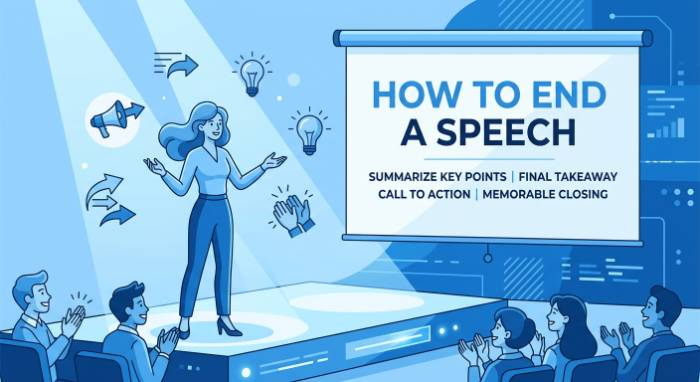
This is your final gear change. Your audience should feel it coming. Use a summary transition first ("So when you put those three things together..."), then move into your close. For more on wrapping up a speech effectively, see our guide on how to end a speech.
Internal summaries work well in longer speeches. Every 5–7 minutes, pause and recap what you've covered before moving on. It keeps your audience oriented without slowing you down.
Verbal vs. Non Verbal Transitions
Not all transitions are word-based. Some of the most effective ones never involve speech at all.
| "Your body can transition before your words do; use physical movement to prep your audience for what's coming next." |
Physical Movement
It is one of the most underused tools in public speaking. Shifting your position on stage, even a few steps, signals to your audience that you're entering a new section. According to public speaking experts at Six Minutes, combining physical and verbal transitions creates maximum clarity.
The Pause is Powerful
A deliberate silence before a new point gives your audience time to process what you just said, and creates a moment of anticipation before what's next. Most speakers underuse it because it feels awkward from the inside. It doesn't look that way from the outside.
Vocal Variety Works the Same Way
Lowering your volume or slowing your pace before a key section signals that something important is coming. Raising your energy signals a shift toward something new.
Rhetorical Questions
It work as both verbal and cognitive transitions. Asking "So what does that mean for you?" before pivoting to your next point pulls the audience in before you've even arrived there. Physical movement transitions covered by VirtualSpeech reinforce that combining techniques gives you the most control over audience attention.
The best speakers combine all of these. A pause, a step, and then: "Now, here's where it gets interesting." That's a transition your audience feels, not just hears.
4 Common Speech Transition Mistakes to Avoid
"The most common transition mistake isn't a bad phrase it's no phrase at all."
Mistake 1: The Missing Transition
You finish a point and jump straight into the next one. Your audience doesn't know if you're adding evidence, making a new argument, or changing subject entirely.
This is the most frequent mistake, and it's the one that costs you the most engagement.
Fix it by treating every major topic shift as a moment that needs a signal no exceptions.
Check how the structure changes across formats like the informative speech and persuasive speech.
Mistake 2: The Overused Transition
"So." "And." "Next." These words do technically signal a shift, but when you use them fifteen times in a ten-minute speech, they lose all power.
Vary your transitions using the table above. Even swapping "and" for "building on that" gives your speech more texture.
For context on how transitions work differently across contexts, see our overview of different types of speeches.
Mistake 3: The Incompatible Transition
This one is subtle. You use "however" when you're actually adding a supporting point, not contrasting one. You use "as a result" when there's no causal link you're just moving on.
Mismatched transitions don't just sound off they confuse your audience about how your ideas relate. Match the transition to the actual relationship between your points.
Mistake 4: The Tangled Transition
"That reminds me of something else entirely..." or "Oh, and one more thing before I forget..." These pull your audience sideways. They suggest you lost your thread, which undermines your credibility.
If something genuinely needs to connect, build the connection clearly. If it doesn't, cut it.
To see how tight, purposeful transitions look in practice, check out these real speech examples.
Contrast transitions are especially useful in a persuasive speech where you're addressing counterarguments head on.
Conclusion
Speech transitions are not decorative phrases they are structural tools that determine whether your audience stays with you or drifts away. When used intentionally, transitions clarify relationships between ideas, guide listeners through complex arguments, and create a sense of momentum from start to finish.
The most effective speakers don’t just move on; they signal why they’re moving on. By choosing the right type of transition, placing it at the right moment, and reinforcing it with pauses, movement, or vocal shifts, you turn a series of points into a cohesive experience.
Master transitions, and your speech stops sounding like disconnected parts and starts sounding like one clear, persuasive whole.
Ready for a Work That Truly Flows?
Our writers handle everything from structure to delivery-ready polish.
- satisfaction guarantee
- 100% original
- Delivered fast
- Plagiarism-free and AI-detection safe
Trusted by students, professionals, and public speakers worldwide
Get Started Now